

Fiber cement is a key option to consider when planning siding installation or repairs in Antelope. Finding Antelope siding installation near me starts with identifying what your home needs, then comparing materials, appearance, maintenance, and installation quality. The right approach should protect your exterior and suit your home’s design.
Look beyond the material name when weighing your options. The condition of the existing siding, the project scope, and the care taken during installation all help determine whether repair or replacement makes sense. Reviews can add context, especially when they describe work similar to yours.
This guide compares fiber cement with other siding materials and explains what to consider when reviewing local contractors, customer feedback, installation, and repairs. You’ll also learn how to define project scope and plan next steps, so you can make an informed decision about protecting your home’s exterior.
Key Takeaways
- Compare siding materials by durability, appearance, maintenance needs, and fit with your home’s exterior.
- Use customer reviews to understand project communication, workmanship, and how similar siding work turned out.
- Look for a local contractor whose experience aligns with the material and scope your home needs.
- Understand how installation and repair decisions depend on the siding’s condition and the extent of the work.
- Explore fiber cement siding as an option for a durable exterior, and learn what careful installation involves.
Siding products and materials
For Antelope homes, siding influences exterior protection, appearance, maintenance, and future replacement planning. Consider how a material may suit the home’s sun exposure, wall condition, and preferred finish. Vinyl, fiber cement, wood, aluminum, brick, and stone veneer each have different trade-offs, so the lowest upfront expense isn’t the only measure to weigh.
How do vinyl, fiber cement, and wood siding compare for Antelope’s climate? Performance depends on the material, installation, maintenance, and conditions on each wall, including direct sun exposure. Compare samples against the home and consider how much upkeep you’re prepared to manage before settling on a finish.
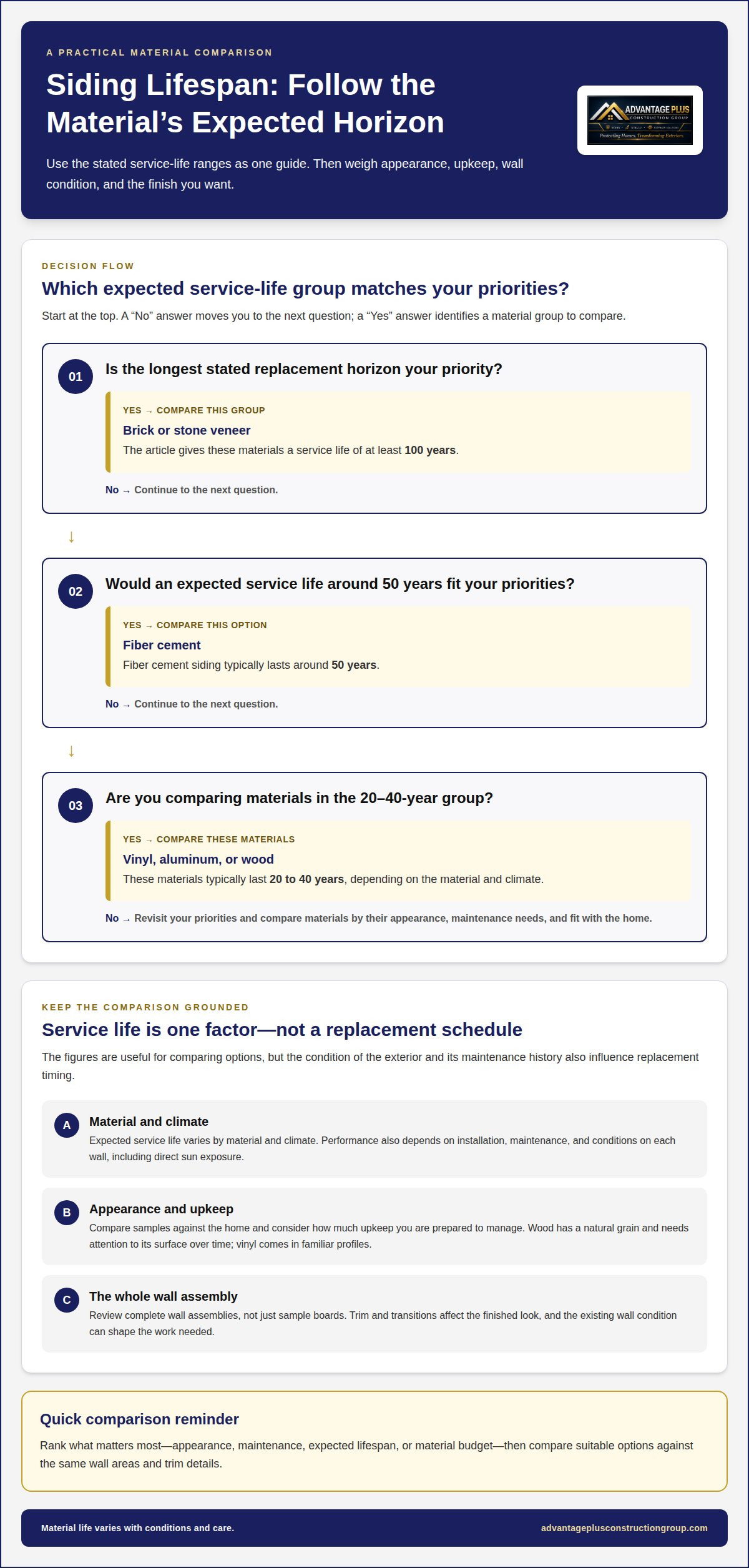
Expected service life varies by material. Vinyl, aluminum, and wood siding typically last 20 to 40 years, depending on the material and climate. Fiber cement siding typically lasts around 50 years. Brick and stone veneer siding lasts at least 100 years. These figures are useful for comparing options, but the condition of the exterior and maintenance history also influence replacement timing.
Common siding choices differ in appearance and care. Vinyl comes in familiar profiles, while aluminum offers another finished look. Wood has natural grain and needs attention to its surface over time. Fiber cement may suit homeowners seeking a durable alternative with varied design possibilities. Brick and stone veneer create a distinct masonry appearance. Review complete wall assemblies, not just sample boards, because trim and transitions affect the final look.
- Vinyl: Compare available profiles, color, and expected upkeep.
- Wood: Consider the natural finish and ongoing surface care.
- Fiber cement: Weigh its expected service life against the chosen style.
- Brick or stone veneer: Consider the masonry appearance and long replacement horizon.
Siding costs depend on the product, home size, design details, and preparation needed. The material is only one part of the scope: removing old siding, addressing damaged areas, and fitting trim or transitions can also affect the work. Compare estimates by their listed materials and included tasks, rather than treating different assemblies as equivalent.
Are permits required for siding replacement in Sacramento County? It depends on the project scope and the property’s permitting jurisdiction, not just the siding material. A replacement that changes exterior details or involves underlying construction may raise different permitting questions from a limited surface repair. Define the scope before scheduling work.
To narrow your choices, rank your priorities, such as appearance, maintenance, expected lifespan, or material budget. Then compare a few suitable materials against the same wall areas and trim details. This makes trade-offs easier to see and helps match the siding to your home and maintenance plans.
Customer reviews of siding projects
Customer reviews can reveal how a siding project went beyond its finished appearance. Look for specific details about planning, communication, workmanship, and cleanup. An account of siding work on a particular home offers more context than a general statement of satisfaction. For Antelope homeowners, reviews are most useful when they describe comparable exterior work and explain what mattered during the process.
One customer described having a 30-year-old home re-sided with James Hardie Board and Batten siding. That account identifies the home’s age and a named siding style, giving readers a clearer project reference than an unspecified “new siding” review. It doesn’t establish that every home or installation will have the same experience. Instead, use the details to consider what questions a similar project might raise.
Read reviews for details about the work, not just the rating. A useful account might explain how the scope was discussed, whether updates were clear, or how finished details look around windows and corners. Note whether the project involved installation, a targeted repair, or a full replacement. These distinctions help you compare similar work.
- Scope: Does the review describe a repair, replacement, or re-side?
- Material: Does it name the siding product or style, such as James Hardie Board and Batten?
- Workmanship: Does the writer mention edges, joints, trim, or other visible details?
- Communication: Does the account describe planning, updates, and coordination?
- Outcome: Does it explain what changed for the home, rather than offering praise alone?
Look for recurring themes across different reviews. If several mention clear explanations, that may offer insight into how project communication is experienced. If a review describes a concern, read the details and any response carefully: a rating alone doesn’t explain what happened. Reviews reflect individual experiences, so consider the project type and context.
Turn useful review details into a brief for your project. Note the condition of your existing siding, the material or style you’re considering, and any visible areas that need attention. Photos and notes about specific concerns, such as a loose panel or damaged corner, can help keep a conversation about the work focused and precise.
Reviews can guide your expectations, but the strongest comparison comes from connecting their details to your home’s needs. If you’re considering siding work, explore siding project guidance as a next step toward defining the work and its priorities.
Finding local siding contractors
When searching for Antelope siding installation near me, focus on contractors whose work fits your material and project scope. Compare how they describe preparation, installation, and the details they’ll finish.
Local Contractor Search
Start by looking for contractors serving Antelope who work with the siding your home needs. Project descriptions can show whether they handle full replacement, localized repairs, or both. Look for relevant materials and exterior details, including trim, corners, and window transitions. These specifics are more useful than broad claims about experience.
Next, compare how each contractor describes the proposed work. A clear scope identifies the areas involved, the material to be installed, and how existing conditions will be addressed. For example, a proposal for a damaged wall should distinguish the repair area from siding that will stay in place. Specific descriptions make comparisons meaningful and help prevent different scopes from looking equivalent.
Use reviews as supporting context, not your only measure. An Antelope homeowner’s account may discuss communication or workmanship, while another review may involve a different material or project size. Match each account to your needs, then note recurring details about planning, finish quality, and cleanup. These points can help you assess similar work.
Before comparing proposals, prepare a brief project outline. Identify the siding areas, note visible damage, and state the material or finish you’re considering. This gives each contractor the same starting point and helps reveal whether proposals cover the same work, rather than seeming lower or broader because their scopes differ.
Estimates and Warranties
Estimates and warranties vary among Antelope siding contractors. A written estimate should state whether there is a fee and describe the proposed work, materials, preparation, and exclusions. Compare the details carefully, especially if one estimate includes removal or repairs that another leaves outside its scope.
Read warranty terms just as carefully. Distinguish coverage for the siding material from coverage for installation workmanship, since they apply to different parts of the project. Review what the written terms cover, how long coverage lasts, what exclusions apply, and how claims are handled. Keep the terms with the proposal for easy reference.
For example, a proposal may cover new siding on the front elevation but leave existing trim untouched. That distinction affects both the estimate and which finished details will remain unchanged. When comparing Antelope siding installation near me options, make sure each proposal describes the same walls, trim, and repair areas. Clear scope language lets you compare the intended work, not just broad descriptions.
- Scope: Compare the same walls, preparation, and finish details.
- Estimate: Check whether fees and exclusions are clearly explained.
- Warranty: Read material and workmanship terms separately.
- Documentation: Keep the proposal and written warranty together.
Clear documentation creates a practical basis for evaluating the project. For a focused discussion of exterior work, review siding installation planning.
Siding installation and repair
Common siding risks in Northern California include poor flashing, loose fastening, open joints, and moisture reaching the wall beneath the exterior. Transitions around windows, doors, corners, and trim need careful attention during installation. A small gap at one of these points can weaken the protection siding is meant to provide.
Installation starts with assessing the existing siding and the wall beneath it. The work plan should identify damaged areas, removal needs, and transitions with existing trim. After the surface is prepared, installers align and fasten siding according to the selected material’s requirements. They then finish edges, openings, and joints, where an uneven fit can affect appearance and protection.
A repair should start by locating the cause, not simply covering visible damage. A cracked panel may be isolated damage, or it may be next to loose trim or a failed joint. The repair scope should identify the affected section and check nearby surfaces for similar problems. Replacing one piece without addressing surrounding conditions can leave the underlying issue unresolved.
For a sound assessment, the work sequence should include these checks:
- Inspect: Note cracked, loose, warped, or missing siding and damaged trim.
- Trace: Examine nearby joints and openings for gaps or water staining.
- Scope: Distinguish a localized repair from broader replacement work.
- Prepare: Address compromised surfaces before installing replacement siding.
- Finish: Review alignment, fasteners, edges, and transitions after installation.
For example, a loose panel beside a window calls for more than inspecting the panel. Assess the surrounding trim, joints, and wall surface before deciding on a repair. This helps distinguish a simple replacement from damage extending beyond the visible siding.
Material changes also affect planning. Fiber cement, vinyl, and wood have different handling and installation requirements, so the repair piece and surrounding details must suit the existing assembly. A mismatched profile or poorly finished edge can stand out and leave a vulnerable transition. Consistent alignment and secure attachment matter throughout the repaired area.
After the work, a close visual review can catch unfinished details. Check that replacement pieces sit evenly, trim meets cleanly, and openings have no visible gaps. The project record should also state what was repaired and what remains unchanged. Clear documentation helps with future maintenance and provides a reference if another siding concern arises.
For NOBELIA exposed-nail siding in coastal areas within 3,000 feet of the coastline, use unstained grade 316 stainless steel nails.
Fiber cement siding installation
Fiber cement siding can give an Antelope home a durable, low-maintenance exterior, but the result depends on careful planning and installation. Material choice is only the starting point. Wall preparation, consistent layout, and clean transitions around windows and trim all contribute to the final appearance and protection.
Begin by assessing each elevation. Review the existing siding, trim, corners, and openings, then identify damaged areas that need attention before installing new boards. A wall with loose trim, for example, needs a different preparation plan from a sound, even surface. This assessment defines the scope and helps keep installation details consistent across the home.
Layout deserves close attention. Plan board placement around windows, doors, corners, and changes in wall height so seams and edges look intentional. A long, uninterrupted wall may call for a different layout from a facade with several openings. Consistent alignment supports a finished appearance and helps avoid awkward transitions.
During installation, handle and position each board according to the product’s requirements. Keep lines consistent, pay attention to joints, and coordinate siding with trim and other exterior details. At a window, for example, the surrounding pieces should meet cleanly without a visibly unfinished edge. Follow the selected material’s installation instructions.
- Assess: Identify damaged siding, trim, and areas needing preparation.
- Plan: Map board placement around openings, corners, and wall transitions.
- Install: Follow the material’s requirements for handling and fitting.
- Review: Inspect alignment, joints, edges, and finished transitions.
Finishing details matter. A straight wall can still look incomplete if corners, trim, and window edges don’t align. Before completing the project, review the finished elevations for consistent spacing and clean joins. Document any areas outside the agreed scope, so the project record reflects what the installation covered.
Fiber cement can suit homeowners seeking a durable exterior with less routine upkeep than some alternatives. Its profiles and finish choices can also support a considered design. Choose based on the home’s architecture, the appearance you want, and a practical installation plan, rather than relying on a sample alone.
For an installation planned around your home’s walls, openings, and finish details, plan your fiber cement siding project.
Advantage Plus Construction Group
Advantage Plus Construction Group helps homeowners plan exterior siding work, assess repairs, and choose an approach suited to the home. Services include Premium Fiber Cement Siding, Expert Stucco Solutions (Stucco Systems), Exterior Envelope Services, and siding and stucco repairs. Turn to the team when weighing repair against replacement, comparing exterior materials, or addressing damaged siding or stucco. Experienced project managers oversee each job, coordinating the work around the home’s exterior and agreed scope. To discuss a siding or exterior project, contact Advantage Plus Construction Group.
Make Your Next Exterior Decision With Confidence
Define what a successful result should protect and preserve. Consider how siding should complement your home’s architecture, which exterior areas need attention, and whether repair or replacement better suits the project. Clear priorities turn a broad renovation idea into a focused scope of work.
When comparing options for Antelope siding installation near me, base your decision on your home’s condition and the finish you want. A thoughtful plan connects appearance, material choice, and installation details before work begins. That preparation makes project discussions more precise and helps you move forward with a clearer direction.
Advantage Plus Construction Group can help you consider the right approach for your exterior project. Contact Advantage Plus Construction Group to discuss your siding needs and next steps. A well-planned exterior project is a practical investment in the home you’re proud to own.
Frequently Asked Questions
What areas near Antelope, California do siding contractors serve?
Advantage Plus Construction Group serves Antelope and nearby Sacramento-area communities, including Roseville, Granite Bay, New Castle, Rocklin, Penryn, Loomis, Citrus Heights, Orangevale, Fair Oaks, Carmichael, Sacramento, Auburn, Folsom, and El Dorado Hills. For homeowners comparing options, proximity is one consideration; the contractor’s experience with your material and project scope matters too.
How much does siding installation cost in Antelope, CA?
Project cost depends on the home and the work included. Key factors include siding material, the area being covered, removal of existing siding, preparation, trim, and repairs needed beneath the surface. Full replacement and a limited installation area have different scopes, so the estimate should clearly describe the work it covers.
What is the cost per square foot for siding installation near Antelope?
There isn’t one per-square-foot figure that applies to every Antelope siding project. The price depends on material, wall layout, preparation, removal, trim details, and repairs required. Square footage alone may not reflect openings, corners, or existing conditions that affect the work. Project pricing is provided after a quote request, with the estimate based on the home’s scope and selected materials.
How long does siding installation take, and what are the steps?
The schedule depends on project size, material, preparation, and repair needs. Work generally moves from assessing the exterior and defining the scope to preparing surfaces, installing siding, finishing transitions, and reviewing completed areas. Damaged trim or underlying surfaces, for example, may need attention before installation proceeds. A project plan should explain the work sequence and site preparation.
What should homeowners check when hiring a siding contractor near Antelope?
Review whether the written proposal identifies the siding material, covered areas, preparation, removal, trim work, repairs, and exclusions. Confirm that its scope matches your intended result, such as replacing one elevation rather than the entire exterior. Read written warranty terms, including coverage and exclusions. Clear documentation shows what the installation includes and which existing details or conditions remain outside the agreed work.


