

What if the best-looking siding choice isn’t the one that best suits your home? Planning a fiber cement siding Citrus Heights upgrade means weighing more than color. The profile should complement your architecture, and the finish and installation plan should account for your home’s exposure, existing materials, and moisture management.
A cohesive exterior starts with choices that suit the home and the conditions around it. Looking beyond the finished surface matters, too. Careful preparation and coordinated installation help support the siding’s performance and protect the home’s exterior envelope.
This guide gives you a practical framework for comparing siding profiles, finishes, and material considerations. You’ll learn which project details to assess, from existing surfaces and openings to moisture-control measures and installation planning. Advantage Plus Construction Group specializes in fiber cement siding and stucco, with project managers overseeing procurement, site preparation, and installation to connect design decisions with the work behind a finished exterior.
Key Takeaways
- Choose fiber cement siding Citrus Heights homeowners can tailor to their home’s architecture, sun exposure, and maintenance preferences.
- Compare lap, panel, and shingle profiles by the visual character each brings to the exterior.
- Plan trim, window surrounds, corners, and transitions together for a cohesive finished appearance.
- Review existing siding, openings, and visible connections before settling on a design and installation plan.
- Coordinated project oversight connects material choices, site preparation, and installation from start to finish.
What Makes Fiber Cement Siding Design in Citrus Heights Home-Specific?
A refreshed exterior should look attractive, suit the home, and support the protection of a significant investment. For homeowners considering fiber cement siding in Citrus Heights, the right choice depends on the property: its architecture, how sunlight reaches each wall, the materials already in place, and the level of upkeep you prefer.
Start with the home’s form and exposure. This helps prevent a profile or color that looks appealing on a small sample but feels out of scale across the façade. Walk around the house and note how its features work together before choosing a profile or finish. This overview of fiber cement siding offers background on the material and its common applications.
Assess your home’s architecture before choosing a siding profile
Look at the rooflines, window placement, entry, and proportions of the existing trim. Identify features that draw the eye, such as a prominent front gable or recessed entrance. Then decide whether the siding should emphasize those features or provide a quieter backdrop.
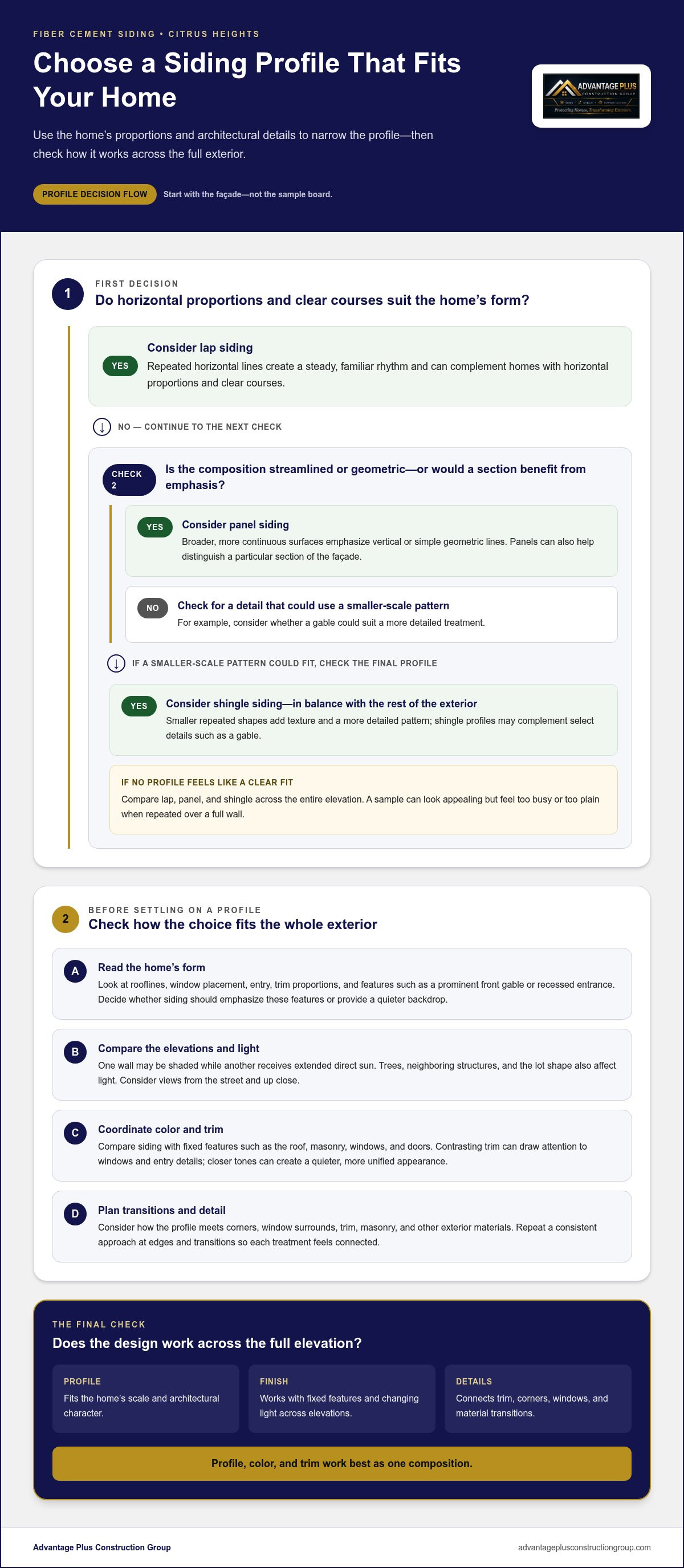
Profiles create different visual rhythms. Lap siding forms repeated horizontal lines, panels create broader and simpler planes, and shingle profiles add smaller-scale texture. Compare each option against the home’s scale and architectural character rather than choosing only by what stands out in a display.
Account for Citrus Heights sun and site conditions
Compare the home’s elevations rather than assuming every wall gets the same exposure. One side may be shaded for much of the day, while another receives extended direct sun. Orientation is a useful starting point, but trees, neighboring structures, and the shape of the lot also affect when light reaches the siding.
View the exterior both from the street and up close. Landscaping may partly screen a wall, while open areas leave more of its finish in view. These observations help you judge how color and texture will read across the property without assuming all Citrus Heights homes have the same conditions.
Consider how the siding will meet existing trim, masonry, or other exterior materials. Decide whether those transitions should blend in or provide contrast. Then weigh your maintenance preferences: a detailed profile adds visual texture, while a simpler arrangement creates a more restrained look. Neither is right for every home. Choose a profile and finish that work together across the elevations.
Before settling on a design, view it alongside the home’s fixed features and in the light conditions around the property. This assessment gives you a clearer basis for choosing siding that supports curb appeal and fits the exterior renovation.
Which Fiber Cement Siding Profiles and Finishes Suit Your Home?
Once you’ve considered the home’s architecture and site conditions, compare siding as part of a complete exterior composition. The profile sets the façade’s visual rhythm; color affects how large surfaces relate to doors and windows; trim defines edges and transitions. For fiber cement siding in Citrus Heights, the right combination should look intentional across the full elevation, not only on a small sample.
Compare lap, panel, and shingle profiles
Each profile creates a distinct pattern. Use the table to narrow your choices, then picture the selected profile across the entire wall. A feature that looks appealing on a sample can feel too busy or too plain when repeated over a full elevation.
| Profile | Visual effect | Design fit to consider |
|---|---|---|
| Lap | Repeated horizontal lines create a steady, familiar rhythm. | Can complement homes where horizontal proportions and clear courses suit the overall form. |
| Panel | Broader, more continuous surfaces emphasize vertical or simple geometric lines. | Can suit a more streamlined composition or help distinguish a particular section of the façade. |
| Shingle | Smaller repeated shapes add texture and a more detailed pattern. | May complement select architectural details, such as a gable, when used in balance with the rest of the exterior. |
Plan how the chosen profile will meet corners, window surrounds, and other materials. For example, a textured section can add contrast to one part of the home, while a simpler field profile keeps the larger wall from feeling crowded. Aim for continuity so each treatment feels connected to the overall design.
Coordinate colour, trim, and exterior details
Compare siding color with fixed features such as the roof, masonry, windows, and doors. Nearby landscaping also affects how a color reads against the home. Muted siding with contrasting trim can draw attention to windows and entry details; closer tones can create a quieter, more unified appearance.
Consistency in trim helps the façade feel resolved. Repeat the chosen approach at corners, window surrounds, and transitions. View the complete palette together rather than judging siding color on its own, and consider it across more than one elevation because light and shade can change its appearance.
Profile, color, and trim work best as one composition, balancing the home’s character with deliberate detail. Fiber cement siding project planning connects those design decisions with preparation and installation.
How Should You Compare Fiber Cement Siding Design Options?
Start with your priorities, not a single sample or a broad claim about what performs best. When comparing fiber cement siding options in Citrus Heights, consider how each will look on the home, fit its existing exterior, align with your maintenance preferences, and affect project scope. This keeps design choices connected to practical planning.
Match design choices to priorities and property conditions
Use the same questions to compare each option. A profile or finish that suits one elevation may not work everywhere, so consider the home as a whole before finalizing the plan.
Appearance: Does the profile create the character you want, such as a defined pattern or a simpler, more restrained surface?
Home compatibility: Does the design work with the home’s proportions, openings, trim, and existing exterior materials?
Maintenance preferences: What routine care do you expect? Review the specific product’s care instructions rather than assuming every finish has the same requirements.
Project scope: Does the plan cover one elevation or a broader exterior update? Existing siding, trim, and transitions can affect the preparation and coordination involved.
Fiber cement offers design options beyond a single look. Profiles can create consistent horizontal courses, broader panel surfaces, or more textured areas. Aim for a coherent approach rather than adding variation without a clear connection to the home. This fiber cement siding installation guide provides further context on how installation planning relates to material choices.
Compare fiber cement with other exterior directions
Compare materials by the appearance you want and the planning each involves. Avoid assuming one option is universally more durable or lower-maintenance. If you want distinct siding profiles, focus on how fiber cement shapes the façade. If you prefer a more continuous wall finish, consider a stucco system. Vinyl is another exterior option, with its own design choices and product-specific care and performance information.
Exposure and existing conditions matter, too. A shaded wall, a sun-exposed elevation, and a surface that meets masonry may call for different finish and transition decisions. Evaluate the exterior as a whole, then review product documentation for claims about finish performance, maintenance, and warranties. Those details vary by product and manufacturer, so a general description should not be treated as a promise about every selection.
If vinyl is also under consideration, this fiber cement and vinyl siding comparison can help frame the differences. Comparing appearance, compatibility, care, and project scope gives you a practical basis for choosing an exterior direction.
What Should a Citrus Heights Siding Design Plan Cover Before Installation?
A sound siding project begins with an understanding of the existing exterior, not just a selected profile or finish. For a fiber cement siding project in Citrus Heights, site conditions help shape the scope, preparation, and details around openings and transitions. A deliberate sequence connects the design decision with the work required for installation.
Review the existing exterior and define the project scope
Assess the current siding, trim, windows, doors, and places where the exterior meets another material. Note visible damage or irregularities, while recognizing that concealed conditions may become clearer during preparation. The project scope should reflect both your design priorities and the protection details the exterior needs.
A practical plan moves through these stages:
- Review the site. Look at each elevation, existing siding and trim, openings, and connections to masonry or other finishes. Record areas that may need closer assessment as work proceeds.
- Set the design and scope. Confirm which areas are included, how the profile and finish relate to existing features, and how corners, window surrounds, and transitions should look.
- Plan preparation and materials. Coordinate material procurement and site preparation with the project sequence. If removal reveals conditions that were not visible beforehand, next steps depend on what is found.
- Review the completed work. Check each elevation for consistent alignment, finished edges, and clean transitions. A final review helps confirm that the installation reflects the agreed design.
Coordinate preparation, installation details, and oversight
Preparation and detailing deserve as much attention as the visible siding. Openings, joints, and changes between materials are important coordination points for flashing and moisture management. Plan their treatment as part of the exterior assembly, not as a cosmetic decision at the end. The exact details depend on the home’s conditions and installation plan.
Sequencing matters. Material procurement, site preparation, and installation need to align so work can proceed in an organized way and design decisions carry through to the finished surface. Advantage Plus project managers oversee procurement, site preparation, and installation, coordinating these stages with attention to schedule and budget.
For broader context on how siding details relate to a home’s protective exterior system, explore this exterior envelope protection guide. Then bring your priorities, observations, and design direction to a project discussion with Advantage Plus Construction Group. A considered plan gives appearance, preparation, and installation a shared purpose.
Plan Your Citrus Heights Fiber Cement Siding Project with Advantage Plus
A successful siding upgrade balances three priorities: a profile and finish that suit the home’s architecture, choices that account for exposure and existing materials, and a project scope shaped around your goals. Advantage Plus Construction Group serves Citrus Heights homeowners with fiber cement siding, stucco, and exterior envelope projects. Project planning connects design decisions with preparation and coordinated installation for an exterior that looks considered and supports the home’s protection.
What homeowners can expect from a tailored exterior project
Every home has a different starting point. Existing siding, trim, openings, and transitions help inform the scope, while your priorities guide the balance between curb appeal and exterior protection. Advantage Plus project managers oversee procurement, site preparation, and installation, coordinating key stages with attention to schedule and budget. The work is planned around the home rather than assuming every project requires identical steps or conditions.
Before the project moves forward, align the major decisions:
- Design direction: Identify the siding profile, finish, and trim approach that complement the home.
- Project priorities: Clarify which elevations or exterior details matter most to your renovation goals.
- Preparation: Consider existing materials, openings, and transitions that may affect the work.
- Coordination: Connect material procurement, site preparation, and installation through project oversight.
This shared framework keeps the visible result connected to the work behind it. A coordinated plan considers how siding meets trim and other exterior materials, and how preparation supports the intended appearance. If your project has broader exterior goals, Advantage Plus also provides stucco systems and exterior envelope services. Consider each decision in relation to the home rather than treating it as an isolated finish choice.
Discuss your Citrus Heights exterior design goals
Whether you’re planning a focused siding update or a broader exterior renovation, a project discussion can help turn your priorities into a tailored plan. Share what you want to change, which features you want to preserve, and any concerns about the existing exterior. That context gives planning a clear starting point.
Discuss your exterior project with Advantage Plus and take the next step toward a carefully planned upgrade. Start with the home, its existing conditions, and the outcome you want to achieve.
Turn Your Siding Plan into a Confident Next Step
A well-planned exterior upgrade begins with a clear idea of what you want your home to express and how you want it to serve you. Before moving forward, note the choices that matter most: the overall character you want, the details you want to preserve, and the practical concerns the project should address. This gives a design discussion a useful starting point and keeps decisions grounded in your priorities.
With fiber cement siding, Citrus Heights homeowners can plan an exterior that feels personal rather than pulled from a template. The goal is more than selecting a material. It’s shaping an outcome that suits the home, supported by thoughtful decisions and careful attention to its existing conditions.
Ready to take the next step? Discuss your Citrus Heights exterior project with Advantage Plus and begin shaping a plan around your home and goals. A focused conversation can help turn uncertainty into a clear direction and a considered direction into an exterior you’re proud to call your own.
Frequently Asked Questions
Is fiber cement siding a good choice for homes in Citrus Heights?
Fiber cement siding may suit a Citrus Heights home, but the right choice depends on the property’s exposure, design goals, and project scope. Consider how the siding will relate to existing materials and the condition of the exterior, not just how it looks in a sample. A property-specific assessment helps establish whether it fits your renovation priorities.
Can fiber cement siding be used on different home styles?
Yes. Different profiles can complement a range of architectural forms, but the result depends on how they relate to the home’s proportions and details. A profile selected for a prominent front gable, for example, should feel connected to the siding across the main walls. Consider trim widths, window and door openings, and existing materials together so the design reads as one composition.
How do I choose a fiber cement siding colour for my home?
Compare color options with the roof, windows, doors, trim, masonry, and landscaping in view. A siding sample held beside a window may look different from the same color against a shaded wall, so assess it in more than one location and under different light. Reviewing the complete palette helps you judge contrast and balance. Check product documentation for manufacturer-specific color-retention statements.
Does fiber cement siding need special design planning in sunny areas?
Direct sun and shade are useful design considerations because they can change how a finish appears across different parts of a home. Look at each elevation and note which areas receive extended sunlight, which are shaded, and how nearby trees or structures affect the light. This property-level review can inform color and finish decisions without assuming every Citrus Heights home has identical exposure.
What should be included in a fiber cement siding project plan?
A useful plan records the existing exterior, the areas included in the work, design priorities, and selected materials and profiles. It should also account for procurement, site preparation, installation coordination, and a final review of the completed work. Note where siding meets a window or another exterior material so those details are included in planning. The scope should reflect the home and the planned work.
Can fiber cement siding be combined with stucco on one home?
Yes. A home may use both materials when the design and transitions are planned as a coordinated exterior. Whether the approach suits the property depends on its architecture, wall layout, and how siding and stucco meet at edges or changes in surface. Advantage Plus Construction Group provides fiber cement siding and professional stucco installation, so homeowners can plan how both materials fit into an exterior project.
How do I get started with a fiber cement siding project in Citrus Heights?
Begin by noting your design goals, preferred appearance, current exterior materials, and any areas that need attention. Advantage Plus Construction Group serves Citrus Heights and nearby communities including Roseville, Granite Bay, New Castle, Rocklin, Penryn, Loomis, Orangevale, Fair Oaks, Carmichael, and Antelope. Visit the Advantage Plus website to discuss your project and start planning around your home and renovation goals.


