
Your home's siding is far more than a simple cosmetic choice; it's the primary defensive shield for your building envelope. When evaluating fiber cement vs vinyl siding, you're making a high-stakes decision that dictates your property's structural performance, fire safety, and environmental resistance. We know the anxiety that comes with rising material costs and the persistent fear of dry rot. It's frustrating to face conflicting contractor advice when your goal is a permanent, disciplined solution that protects your investment.
Defense matters. You want a home that reflects your standards of quality and provides a sense of lasting security. This article will reveal the structural and financial realities of these materials to help you secure an exterior that is resilient, beautiful, and permanent. We'll preview the critical differences in fire resistance, long-term maintenance requirements, and property appraisal boosts. We will also compare the 50-to-75-year lifespan of fiber cement against the 20-to-40-year cycle of vinyl. Our goal is to provide the technical clarity you need to move from maintenance anxiety to the quiet pride of a perfectly protected home.
Key Takeaways
- Understand why your siding choice acts as the primary shield for your building envelope; it's the most critical factor in preventing structural decay.
- Compare the chemical engineering of Portland cement and PVC to see how each material handles extreme environmental stressors over several decades.
- Evaluate the long-term financial implications of fiber cement vs vinyl siding by analyzing initial investment costs against projected property appraisal boosts.
- Learn why the success of your exterior depends on specialized installation techniques and the integrity of the weather-resistive barrier beneath the planks.
The Exterior Envelope Debate: Why Your Siding Choice Dictates Home Security
The exterior of your home is a complex assembly, not a mere collection of planks. When we discuss the building envelope, we're referring to the physical separator between your conditioned living space and the harsh Sacramento environment. Your siding is the first line of defense in this system. It bears the brunt of every storm, every heatwave, and every UV ray. Choosing between Fiber cement siding and vinyl is a choice between a structural shield and a cosmetic surface. For homeowners in Northern California, this decision is the difference between long term security and constant maintenance anxiety.
The debate over fiber cement vs vinyl siding often centers on price, but the true value lies in structural performance. Fiber cement acts as a heavy duty shield, offering density and fire resistance that vinyl simply cannot match. Vinyl remains a popular surface treatment due to its lower entry cost, yet it often lacks the rigidity required to protect a home's core over several decades. We view siding as a critical component of your home’s defense strategy. It's about craftsmanship, discipline, and the rejection of shortcuts.
Defining the Building Envelope System
Siding never works in isolation. It's part of a sophisticated network that includes moisture barriers, flashing, and specialized sealants. This integrated system of defense ensures that water is shed away from your home's framing rather than being trapped against it. When a siding material fails or is installed incorrectly, moisture penetrates the secondary layers. This leads to the silent, destructive spread of dry rot within your walls. We prioritize the integrity of the entire envelope, ensuring every transition and joint is sealed with professional precision. A high quality exterior keeps the structure dry, stable, and secure for a lifetime.
Why Material Choice Matters in the Sacramento Climate
Our local climate in Roseville and Granite Bay places unique demands on building materials. Intense UV exposure can cause inferior materials to fade, warp, or become brittle in just a few years. Temperature fluctuations cause siding to expand and contract. If the material isn't stable, these movements can pull fasteners loose or create gaps in your home's armor. Fiber cement offers superior thermal stability, which helps mitigate thermal bridging and improves overall energy efficiency. It doesn't melt under the California sun or crack during a cold snap. By choosing a material engineered for environmental resistance, you're investing in a permanent solution that preserves both the beauty and the safety of your property.
Material Composition: The Engineering Behind Fiber Cement and Vinyl
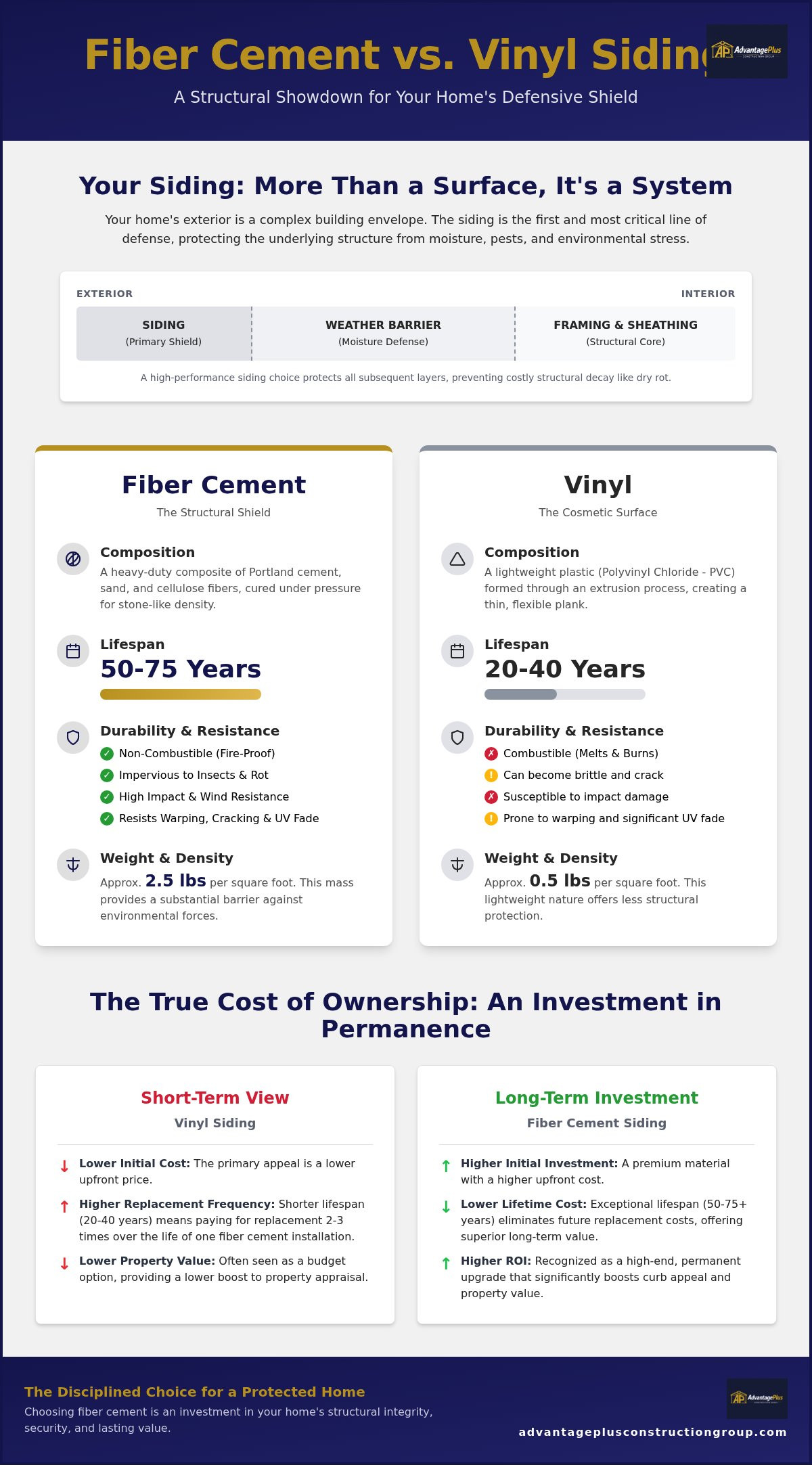
Engineering defines endurance. When comparing fiber cement vs vinyl siding, we must look beneath the surface at the molecular level. Fiber cement is a heavy, composite material weighing approximately 2.5 pounds per square foot. In contrast, vinyl is a lightweight plastic weighing only 0.5 pounds per square foot. This weight difference is not just a logistical detail for the installation crew. It dictates how the material absorbs impact, resists wind, and shields your home's framing from environmental stress. Mass matters. A heavier material provides a more substantial barrier against the external world.
The manufacturing methods are fundamentally different. Fiber cement undergoes a process called autoclaving. This involves curing the material under high-pressure steam to create a stone-like bond that is dimensionally stable. Vinyl is produced through extrusion. Molten plastic is pushed through a die to form a thin, flexible plank. While extrusion allows for a lower price point, autoclaving produces a product designed for permanence. Understanding these structural profiles is essential for maintaining exterior envelope integrity over the coming decades.
The Anatomy of Fiber Cement (Hardie Board)
Fiber cement is a specialized blend of Portland cement, sand, and cellulose fibers. The cement provides the structural backbone. The sand acts as a filler for density. The cellulose fibers serve as a reinforcement, acting much like rebar in a concrete slab. This combination creates a material that is virtually impervious to the threats that destroy natural wood. It resists wood-boring insects, prevents dry rot, and stands firm against woodpeckers. You can select textures that mimic deep wood grain or opt for smooth finishes that offer a disciplined, architectural look.
The Chemistry of Vinyl Siding
Vinyl siding is composed primarily of Polyvinyl Chloride (PVC). To make this rigid plastic flexible enough for siding planks, manufacturers add chemical plasticizers. These additives are the material's greatest weakness. Under the relentless UV exposure found in Roseville and Granite Bay, these plasticizers gradually degrade. The result is a siding that becomes brittle, prone to cracking, and susceptible to fading. You may choose between standard hollow-back vinyl or insulated versions. Insulated options include a foam backing to improve rigidity, yet the core chemistry remains a high-grade plastic vulnerable to the elements.
Performance Metrics: Durability, Fire Resistance, and Longevity
When you invest in your home's exterior, you're choosing a timeline for your property's protection. Fiber cement siding offers an expected lifespan of 50 to 75 years, effectively serving as a permanent structural solution. Vinyl siding typically lasts between 20 and 40 years before environmental degradation necessitates a full replacement. This disparity in longevity is a core factor in the fiber cement vs vinyl siding debate. One is a generational investment; the other is a recurring maintenance cycle that eventually requires more labor and material. We view siding as a long-term commitment to your home's health, and the data suggests that fiber cement is the only choice for those seeking permanence.
Fire Safety and Non-Combustible Materials
In Northern California, fire safety isn't a luxury. It's a fundamental requirement for home security. Fiber cement holds a Class 1A fire rating and is classified as non-combustible. It won't ignite, it won't melt, and it won't contribute fuel to a fire. This provides a critical layer of defense in Wildland-Urban Interface (WUI) zones across Roseville and Granite Bay where local building codes are increasingly stringent. Vinyl is a thermoplastic. It can warp or melt at temperatures as low as 160 degrees Fahrenheit. It doesn't just fail in a wildfire; it can fail from the heat of a neighbor’s grill or reflected sunlight from energy-efficient windows. Choosing a non-combustible shield is a disciplined decision that protects your family and your investment.
Impact Resistance and Storm Performance
Physical resilience determines how your home survives the unexpected. Fiber cement’s density allows it to withstand impacts from hail, wind-driven debris, or stray baseballs that would shatter lesser materials. Its rigidity ensures it remains flat and secure against the building envelope. Vinyl relies on flexibility. While this helps it bounce back from minor bumps in mild weather, the material becomes dangerously brittle as it ages or when temperatures drop. A heavy hailstone can easily puncture an aged vinyl plank. We prioritize the structural heft of fiber cement because it offers a level of impact defense that flexible plastics cannot replicate.
Wind performance is where professional installation and material weight converge. Because fiber cement is fastened directly to the studs, it's remarkably resistant to wind blow-off. Vinyl is often hung loosely on a nailing hem to allow for thermal expansion. If not installed with expert precision, high winds can get behind the planks and strip them from the wall. Our project managers oversee a fastening pattern that locks your siding in place, creating a reliable, high-performance shield that doesn't rattle or fail when the weather turns. It’s about doing it right the first time to ensure your peace of mind remains intact.
The True Cost of Ownership: Maintenance and Long-Term ROI
Financial clarity is essential when choosing a permanent shield for your home. While the initial investment for fiber cement vs vinyl siding varies, the long-term value story is clear. Fiber cement typically requires a higher upfront cost, ranging from $10 to $18 per square foot installed, compared to vinyl's $6 to $12 range. This price gap reflects the material's structural density and the specialized labor required for a precise installation. However, viewing this strictly as an expense is a mistake. It's a capital improvement that secures your building envelope for 50 years or more, whereas vinyl often requires a full replacement cycle within 20 to 40 years. Value is a long game.
The return on investment (ROI) for fiber cement is among the highest in the remodeling industry. National data indicates that homeowners can recoup approximately 114% of the cost of fiber cement siding at resale, effectively making the upgrade a profit-generating asset. Vinyl siding recoups significantly less, averaging around 77%. For the disciplined homeowner, the choice is between a temporary cosmetic fix and a structural legacy that pays for itself. If you're ready to prioritize your property's financial health, our team provides expert exterior envelope services to ensure your investment is protected from day one.
Maintenance Realities: Repainting vs. Washing
Maintenance requirements are often misunderstood. Vinyl is frequently marketed as "maintenance-free," yet this is a half-truth. While vinyl only requires annual washing to remove oxidation and dirt, it's susceptible to permanent UV fading. Because the color is baked into the plastic, you cannot easily repaint vinyl to refresh its look or match a repair. If a single panel cracks after ten years of sun exposure, the new replacement panel will likely clash with the faded original siding. This creates a "patchwork" aesthetic that devalues the home.
Fiber cement requires a different, more proactive approach. It needs to be repainted every 10 to 15 years to maintain its moisture resistance and aesthetic appeal. This comes with a projected 20-year maintenance cost of $6,000 to $12,000, which is higher than vinyl's $2,000 to $4,000 estimate. However, the ability to repaint is a strategic advantage. It allows you to update your home's style, repair minor scuffs perfectly, and maintain a "brand new" appearance for the life of the structure. Many homeowners opt for factory-applied color technology, which offers a baked-on finish that is far more durable than traditional field-applied paint.
Resale Value and Curb Appeal in the Sacramento Market
In the premium neighborhoods of Granite Bay, Rocklin, and Roseville, curb appeal is synonymous with structural integrity. Local buyers are sophisticated. They recognize the thin, overlapping seams of vinyl and often perceive them as a budget-conscious compromise. In contrast, fiber cement provides the deep shadow lines and authentic texture of natural wood. This "premium" market positioning is reflected in home appraisals. A house clad in fiber cement projects a sense of permanence, safety, and meticulous care. It tells a prospective buyer that the owner didn't take shortcuts, which builds the confidence necessary to secure a higher closing price.
Beyond the Plank: Why Specialized Installation is the Ultimate Shield
Choosing the right material is only half the battle. Whether you decide on fiber cement vs vinyl siding, the success of your project rests on the precision of the installation. A premium plank installed poorly is nothing more than a cosmetic failure waiting to happen. In fact, labor accounts for 55 to 65 percent of the total cost for fiber cement, compared to 40 to 50 percent for vinyl. This reflects the intense technical discipline required to handle heavier, more permanent materials. We believe that a true defensive shield is built through expert oversight, meticulous planning, and a rejection of shortcuts.
We approach every project as a comprehensive exterior envelope service. This means focusing on the hidden layers that dictate your home's long term health. The Weather Resistive Barrier (WRB) serves as your structure's second skin. It must be integrated perfectly with windows, doors, and rooflines to prevent the catastrophic dry rot that often remains hidden until it's too late. Our specialized project managers ensure that every component, from the starter strip to the final trim piece, functions as a unified system of defense.
The Role of Moisture Barriers and Flashing
Water management is a game of inches. Improper installation often leads to trapped moisture, which is the primary catalyst for structural decay. While it might seem intuitive to make siding as "tight" as possible, a professionally managed exterior requires a balance of sealing and ventilation. Precision caulking and kick-out flashing are essential. These components direct water away from vulnerable wall intersections and channel it safely into the gutter system. We maintain a rigorous standard for moisture management to ensure that your home's framing remains dry, stable, and secure regardless of the season.
The Advantage Plus Project Management Standard
Our "Specialized Guardian" approach sets us apart from general contractors. We provide a dedicated project manager for every job to ensure that every seam and fastener meets strict manufacturer specifications. This level of oversight removes the weight of responsibility from your shoulders. You can move from the anxiety of property maintenance to the quiet pride that comes with high quality protection. We take the time to do it right the first time because we understand that your home is your most significant investment. It deserves a partner who prioritizes structural performance and environmental resistance.
The transition to a maintenance free exterior begins with a clear understanding of your home's current condition. Our team is ready to provide the technical clarity and professional reliability you need to secure your property's future. Secure your home’s future with a professional exterior assessment today and experience the peace of mind that comes with a truly specialized installation.
Securing Your Home’s Structural Legacy
Your home is a sanctuary that deserves a permanent shield. The choice between fiber cement vs vinyl siding is ultimately a decision about the level of protection you want for your family and your future. We have seen how material density, fire safety, and cost efficiency favor a structural approach over a cosmetic one. True security is built on a foundation of engineering, discipline, and expert oversight. It's about protecting your investment from the inside out.
As Sacramento regional specialists, we prioritize the health of your building envelope. Our team provides specialized project management oversight to ensure every detail meets our rigorous standards for environmental resistance. We focus on moisture management, structural performance, and lasting beauty. You don't have to navigate these complex technical decisions alone. A trusted partner makes all the difference in achieving a maintenance free exterior.
Take the first step toward a more resilient home today. Request Your Specialized Exterior Consultation and let us provide the technical clarity you deserve. Your property is your legacy; we are here to help you defend it.
Frequently Asked Questions
Is fiber cement siding worth the extra cost compared to vinyl?
Fiber cement is worth the investment because it offers a lifespan of 50 to 75 years and a superior return on investment. While the initial cost is higher, you're securing a structural shield that recoups approximately 114% of its value at resale. It eliminates the 20-year replacement cycle common with vinyl surfaces. Choosing fiber cement vs vinyl siding is a decision to prioritize long-term security over a temporary cosmetic fix.
How does fiber cement siding perform in high-heat areas like Sacramento?
Fiber cement excels in the intense Sacramento heat because it's dimensionally stable and won't warp, melt, or sag. Unlike vinyl, which can become brittle or lose its shape under relentless UV exposure, fiber cement maintains its stone-like integrity. It provides a reliable defense against the fluctuating temperatures of Northern California. It doesn't expand and contract like plastic, ensuring your seams remain tight and your home stays protected.
Can I paint vinyl siding if I want to change the color later?
You shouldn't paint vinyl siding because the material isn't engineered to bond with traditional exterior paints. Painting vinyl often leads to peeling and can even cause the planks to warp if the new color absorbs too much heat. If you value the ability to refresh your home's aesthetic every decade, fiber cement is the superior choice. It's designed to hold paint beautifully, allowing for total design flexibility over the life of the structure.
Which siding material is better for preventing dry rot?
Fiber cement is the superior material for preventing dry rot because its composition of Portland cement and sand is completely impervious to fungal decay. It doesn't trap moisture against your home's framing like poorly installed vinyl can. When our specialized project managers oversee the installation of the weather-resistive barrier, the result is a sealed building envelope. This disciplined approach ensures that your home's core remains dry and structurally sound for decades.
Does fiber cement siding really help with home insurance premiums in fire zones?
Many insurance providers offer lower premiums for homes clad in non-combustible materials like fiber cement. Since it holds a Class 1A fire rating, it significantly reduces the risk of total loss during a wildfire event. You should consult with your specific carrier in Roseville or Granite Bay to confirm potential discounts. Investing in a non-combustible shield is a proactive step that protects both your family and your financial interests.
How long does a typical siding installation take for a home in Roseville?
A professional siding installation for a standard home usually takes 7 to 14 working days. The exact timeline depends on the complexity of your home's architecture and the level of detail required for flashing and trim. Fiber cement requires more time than vinyl due to its significant weight and the specialized tools needed for cutting. We prioritize a methodical, unhurried process to ensure every fastener is placed with professional precision.
What is the most low-maintenance siding option for California homeowners?
Vinyl is technically the most low-maintenance option because it only requires an annual wash to remove dirt and oxidation. However, fiber cement with factory-applied color offers a level of durability that resists fading and impact much better than plastic. For homeowners seeking a balance of premium beauty and structural defense, fiber cement's 15-year repainting cycle is a strategic trade-off. It maintains a "brand new" appearance long after vinyl begins to show its age.
Does vinyl siding improve my home’s energy efficiency?
Standard vinyl siding offers negligible insulation, but insulated vinyl with foam backing can help reduce thermal bridging. This foam layer creates a break between the exterior air and your home's wall studs. While this helps with energy efficiency during hot Sacramento summers, it doesn't offer the same density or structural performance as fiber cement. For maximum efficiency, we focus on the integrity of the entire building envelope rather than just the siding material itself.


