
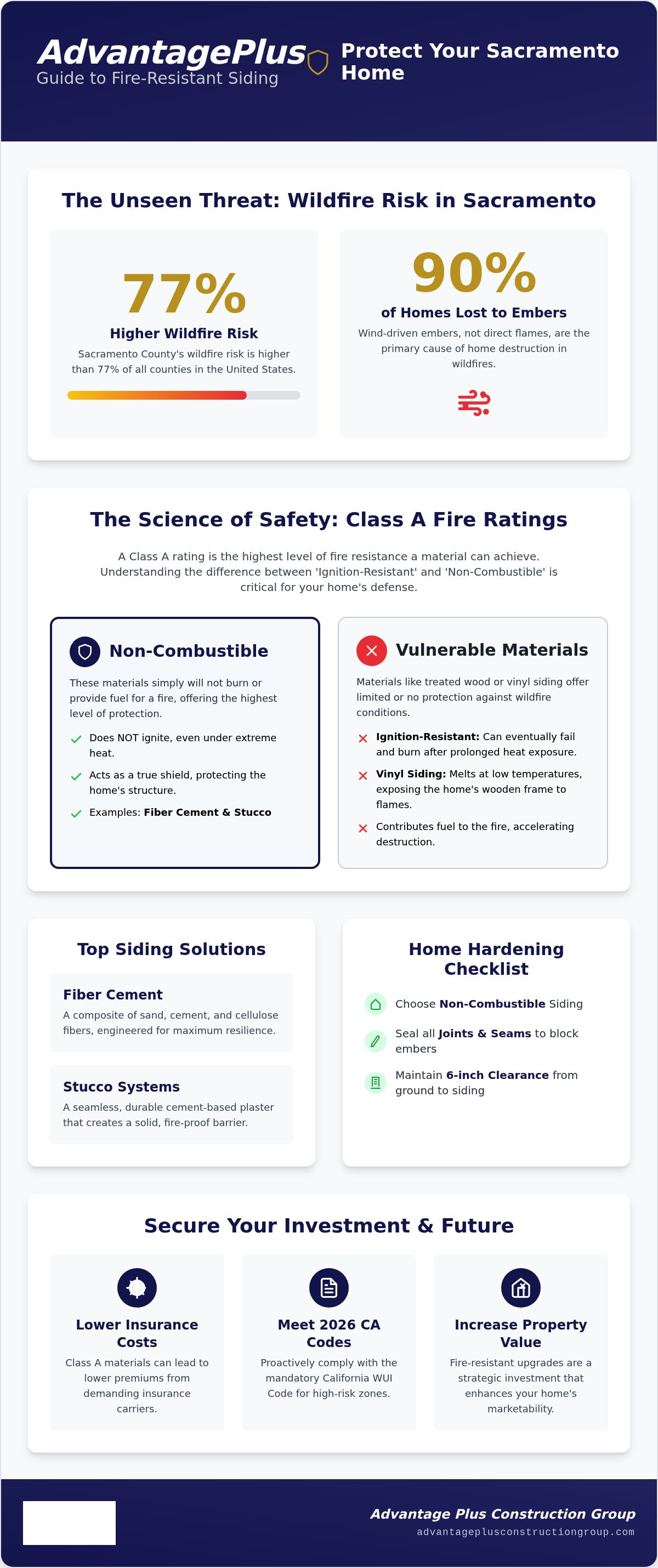
Did you know that Sacramento County currently faces a wildfire risk higher than 77 percent of all counties in the United States? For many local homeowners, this isn't just a statistic. It's a source of genuine anxiety every time the wind picks up, every time a nearby fire makes the news, and every time an insurance renewal notice arrives in the mail. You likely feel the pressure of rising premiums and the complex transition to the mandatory 2026 California WUI Code. It's a weight no homeowner should carry alone.
We believe your home deserves a defense as resilient as the family inside it. This article reveals how fire resistant siding Sacramento installations provide the structural integrity needed to withstand ember storms and extreme heat. You'll learn how specialized fiber cement and stucco systems shield your exterior envelope from the core out. We will preview the latest "Zone 0" requirements, explain the benefits of noncombustible materials, and detail how professional upgrades can help lower your insurance costs while increasing property value. True security starts with the right materials, the right standards, and a partner who refuses to take shortcuts.
Key Takeaways
- Understand the critical distinction between fire-rated and non-combustible materials to ensure your home meets the highest Class A safety standards.
- Discover why fiber cement and stucco systems are the most effective options for fire resistant siding Sacramento residents can install to mitigate wildfire risks.
- Learn how a specialized focus on the exterior envelope prevents embers from penetrating vulnerable joints and seals during a fire event.
- Follow a practical checklist to harden your property, focusing on the critical six-inch clearance zone between the ground and your siding.
- Position your home for long-term financial stability by meeting 2026 building codes and potentially lowering your property insurance premiums.
The Sacramento Fire Risk: Why Your Siding Choice Matters Now
The Sacramento Valley presents a specific set of environmental challenges that demand a disciplined approach to home construction. We see it every summer. Triple-digit heat. Humidity levels that drop into the single digits. Gusting north winds. This combination creates a kiln-like effect that prepares traditional building materials to ignite at the slightest spark. In suburban corridors like Roseville, Rocklin, and Granite Bay, the risk is not just theoretical. Sacramento County currently faces a wildfire risk higher than 77 percent of all counties in the United States. For homeowners in these areas, the exterior of the house is the only thing standing between their investment and a fast-moving fire.
Traditional vinyl siding often fails when it is needed most. It doesn't just burn; it melts. This melting process occurs at relatively low temperatures, exposing the underlying wood sheathing and studs to intense heat and direct flame. Once the exterior envelope is compromised, the structural integrity of the entire home is at immediate risk. This is why the transition to fire resistant siding Sacramento homeowners can rely on is no longer an optional aesthetic choice. It's a foundational requirement for modern property protection that prioritizes longevity over temporary fixes.
Understanding the Ember Threat
Homeowners often focus on the wall of flame during a wildfire. However, statistics reveal a more insidious danger. Approximately 90 percent of homes destroyed in these events are lost to wind-driven embers. These sparks can travel miles ahead of the actual fire front. They seek out vulnerabilities. They find gaps in the siding. They ignite dry debris against the foundation. A robust exterior envelope prevents these stray sparks from finding a foothold. By using non-combustible materials, you eliminate the fuel source that allows a small spark to become a total loss. We focus on sealing every joint and seam to ensure the core of your home remains untouched by these airborne threats.
Insurance Premiums and the Class A Requirement
California's insurance market is currently undergoing a massive correction. Carriers are no longer just suggesting home hardening; they are demanding it. As of January 1, 2026, the new California WUI Code (Title 24, Part 7) has established more stringent standards for structural safety in high-risk zones. Insurers prioritize Class A fire-rated materials, which represent the highest level of resistance available. Investing in fiber cement siding or professional stucco systems satisfies these rigorous requirements. It's a strategic move. Proactive hardening is significantly less expensive than the high premiums or forced repairs mandated by insurance companies later. You aren't just buying siding. You're securing your financial future and your family's peace of mind.
Class A Fire Ratings: The Science of the Exterior Shield
The term "Class A" is often used loosely in home improvement, yet its technical reality is the foundation of structural survival. A Class A fire rating represents the highest level of fire resistance a building material can achieve. To earn this designation, materials undergo rigorous testing to measure their flame spread index and smoke developed index. In our role as a specialized guardian, we don't settle for "good enough." We prioritize materials that refuse to ignite, ensuring that your fire resistant siding Sacramento installation acts as a true shield rather than a liability.
This scientific approach to safety is what separates a general contractor from a specialist. We look beyond the surface. We analyze how a material responds to the extreme thermal stress common in the Sacramento Valley. When you choose a material with a Class A rating, you are choosing a product that has proven its ability to withstand severe fire exposure without contributing to the spread of flames. It's a commitment to the long-term health of your property.
Non-Combustible vs. Ignition-Resistant
Understanding the technical distinction between these terms is vital for your security. Ignition-resistant materials are designed to resist burning for a specific duration, but they can eventually succumb to intense heat. Non-combustible materials, such as fiber cement and stucco, simply will not burn. They do not provide fuel for the fire. This is a critical distinction during a Sacramento summer fire. The physics of heat transfer mean that even if a flame doesn't touch your siding, the radiant heat can cause internal wall studs to ignite if the exterior material fails to insulate the core. By choosing fiber cement or stucco, you're installing a barrier that remains stable under extreme thermal stress.
The Role of Moisture Barriers in Fire Safety
Fire safety and moisture management are two sides of the same coin. A compromised, damp exterior envelope is prone to structural failure during a heat event. When we perform a moisture barrier siding installation, we're protecting the "bones" of your home from dry rot and environmental decay. A dry, healthy wall structure is far more resilient when facing high temperatures. Regarding technical standards, the ASTM E136 test measures non-combustibility by ensuring a material does not ignite or support combustion when exposed to 1,382 degrees Fahrenheit. Integrating these high-performance materials with a professional seal is how we provide lasting peace of mind. If you're concerned about your current exterior's performance, our team can help you secure your home's perimeter with a specialized assessment.
Top Fire-Resistant Siding Options for Sacramento Homes
Selecting the right material for your home's exterior is a decision that balances aesthetic preference with structural survival. In the Sacramento Valley, where environmental stressors are constant, the choice of siding must be deliberate. We prioritize materials that offer a dual benefit: visual excellence and unyielding defense. While several products claim to be "hardened," only a few truly stand up to the rigorous demands of the local climate and the strict requirements for fire resistant siding Sacramento homeowners now face. Our focus remains on permanence, quality, and craftsmanship.
The Case for Fiber Cement Siding
Fiber cement has emerged as the versatile leader in home hardening for good reason. It's composed of a specialized blend of Portland cement, sand, and cellulose fibers. This mixture creates a board that is exceptionally dense and entirely non-combustible. Because it does not provide fuel for a fire, a professional fiber cement siding installation Sacramento is often the first recommendation for properties in high-risk zones. Homeowners appreciate that they don't have to sacrifice style for safety. Modern manufacturing allows these boards to mimic the deep grain and warm texture of natural cedar without the inherent fire risk of wood. It is a solution that offers beauty, durability, and peace of mind.
Stucco: The Original Firewall
Stucco systems have protected California homes for generations, serving as a traditional yet highly effective firewall. These cement-based systems are naturally fire-rated and provide a seamless exterior shell. Experienced stucco contractors Sacramento CA frequently recommend this option for homes with tight property lines. In dense neighborhoods where structures are close together, a non-combustible stucco finish prevents a fire from jumping between buildings. Beyond its safety profile, modern stucco offers a clean, sophisticated aesthetic. It provides a smooth, monolithic look that enhances curb appeal while maintaining a disciplined defense against the elements.
Evaluating Longevity and Accents
While fiber cement and stucco are our primary recommendations, other materials play a supporting role in a comprehensive home hardening strategy. Metal siding and stone veneer are excellent secondary options, particularly for high-risk accent areas or ground-level transitions. These materials are impervious to embers and offer a striking visual contrast. When evaluating your options, consider the long-term maintenance requirements. Fire-rated materials are built for the long haul. They resist warping, rotting, and pest infestations. Choosing a high-performance exterior is an investment in the structural health of your property that pays dividends in both safety and reduced maintenance costs over the coming decades.
Sacramento Home Hardening: A Practical Checklist
Hardening your home is a methodical process. It requires moving beyond the surface and examining the vulnerabilities of the entire exterior envelope. While choosing fire resistant siding Sacramento homeowners can trust is a major step, the installation must be part of a broader, disciplined strategy. We recommend starting with a thorough audit of your current structure to identify where sparks might find a foothold. This isn't about a quick fix; it's about a permanent defense.
- Identify current materials: Determine if your existing siding is vinyl, wood, or an older composite. Each has a different ignition threshold and failure point.
- Inspect the critical zone: Ensure there is at least a 6-inch gap of non-combustible material, such as concrete or stone, between the ground and the start of your siding.
- Assess eaves and soffits: These areas often trap rising heat and embers. They should be boxed in with fire-rated materials to prevent fire from entering the attic space.
- Evaluate trim and casings: Window and door surrounds are frequent failure points. Upgrading to non-combustible trim prevents flame intrusion at the seams of the building.
The 5-Foot Defensible Space Rule
Siding doesn't exist in isolation. It interacts directly with your landscaping and immediate perimeter. The first five feet around your foundation, often called "Zone 0," is the most critical area for structural survival. If you have mulch, dry bushes, or wooden fences touching your house, you're providing a direct bridge for fire. Removing combustible debris from the base of your siding is essential for the material to perform as designed. During a fire resistant siding Sacramento upgrade, we also emphasize the use of non-combustible flashing. This metal barrier prevents embers from smoldering behind the siding panels, which is vital during the intense, dry heat of a Sacramento summer.
Vents and Openings: The Envelope Perspective
Your siding is only as strong as its weakest opening. Embers are small, persistent, and capable of traveling long distances. They frequently enter the home core through standard attic or crawlspace vents that were never designed for wildfire protection. Specialized ember-resistant vents are the necessary partner to any new siding project. These vents use advanced baffles to block radiant heat and sparks while still allowing for proper structural airflow. For maximum protection, all vent openings must be covered with a corrosion-resistant, non-combustible 1/8 inch mesh to prevent even the smallest embers from penetrating the structure. Closing these gaps ensures that your exterior shield remains uncompromised. If you're ready to evaluate your home's defenses, schedule a professional exterior audit to identify and eliminate your highest-risk vulnerabilities.
The Advantage Plus Approach: Precision and Protection
The highest-rated materials in the world cannot protect a home if the installation lacks precision. At Advantage Plus Construction Group, we believe that specialized installation is just as critical as the material itself. A single gap in a seal or an improperly fitted joint can become the entry point for a wind-driven ember. We don't approach your home as a generalist would. Instead, we act as a specialized guardian, focusing on the technical nuances that ensure your fire resistant siding Sacramento project provides the security you expect. Our disciplined project management process oversees every detail, from the initial teardown to the final inspection.
We take immense pride in serving homeowners across the Sacramento region, including the fire-prone corridors of Roseville, Granite Bay, and Rocklin. These communities require a partner who understands the high stakes of structural integrity. Our philosophy is rooted in the concept of doing it right the first time. We reject shortcuts. We prioritize the long-term health of your property over quick, superficial upgrades. This commitment to professional standards is what allows our clients to transition from anxiety about wildfire risks to the peace of mind that comes with high-quality, durable protection.
Expertise in the Exterior Envelope
Our work moves beyond simple siding replacement to address the total building envelope. The exterior envelope is a complex system of layers designed to manage heat, moisture, and air. If one part of this system is compromised, the entire structure is at risk. We manage every aspect of material procurement and site preparation to ensure maximum safety. This includes the integration of fire-rated flashing, moisture barriers, and non-combustible trim that works in harmony with your new siding. By viewing your home as a complete system, we provide a solution that enhances both the visual appeal and the environmental resistance of your property. This holistic approach is essential for maintaining property value in California's evolving insurance landscape.
Your Consultation: Building a Specialized Shield
Every home has a unique architectural story and a specific set of vulnerabilities. During a professional exterior renovation assessment, we don't just provide a quote. We conduct a thorough analysis of your home's perimeter to identify high-risk zones. We look at the way your eaves interact with the siding and how your window casings are sealed against the core. This allows us to customize a fire-resistant solution that matches your home’s architecture while meeting the stringent requirements of the 2026 California WUI Code. We are here to take the weight of responsibility off your shoulders and provide a clear, professional path toward a safer home. Secure your home’s future with a professional siding consultation.
Securing Your Home’s Legacy in the Sacramento Valley
The safety of your home isn't a matter of chance; it's a matter of disciplined preparation. By prioritizing Class A fire-rated materials and addressing every vulnerability in your exterior envelope, you protect your investment from the persistent threat of wind-driven embers. We've explored how the right choices in fire resistant siding Sacramento can stabilize insurance premiums and provide structural permanence. True security requires a partner who understands that craftsmanship and safety are inseparable.
Advantage Plus Construction Group brings specialized expertise in James Hardie and premium stucco systems to homeowners in Roseville, Granite Bay, and the greater Sacramento region. Our dedicated project management ensures that every seal is tight and every joint is secure. We're here to help you move from property anxiety to total peace of mind. Don't leave your home's defense to generalists who overlook the technical details of the building envelope.
Request Your Specialized Exterior Protection Quote
Your home is more than a structure. It's a sanctuary worth protecting with the highest professional standards and unyielding attention to detail.
Frequently Asked Questions
Is fiber cement siding actually fireproof?
Fiber cement is non-combustible, which means it will not ignite when exposed to direct flame or act as fuel for a fire. While no building material is entirely "fireproof" under extreme, prolonged heat, fiber cement offers the highest level of residential protection available. It won't melt like vinyl or char like wood, ensuring the core of your home remains shielded during an ember storm.
Will installing fire-resistant siding lower my Sacramento home insurance?
Many California insurance providers offer premium credits or discounts for documented home hardening measures. Installing fire resistant siding Sacramento homeowners can verify as Class A fire-rated often satisfies the rigorous safety requirements set by modern carriers. We recommend contacting your insurance agent to discuss specific "Safe from Wildfire" credits or local rebate programs currently available in Sacramento County.
What is the best siding for fire resistance in California?
Fiber cement and traditional stucco systems are the gold standards for fire resistance in the California landscape. Both materials carry a Class A fire rating and are inherently non-combustible. Fiber cement is often preferred for its versatility and wood-like aesthetics, while stucco provides a monolithic, seamless barrier. The best choice depends on your home’s specific architecture and proximity to neighboring structures.
How much does fire-resistant siding cost in Sacramento compared to vinyl?
High-performance materials like fiber cement require a larger initial investment than entry-level vinyl products. However, the long-term value is significantly higher because these materials resist the warping and melting common in the Sacramento heat. You're investing in structural longevity and reduced maintenance costs rather than a temporary surface fix. This proactive upgrade protects your property value and your home's structural integrity for decades.
Can stucco be applied over existing siding to increase fire resistance?
We strongly advise against applying new stucco over existing siding materials. For a stucco system to provide a true fire-rated shield, it must be installed directly onto a properly prepared structural base with a professional moisture barrier. Layering materials can trap moisture and create air pockets, which leads to dry rot and compromises the fire safety of your entire exterior envelope.
Do I need a permit for fire-resistant siding installation in Roseville or Rocklin?
Yes, most jurisdictions in the Sacramento region require a building permit for siding replacement projects. This process ensures that the new installation meets the 2026 California WUI Code and local safety standards for fire-prone areas. Our project management team handles the permitting details to ensure every aspect of your renovation is fully compliant with Roseville or Rocklin municipal requirements.
What is a Class A fire rating for residential siding?
A Class A fire rating is the superior industry standard for fire resistance in building materials. It indicates that the product has passed rigorous testing for flame spread and smoke development. Materials with this rating, such as fiber cement and stucco, are the most effective at preventing fire from penetrating your home’s interior during a wildfire or a structural fire event.
How long does it take to replace siding with fire-rated materials?
A professional exterior renovation typically takes between one and three weeks, depending on the size and complexity of your home. This timeline includes the careful removal of old materials, a thorough inspection of the underlying structure, and the precision installation of the new fire-rated system. We maintain a disciplined schedule to minimize disruption while ensuring every seal and joint is perfectly secure.


