
43% of Sacramento area structures now face a significant wildfire risk. This reality has transformed your home's exterior from a simple design choice into a vital, durable, and necessary survival strategy. You've likely felt the mounting pressure of rising insurance premiums or the seasonal anxiety that arrives alongside the dry North winds. Finding the right fire resistant siding Sacramento solution is no longer just about aesthetics; it's about the disciplined defense of your greatest investment.
This guide will show you how to defend your property using high-performance, non-combustible materials that meet the rigorous 2026 WUI building codes. Precision matters. By focusing on the structural integrity of your exterior envelope, you can secure insurance discounts, satisfy the latest Zone 0 regulations, and enhance your curb appeal. We will examine the differences between ignition-resistant and non-combustible systems, the impact of the 2025 hazard map updates, and the precise steps required to harden your home. Security starts here. It's time to replace uncertainty with the confidence of a professionally shielded home.
Key Takeaways
- Understand the vital distinction between fire-resistant and non-combustible materials to protect your property from intensifying wildfire risks.
- Learn why fiber cement and stucco systems are the gold standard for creating a durable, ignition-proof barrier around your home.
- Discover how the right fire resistant siding Sacramento choice can lead to significant insurance premium reductions under the latest 2026 regulations.
- Identify why professional installation and a holistic exterior envelope approach are necessary to prevent dangerous gaps in your home's thermal armor.
Understanding Fire-Resistant Siding in the Sacramento Region
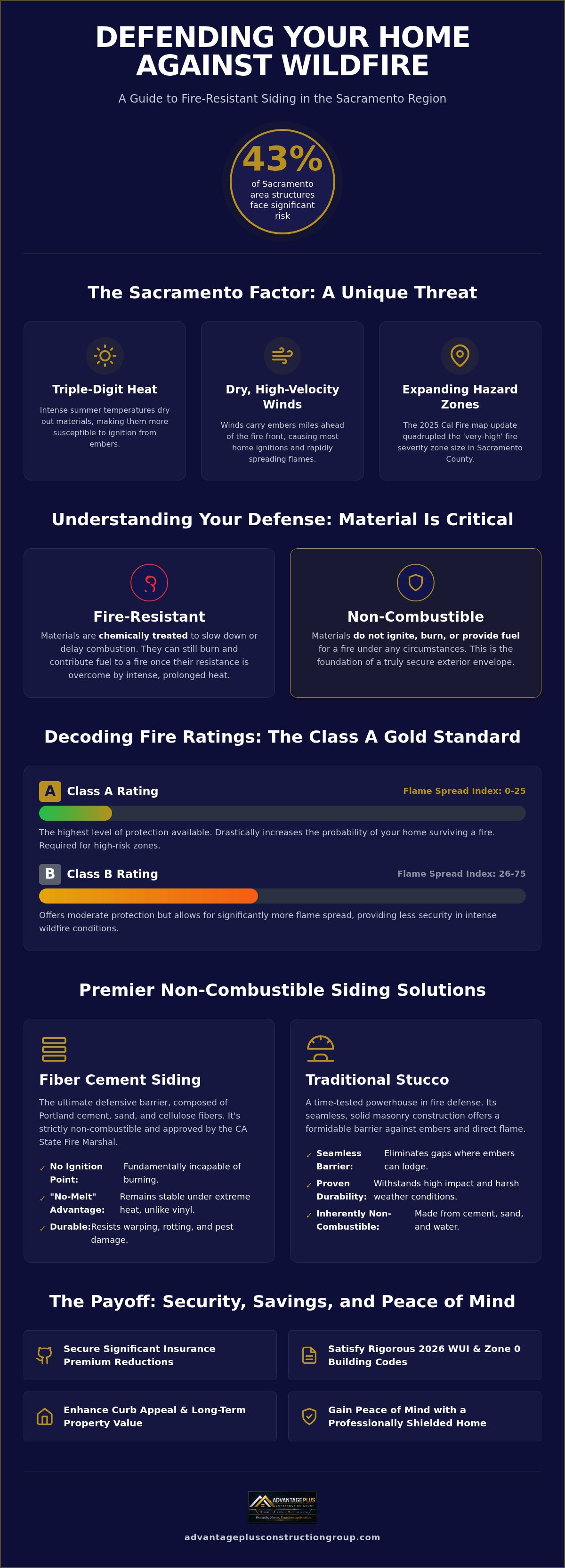
Fire-resistant siding consists of materials engineered to withstand high temperatures, resist ignition, and slow the advance of flames across a building's surface. In the context of fire resistant siding Sacramento, these properties are critical for structural survival. It's vital to distinguish between fire-resistant and non-combustible systems. Fire-resistant materials are often treated to delay combustion, whereas non-combustible materials, such as Fiber cement siding or traditional stucco, don't ignite or provide fuel for a fire. This distinction is the foundation of a secure exterior envelope.
Sacramento homeowners face a unique set of environmental pressures. The Sacramento Factor involves triple-digit summer heat combined with dry, high-velocity winds that turn small sparks into fast-moving threats. The March 2025 Cal Fire hazard map update quadrupled the size of the very-high fire severity zone in our county. These conditions necessitate the Class A Fire Rating. This rating is the gold standard for residential exteriors; it represents the highest level of protection available against fire penetration and flame spread.
The Science of Flame Spread and Ignition
Wildfires rarely consume homes through a single wall of flame. Instead, most structures ignite due to wind-borne embers that lodge in gaps or settle against combustible surfaces. Heat flux, which is the rate of heat energy transfer, can cause internal wall components to combust even without direct flame contact. Traditional wood siding provides ready fuel, while vinyl siding often melts and deforms under moderate heat exposure. Non-combustible siding acts as a thermal shield. It reflects heat energy and prevents the temperature of the underlying studs from reaching the point of ignition.
Class A vs. Class B Fire Ratings
Material performance is measured through rigorous standardized testing. The ASTM E119 and UL 723 standards evaluate how long a material can withstand intense heat and how quickly flames travel across its surface. Class A materials have the lowest flame spread index, typically between 0 and 25. Class B materials allow for significantly more flame spread and offer less protection. In high-risk zones, choosing Class A isn't just a preference; it's a disciplined decision that drastically increases the probability of your home surviving a fire event. It provides the peace of mind that comes from professional-grade defense.
Fiber Cement Siding: The Non-Combustible Shield
Fiber cement siding stands as a premier choice for homeowners seeking the ultimate defensive barrier. Its composition is a disciplined, high-performance blend of Portland cement, sand, and cellulose fibers. This specific ratio results in a material that is strictly classified as non-combustible. It won't ignite or add fuel to a fire, even when subjected to direct flame or the intense radiant heat typical of a Sacramento wildfire. This material is prominently included on the official list of approved building materials by the California State Fire Marshal. It remains the most reliable form of fire resistant siding Sacramento residents can choose to secure their property. Beyond its defensive capabilities, it offers remarkable aesthetic versatility. Homeowners can select from traditional lap siding, rustic shingles, or sleek architectural panels to achieve a high-end look without compromising on safety.
Thermal Performance Under Pressure
In our region, summer temperatures frequently exceed 100°F for weeks at a time. Fiber cement excels in these conditions by acting as a thermal heat sink. It absorbs and dissipates heat, which effectively protects the wooden framing and insulation hidden behind the exterior. This creates a significant "no-melt" advantage over vinyl products. While vinyl siding can sag, warp, or deform at relatively low heat levels, fiber cement remains structurally sound and dimensionally stable. Consider this: while cedar wood has a specific ignition temperature where it begins to fuel a fire, fiber cement has no ignition point because it is fundamentally incapable of burning. It remains the cornerstone of effective fire resistant siding Sacramento systems.
Long-Term Resilience in California
Protection isn't just about fire; it's about enduring the daily environmental stressors of the Central Valley. Fiber cement resists warping, rotting, and common local nuisances like woodpecker damage. It's a material designed for permanence, longevity, and peace of mind. Choosing fiber cement siding installation Sacramento is a one-time investment in the long-term health of your property. We approach every project through the lens of a Specialized Guardian. Our project managers ensure that every panel is installed with the precision required to maintain the integrity of your home's protective shield. This commitment to craftsmanship ensures that your home remains beautiful, secure, and professionally defended for decades. If you're ready to upgrade your home's defense, a professional assessment can clarify your next steps.
Stucco Systems and Fire Defense: A Traditional Powerhouse
While modern materials offer exceptional protection, traditional stucco remains one of the most effective forms of fire resistant siding Sacramento homeowners can utilize. It is essentially a layer of stone wrapped around your home. This masonry barrier is created through a disciplined, multi-coat application process involving a scratch coat, a brown coat, and a final finish coat. The result is a thick, non-combustible shield that refuses to ignite even under intense thermal stress. Unlike panel-based systems, stucco is monolithic and seamless. It eliminates the joints and gaps where wind-driven embers often find purchase, providing a continuous line of defense from the foundation to the eaves.
We often contrast traditional three-coat stucco with modern EIFS (Exterior Insulation and Finish Systems), which are synthetic. While EIFS has its place, traditional masonry stucco offers superior fire resistance due to its higher cement content and greater thickness. It represents a commitment to structural integrity that generalists often overlook. It is about permanence, protection, and professional standards.
The Masonry Advantage
A standard three-coat stucco system provides an inherent one-hour fire rating. This means the assembly can withstand direct fire exposure for sixty minutes before the heat transfers to the structural framing. For high-risk hillside properties, this window of time is often the difference between a total loss and a survivable event. Specialized stucco contractors Sacramento CA understand how to manage the critical moisture-fire balance. Proper application includes a dedicated drainage plane to prevent dry rot while maintaining the fire-resistant seal. It is a technical nuance that requires a guardian's attention to detail.
Stucco Maintenance and Longevity
Longevity is a hallmark of a well-executed stucco system, yet maintenance remains vital to ensure the fire barrier remains intact. Homeowners should regularly inspect their exteriors for signs you need new siding or stucco remediation, such as significant cracking or bulging. Small hairline cracks are common, but larger fissures can compromise the fire-resistant seal by allowing heat to reach the underlying lath. Repairing these gaps is a necessary act of property defense. Modern stucco also utilizes color-integrated finishes. This eliminates the need for combustible paint layers, ensuring that your home's beauty is literally baked into its protection. It is a durable, beautiful, and secure solution for the Sacramento climate.
Sacramento Building Codes and Insurance Benefits in 2026
As of January 1, 2026, the 2025 California Wildland-Urban Interface (WUI) Code, also known as Title 24, Part 7, is the mandatory standard for our region. This consolidated code replaces the older Chapter 7A and simplifies the requirements for homeowners. Compliance is no longer a suggestion. It is a disciplined requirement for any new building permit. For those seeking fire resistant siding Sacramento, these updated regulations ensure that your exterior is built to survive the intensifying fire seasons. This shift in building standards has a direct, positive impact on your financial security. It transforms your home into a "Hardened Home," which is the primary metric insurance companies use to assess risk.
The financial incentives for home hardening have never been more significant. Under the "Safer from Wildfires" framework, California law requires insurance providers to offer discounts for homes with verified wildfire mitigation features. The California FAIR Plan, which has seen its enrollment surge to over 645,000 properties, now offers up to a 16.4% discount on the wildfire portion of premiums for homes that meet all hardening criteria. This makes the exterior envelope a strategic financial asset rather than just a maintenance expense. In high-risk areas like Roseville, Granite Bay, and Rocklin, these savings can offset a substantial portion of your annual housing costs.
Navigating WUI Compliance
Homeowners in the Wildland-Urban Interface must prioritize materials that appear on the State Fire Marshal's approved list. Local fire marshals in Placer and Sacramento counties strictly enforce the use of non-combustible or ignition-resistant materials. A truly fire-resistant envelope requires more than just the panels. It involves a holistic approach to the exterior, including ember-resistant vents and non-combustible soffits. The recent approval of "Zone 0" regulations, which create an ember-resistant zone within five feet of the structure, makes non-combustible siding even more critical. It ensures that no part of the home's primary shell can serve as a fuse for wind-borne embers.
Maximizing Your ROI Through Safety
A hardened home commands a higher market value in the 2026 Sacramento real estate market. Buyers now view fire resistance as a non-negotiable feature for long-term security. While understanding the cost of siding installation Sacramento is important for budgeting, the long-term insurance savings and property appreciation create a compelling return on investment. Insurance providers frequently leverage the FireWise USA program to verify that a property's siding and surrounding vegetation meet the rigorous standards required for premium credits. You are not just buying siding; you are purchasing a decade of reduced liability and increased peace of mind. Secure your property's future with a professional WUI compliance assessment from a specialized expert.
Professional Installation: Your Final Line of Defense
Precision is the difference between a house that stands and a house that burns. Even the highest-rated fire resistant siding Sacramento homeowners can purchase remains vulnerable if the installation is flawed. Gaps, improper flashing, or neglected thermal bridges create entry points for wind-driven embers. During a fire event, these embers seek out any weakness in the exterior shell. If they penetrate the siding, they can ignite the structural framing from the inside out, rendering the non-combustible panels useless. This is why a systemic approach is non-negotiable. It requires a disciplined focus on every seam, joint, and transition point to ensure the protective barrier is absolute.
We operate as a specialized exterior envelope contractor Sacramento, which means we view your home as a single, integrated defensive system. Our process prioritizes critical technical details that generalists often overlook. We implement rigorous fire-blocking at the corners, use high-temperature caulking for seals, and ensure that metal flashing is integrated to deflect radiant heat. This level of craftsmanship isn't about speed. It's about the long-term security of your investment and the safety of your family. We take pride in doing it right the first time.
The Advantage Plus 'Guardian' Process
Our role as a Specialized Guardian is defined by oversight and accountability. We assign dedicated project managers to every job to ensure that the design intent matches the final application. We utilize a specific triplet of service: precision procurement, site defense, and expert application. This methodical flow ensures that the right materials are staged correctly and installed without compromise. You can transition from the anxiety of fire season to the security of documented quality control. Every project we touch is a testament to professional reliability and structural integrity.
Next Steps for Sacramento Homeowners
Securing your home for 2026 starts with a comprehensive evaluation of your current vulnerabilities. A specialized exterior envelope assessment identifies where your existing siding fails and how a non-combustible system can be integrated into your property. When preparing for a renovation, expect a timeline that prioritizes planning and permitting to ensure full WUI compliance. This is a significant upgrade, but it is one that pays dividends in safety, insurance savings, and pride of ownership. Don't leave your home's defense to chance or general contracting shortcuts. Secure your investment and your peace of mind with Advantage Plus Construction Group today.
Securing Your Sacramento Home for the Seasons Ahead
Hardening your home's exterior isn't just a maintenance task; it's a disciplined requirement for long-term security in 2026. You now understand how non-combustible fiber cement and seamless stucco systems serve as your primary defense against wind-borne embers. By prioritizing high-performance fire resistant siding Sacramento, you satisfy the latest WUI building codes while securing vital insurance discounts. This structural upgrade transforms your property into a resilient fortress that's ready for any fire season.
As Specialized Exterior Envelope Experts serving Roseville, Granite Bay, and the Greater Sacramento Area, we focus on the technical nuances of fire defense. We provide dedicated project management for every installation to ensure your home's shield is absolute and without weakness. It's time to move from anxiety to the quiet pride of ownership that comes with professional protection. Secure your home’s future with a professional fire-resistance assessment from Advantage Plus. Your property is your greatest investment. Let's ensure it's built to last.
Frequently Asked Questions
Is fiber cement siding actually fireproof?
Fiber cement is classified as a non-combustible material, meaning it won't ignite or act as fuel when exposed to direct flame. While nothing is entirely indestructible, this material provides a critical defensive layer for your home's exterior envelope. It's engineered to withstand the intense radiant heat common during Sacramento wildfires. This resilience ensures that the structural framing behind your walls remains protected, significantly increasing your property's chances of survival during a high-heat event.
Can fire-resistant siding lower my home insurance in California?
Yes, installing fire resistant siding Sacramento can lead to substantial insurance premium reductions. Under California's Safer from Wildfires framework, insurance providers are required to offer discounts for verified home hardening measures. The California FAIR Plan currently provides up to a 16.4% discount for homes that meet comprehensive hardening criteria. These savings, combined with increased property value, make the investment in a non-combustible exterior a strategic financial decision for local homeowners.
What is the difference between stucco and fiber cement for fire protection?
Both materials are non-combustible, but they offer different structural advantages. Stucco is a masonry system that provides an inherent one-hour fire rating due to its thickness and density. It's a monolithic, seamless barrier that eliminates entry points for embers. Fiber cement is a high-performance board that is easier to install in various styles while maintaining a Class A fire rating. Both systems effectively protect your home from the radiant heat and sparks typical in Roseville and Granite Bay.
How much does fire-resistant siding cost in Sacramento?
The investment for fire-resistant systems varies based on the material choice, the complexity of your home's architecture, and the specific WUI code requirements for your zone. While initial costs for non-combustible materials like fiber cement or stucco are higher than combustible options like vinyl, the long-term ROI is significant. Homeowners often see returns through lower insurance premiums, reduced maintenance costs, and higher resale values in fire-prone areas like Loomis, Penryn, and Rocklin.
What are WUI building codes and does my home need to follow them?
WUI stands for Wildland-Urban Interface, and these codes regulate building materials in high-risk fire zones. As of 2026, the updated Title 24, Part 7 standards are mandatory for new permits in designated Very High Fire Hazard Severity Zones. If your property is in an area like Granite Bay or the foothills of Placer County, you must use approved, ignition-resistant materials. Following these codes is necessary for both legal compliance and securing modern homeowners insurance.
Does fire-resistant siding require special maintenance?
Non-combustible siding systems are remarkably low-maintenance, but they aren't maintenance-free. To maintain the integrity of your fire-resistant seal, you should periodically inspect the caulking around windows and doors. For stucco systems, it's vital to repair any significant cracks that could allow heat to penetrate the underlying structure. In the dry Sacramento climate, keeping these seals intact ensures your home's exterior envelope remains a reliable barrier against both fire and moisture intrusion.
Can I install fire-resistant siding over my existing exterior?
For a true fire-resistant installation, we generally recommend removing the old siding down to the structural framing. This allows our project managers to inspect for existing damage and install a proper weather-resistive barrier and fire-blocking. Simply covering old, combustible wood or vinyl with a new layer doesn't address the underlying risk. A full replacement ensures that your new fire resistant siding Sacramento system is installed with the precision required for maximum protection and code compliance.
Which siding material is best for high-wind wildfire areas?
Both fiber cement and traditional stucco are excellent choices for wind-prone areas like Citrus Heights and Antelope. Stucco's monolithic application makes it exceptionally resistant to wind-driven embers because it lacks seams where sparks can lodge. Fiber cement is also highly durable and won't rattle or detach during high-velocity wind events. The key to performance in high winds is professional installation, ensuring that every fastener and seal is placed according to strict engineering standards to prevent wind uplift.


