
The best-looking siding on a sample board may be the wrong choice for your home’s exposure. The best exterior siding for Loomis homes depends on more than curb appeal: intense summer sun, heat, seasonal moisture, and applicable fire-safety requirements can all affect how a material performs over time.
It’s reasonable to want a finish that suits your home and protects your investment without demanding more upkeep than you can manage. But even a durable material can fall short if the wall assembly and moisture-management details aren’t planned carefully.
This guide compares common siding options through the lens of Loomis conditions, home design, durability, and maintenance. You’ll see where fiber cement and stucco may fit, what to consider with other materials, and which questions to bring to a qualified contractor. We’ll also explain why the existing wall assembly, a continuous water-resistive barrier, and project-specific local requirements deserve attention alongside the siding itself. The goal is to help you build a practical shortlist and choose a system that balances appearance with lasting protection.
Key Takeaways
- The best exterior siding for Loomis homes depends on your property’s sun and moisture exposure, existing wall assembly, and maintenance preferences.
- Compare fiber cement and stucco by appearance, upkeep, and system requirements. Wood and vinyl are alternatives to evaluate, not confirmed Advantage Plus Construction Group offerings.
- Consider installation details separately from a siding material’s qualities, including moisture management and the condition of the wall behind the cladding.
- Before work begins, assess the home, confirm project-specific requirements with the applicable local authority, and review the scope with your contractor.
- Ask a prospective specialist about relevant experience, project oversight, and how the proposed siding system fits your home and goals.
How to choose exterior siding for a Loomis home
Choosing siding means balancing appearance, protection, maintenance, and the construction already in place. The material should suit your home’s design, but it also needs to work with the existing wall assembly and the way water is managed around the exterior. A finish that works well on one property may not be the right fit for another.
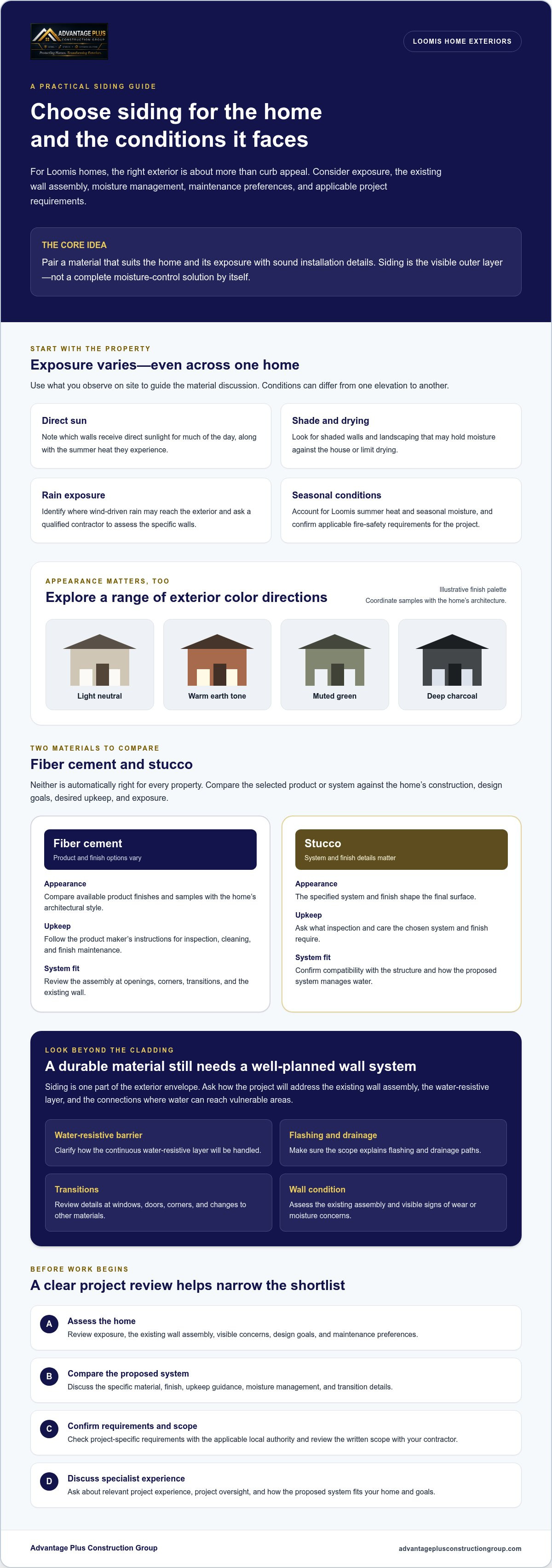
A good siding choice pairs a material suited to the home and its exposure with sound installation details. Siding is the visible outer layer of an exterior wall, not a complete moisture-control solution on its own. For a basic overview of its purpose and common materials, see Siding (construction).
What matters about a Loomis property’s exposure?
Loomis experiences inland summer heat and seasonal moisture, but exposure varies from property to property. Note which walls receive direct sun for much of the day, which stay shaded, where wind-driven rain may reach the exterior, and whether nearby landscaping holds moisture against the house or limits drying. Conditions can differ between elevations on the same home.
Use what you observe to guide material discussions rather than relying on broad regional assumptions. Ask a qualified contractor to examine the specific walls and identify visible signs of wear or moisture concerns. Any assumptions about a particular property’s conditions should be checked on site.
Why the wall system matters as much as the siding
The exterior envelope is the coordinated set of layers and connections that helps manage water and protect the structure. Siding forms part of that system; it shouldn’t be expected to make up for gaps or poor detailing beneath or around it. Even a durable material needs a compatible wall assembly and careful installation.
During an assessment, ask how the project will address the water-resistive layer and the details where walls meet windows, doors, corners, and other materials. Make sure the project scope clearly accounts for flashing, drainage paths, and transitions. These are not minor finishing details. They help direct water away from vulnerable areas.
For a closer look at the coordinated protection layers around a home, read this exterior envelope protection guide. Understanding the assembly first makes it easier to compare siding options on more than appearance and discuss a system suited to your home’s exposure and existing construction.
How fiber cement and stucco perform on Loomis homes
Fiber cement and stucco are two areas of Advantage Plus Construction Group’s expertise, but neither is automatically the right choice for every Loomis property. Compare them against the home’s existing construction, desired appearance, upkeep preferences, and the details of the complete wall system. Confirm performance and maintenance guidance for the specific materials being considered.
| Comparison point | Fiber cement | Stucco |
|---|---|---|
| Appearance | Available appearances depend on the selected product and finish; compare samples with the home’s architectural style. | Offers a distinct finished surface, with appearance shaped by the specified system and finish. |
| Upkeep | Follow the product maker’s instructions for inspection, cleaning, and finish maintenance. | Ask what inspection and care the specified system and finish require. |
| System details | Review how the proposed assembly meets openings, corners, and other transitions. | Confirm how the system is designed for the existing structure and how it manages water. |
| Fit for the home | Assess the existing wall assembly, exposure, and design goals before selecting a product. | Assess the structure, desired finish, and project-specific system details before proceeding. |
When fiber cement siding may suit a Loomis home
Fiber cement may be worth considering if its available appearance and care requirements suit your home and preferences. Product options vary, so ask for the specific manufacturer’s guidance rather than assuming all fiber cement has the same finish or maintenance needs. Advantage Plus specializes in fiber cement siding in the Sacramento region, including Loomis. Its fiber cement siding installation guide offers more background for your project discussion.
When a stucco system may suit a Loomis home
Stucco suitability depends on the structure, the finish you want, and how the proposed system is designed and detailed. Avoid relying on blanket promises about cracking, durability, or maintenance. Ask how those considerations apply to the specified system and what the product documentation says. Learn more in this professional stucco systems guide.
Wood and vinyl are other general siding alternatives, but they are not confirmed Advantage Plus offerings. Compare them only if they fit your goals and project requirements. Installation quality affects siding performance as much as material choice, because careful detailing helps the cladding work with the wall assembly to manage water. The best exterior siding for Loomis homes is a system matched to the property, not simply a material chosen from a sample.
Before deciding, discuss your home’s exposure, existing wall assembly, and project goals with a qualified specialist. A clear comparison of product documentation and installation scope can help you make an informed choice.
What should Loomis homeowners compare before choosing siding?
A fair comparison starts with your home, not a material label. The best exterior siding for Loomis homes depends on the property’s exposure, the condition of its walls, your preferred appearance, and how much ongoing care you’re prepared to take on. Rank your priorities before reviewing options, then ask a qualified exterior specialist to assess the wall condition and site-specific exposure.
Which performance criteria should you prioritize?
Use the same criteria to evaluate each candidate material. A consistent comparison makes it easier to see trade-offs instead of choosing based on one appealing feature or a broad performance claim.
- Exposure: Consider which walls receive direct sun, stay shaded, or face wind and rain.
- Wall condition: Ask what the assessment found and whether the existing assembly affects material suitability or project scope.
- Upkeep: Compare the inspection, cleaning, and finish-care instructions for the specific product or system.
- Appearance: Review samples in the context of your home’s design, rather than relying on a small sample alone.
- Protection: Understand how the proposed cladding works with the wall assembly and its water-management details.
Check performance and maintenance information against manufacturer documentation for the exact products proposed. Materials in the same broad category can have different instructions, finishes, and system requirements.
How to compare siding proposals fairly
Look beyond the material name. Two proposals may describe different preparation, detailing, and project responsibilities, so compare their written scopes line by line. Ask each contractor to clarify what is included and excluded before you evaluate the proposed work.
- How will existing siding be removed or the surface prepared, and how will the wall condition be addressed?
- What materials and water-management details are specified, including treatment of openings and transitions?
- What work is included in the project scope, and what exclusions or potential changes should you understand?
- Who manages the project, how will schedule changes be communicated, and what site-protection and cleanup steps are planned?
Keep the categories distinct. Manufacturer information describes material attributes; the proposal should explain installation practices; and contractor credentials should be verified separately. Promises about scheduling or project oversight are not a substitute for a clear written scope. Advantage Plus Construction Group’s project managers oversee material procurement, preparation, and installation, with attention to schedule and budget. For cost-planning detail, see the Sacramento siding installation investment guide.
How to plan a siding project for your Loomis property
A sound project plan moves in sequence: assess the home, confirm applicable requirements, select a siding system, review the written scope, then schedule the work. This order connects material choice to the wall’s condition and moisture-management details, while leaving time to resolve questions before work begins.
What should a contractor assess before recommending siding?
Ask the contractor to review the existing siding and visible wall condition, along with openings, trim, and water-management details. Discuss your property’s sun, shade, and wind exposure, the appearance you want, and how much maintenance fits your priorities. An initial visual assessment can identify visible concerns, but it can’t confirm concealed damage without further investigation. Ask how additional investigation would be handled if concerns arise.
Before the first conversation, gather photos and notes about existing damage, staining, areas that stay damp, and transitions such as window edges and changes between materials. This gives the discussion a useful starting point without assuming the cause of anything you’ve observed.
Which Loomis approvals and details should be confirmed?
Permit and code obligations depend on the project scope and the authority with jurisdiction over the property. Confirm requirements with the relevant Town of Loomis or Placer County office before work begins. Also ask whether current state or local provisions, including any site-specific fire requirements, apply to your project. Don’t assume a requirement applies, or doesn’t apply, based only on the neighborhood.
Once requirements and the proposed system are clear, review the written scope and confirm site logistics. Cover access, material staging, landscaping protection, schedule, preparation, water-management details, and cleanup. Specifics help set expectations and reduce avoidable surprises.
Bring this checklist to your initial contractor conversation:
- What did you observe about the siding, wall condition, openings, trim, and visible drainage or flashing details?
- How will the proposed system fit the home’s exposure, appearance goals, and maintenance preferences?
- What additional investigation may be needed to assess concealed conditions?
- Which permits or current code provisions should I confirm with the local authority?
- What preparation, materials, moisture details, cleanup, exclusions, and schedule will the written scope cover?
- How will access, staging, landscaping protection, and project changes be handled?
Advantage Plus Construction Group specializes in fiber cement siding, stucco systems, and exterior-envelope work in the Sacramento region, including Loomis. To discuss your existing wall assembly, exposure, and project goals, learn about exterior siding services.
Choosing a siding specialist for your Loomis home
A siding recommendation should start with your property, not a one-size-fits-all material pitch. Specialist experience can help connect the home’s existing construction and exposure to a suitable system, while clear project oversight and a detailed written scope make it easier to understand how the work will be carried out. No material or contractor can promise a particular outcome, but careful assessment and planning give you a stronger basis for your decision.
What should Loomis homeowners ask a siding contractor?
Ask the contractor to explain why the proposed material and system fit your home. Request the information supporting that recommendation, such as relevant manufacturer guidance and an explanation of how the proposed details address the existing wall assembly. A useful discussion should cover more than the finish: preparation, water management, transitions, and the project’s limits all matter.
- What about the home’s condition, exposure, and design goals informed this recommendation?
- How will the team handle preparation and water-management details, including around openings and transitions?
- Who will oversee the work, and how will scheduling, progress updates, and changes be communicated?
- Does the written scope identify proposed materials, exclusions, responsibilities, and approvals to confirm?
Review contractor credentials and relevant experience independently. A written scope should make clear what is included, what is excluded, and which project details still need confirmation. That clarity helps you compare proposals based on the work itself, not just the material name.
How Advantage Plus supports exterior renovation projects
Advantage Plus Construction Group specializes in fiber cement siding, stucco systems, and exterior-envelope work in the Sacramento region, including Loomis. These are areas of expertise, not a claim that one system is right for every home. Recommendations should reflect the property’s condition, exposure, appearance goals, and the installation details needed for the proposed assembly.
Project managers oversee material procurement, preparation, and installation, with attention to schedule and budget. That oversight provides a point of coordination as the work moves from planning to installation. Discuss how the proposed scope will address preparation and moisture-management details, and confirm project-specific requirements before work is scheduled.
The best exterior siding for Loomis homes is the system that fits the property and is supported by a clear, considered plan. To learn about discussing your home, goals, and possible next steps, view Advantage Plus Construction Group’s website.
Choose a siding system with confidence
The best exterior siding for Loomis homes is the option that fits the property, its existing construction, and your priorities for appearance and upkeep. Compare materials against the home’s actual exposure, but don’t stop at the surface: installation planning and moisture-management details are essential parts of a well-considered siding project.
A clear written scope helps you understand the proposed materials, preparation, responsibilities, and project sequence before work begins. Confirm applicable requirements with the relevant local authority, and ask how the recommendation accounts for your home’s wall assembly and goals.
Advantage Plus Construction Group specializes in fiber cement siding and stucco systems in the Sacramento region, serving Loomis and nearby communities including Roseville, Granite Bay, New Castle, Rocklin, Penryn, Citrus Heights, Orangevale, Fair Oaks, Carmichael, and Antelope. Its project managers oversee procurement, preparation, and installation, with attention to schedule and budget. To discuss your property and possible next steps, visit Advantage Plus Construction Group.
Start with the details of your home. A careful conversation can help turn uncertainty into a practical plan for lasting protection and a finish you’re proud of.
Frequently Asked Questions
What is the best siding material for a home in Loomis, California?
There’s no single best material for every Loomis home. The best exterior siding for Loomis homes depends on the property’s sun and weather exposure, existing wall assembly, appearance goals, and maintenance preferences. Compare options using product-specific information, and ask a qualified exterior specialist to assess the home before recommending a system. Consider how the siding will work with the wall’s moisture-management details, not just how the finished exterior will look.
Is fiber cement siding a good choice for Loomis homes?
Fiber cement may suit a Loomis home if its appearance, product-specific care requirements, and installation details fit the property. Performance and maintenance can vary by product, so check the manufacturer’s guidance for the exact material being considered. Ask how the proposed system will meet openings and transitions, and how it will work with the existing wall assembly. Advantage Plus Construction Group specializes in fiber cement siding, but suitability should be assessed home by home.
Is stucco suitable for every Loomis home?
No. Stucco suitability depends on the home’s structure, the desired finish, and the design of the proposed system. Before choosing it, ask a qualified specialist to assess the existing assembly and explain how the system’s details will manage water at openings and transitions. Avoid relying on blanket claims about cracking, durability, or maintenance; ask for information specific to the proposed system and confirm its care guidance with the manufacturer.
How do I choose between fiber cement and stucco siding?
Compare fiber cement and stucco against the same criteria: appearance, upkeep, existing wall condition, property exposure, and system details. Ask for product-specific maintenance information and a clear explanation of how each option fits your home. A contractor should connect the recommendation to the structure and installation plan, not simply name a material. Advantage Plus Construction Group specializes in both systems, but neither should be treated as the right choice for every property.
Can new siding help protect a home from moisture damage?
New siding can be part of a moisture-protective exterior, but siding alone isn’t a complete moisture solution. The wall assembly and its connections must also be considered, including water-resistive layers, flashing, drainage, and transitions around openings. Ask the contractor how the proposed system directs water away from vulnerable areas and what preparation is included. If there are visible signs of damage, ask whether further investigation is needed to assess concealed conditions.
Do Loomis homeowners need a permit to replace siding?
A permit is generally required for siding replacement in Loomis, but requirements can depend on the project scope and the authority responsible for the property. Before work begins, confirm the applicable permit and code requirements with the Town of Loomis or Placer County, as appropriate. Ask whether any current, site-specific fire provisions apply as well. Don’t rely on assumptions based only on the material or neighborhood.
How can I compare siding contractor proposals?
Compare written scopes, not just material names. Check whether each proposal explains preparation, materials, water-management details, exclusions, responsibilities, cleanup, and how scheduling or changes will be handled. Ask who will oversee the work, and verify relevant contractor credentials independently. Advantage Plus serves Loomis and nearby communities including Roseville, Granite Bay, New Castle, Rocklin, Penryn, Loomis, Citrus Heights, Orangevale, Fair Oaks, Carmichael, and Antelope. Clear documentation makes differences between proposals easier to understand.


