

Fire-resistant siding can strengthen one part of your home’s defenses, but it can’t protect the entire house on its own. Comparing fire resistant siding options Rocklin homeowners may consider means looking beyond the surface to how the exterior assembly is designed and installed.
It’s reasonable to want a clear answer about which materials resist ignition or heat. The comparison, though, isn’t simply “safe” versus “unsafe.” Material properties, installation details, and the areas where siding meets trim, openings, and other exterior components all matter. Fire resistance should be understood as risk reduction, not a guarantee of protection.
This guide compares fiber cement, stucco, metal, vinyl, and wood-based siding, and explains what material claims can and can’t tell you. You’ll also learn why preparation, transitions, and the wider exterior envelope deserve attention when planning a project. For Rocklin homeowners, the goal is a well-informed choice that balances resilience, appearance, and long-term performance. Advantage Plus Construction Group installs fiber cement siding and stucco systems, with project managers overseeing preparation and installation as part of the exterior renovation.
Key Takeaways
- Compare fire resistant siding options Rocklin homeowners may consider by looking beyond material claims to appearance, upkeep, moisture management, and project fit.
- Learn why siding can contribute to fire resistance without making a home fireproof, and which exterior transitions deserve attention.
- Use a practical checklist to review your existing exterior, set priorities, and locate current parcel-specific hazard information from official sources.
- See how project oversight, careful preparation, and installation planning can support a considered fiber cement or stucco project.
What Fire-Resistant Siding Can, and Cannot, Do for a Rocklin Home
Fire-resistant siding is exterior cladding selected for characteristics that may help reduce vulnerability to ignition or fire exposure. The term describes a material’s potential contribution, not a promise that a house will withstand every fire. For homeowners comparing fire resistant siding options Rocklin, that distinction matters: siding is one part of a wall, and the wall is one part of the home’s broader exterior envelope.
Cladding covers and protects the outside of a building, but its properties vary by material and installation. This siding material overview provides background on common cladding types. Evaluating fire-related performance requires looking beyond a material name to the specific product and installed assembly. Material selection, preparation, attachment, joints, and transitions all shape the finished result.
How siding contributes to exterior fire resistance
During a fire, exterior walls may be exposed to radiant heat, sparks, or windblown embers. Cladding can affect how the wall responds, but a material’s general characteristics don’t establish the performance of every wall made with it. Backing layers, gaps, joints, and installation details also matter. Review product and assembly documentation rather than relying on a broad material label or assuming a particular level of protection.
That’s why the comparison should be specific. Fiber cement and stucco are options Advantage Plus Construction Group installs, but the material name alone shouldn’t be treated as proof of a fire rating. A considered project looks at the intended product, its installation, and how the exterior wall connects to the rest of the home.
Why siding alone cannot protect every part of a home
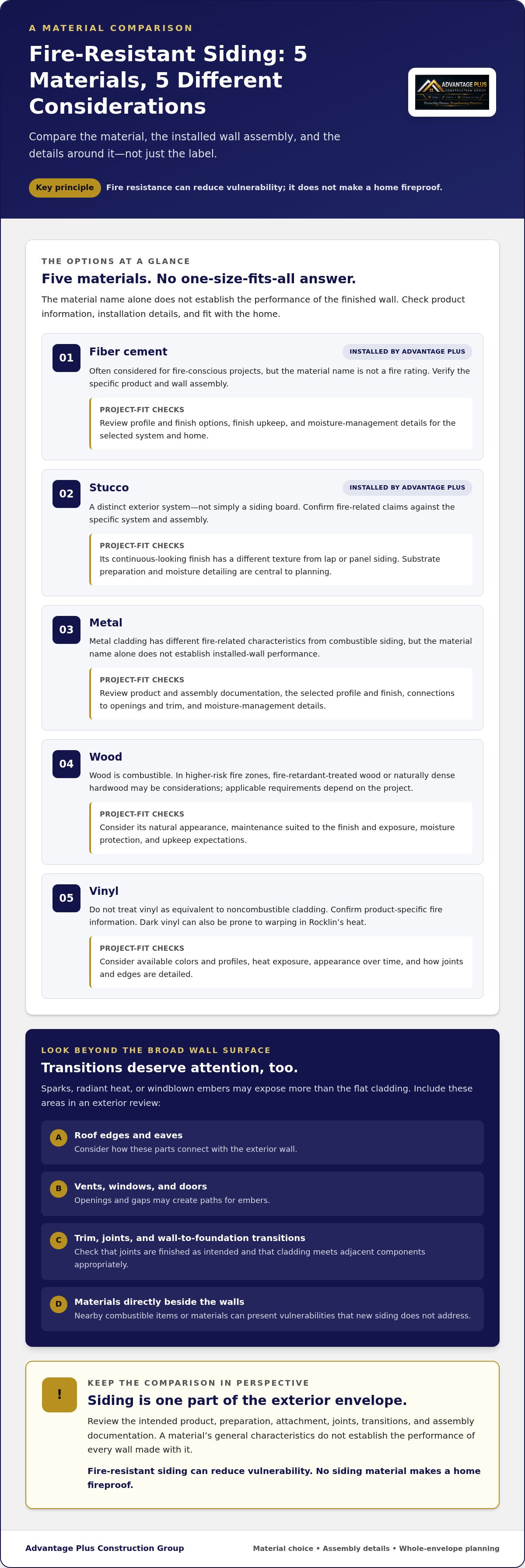
Fire exposure doesn’t stop at the wall’s broad, flat surface. Roof edges and eaves, vents, windows and doors, and the transition where the wall meets the foundation can all affect how the exterior performs. Openings and gaps may create paths for embers, while nearby combustible items or materials can present vulnerabilities that new siding doesn’t address.
In practice, an exterior review should consider how the cladding meets trim and openings, whether joints are finished as intended, and what materials sit directly beside the walls. Relevant concerns and requirements can vary by property. Rocklin homeowners shouldn’t assume every parcel faces the same hazard conditions.
Fire-resistant siding can reduce vulnerability, but no siding material makes a home fireproof. A stronger plan considers the complete exterior assembly and its vulnerable transitions, not just the visible cladding. This whole-envelope perspective helps homeowners make a more informed material choice and plan the work with care.
Comparing Fire-Resistant Siding Options for Rocklin Homes
A useful comparison separates a material’s fire-related characteristics from the performance of the finished wall. Fiber cement and stucco are options Advantage Plus Construction Group installs. Metal, wood, and vinyl have different material characteristics and may suit different priorities. For any option, review product information, installation details, and fit with the home. Use the table as a starting point, not a substitute for product-specific ratings or assembly documentation.
| Material | Fire-related consideration | Appearance, maintenance, moisture, and project fit |
|---|---|---|
| Fiber cement | Often considered for fire-conscious projects; don’t assume a particular rating from the material name alone. Verify the product and wall assembly. | Offers varied profiles and finishes. Review finish upkeep and moisture-management details for the selected system and home. |
| Stucco | A distinct exterior system, not simply a siding board. Confirm fire-related claims against the specific system and assembly. | Creates a continuous-looking finish with a different texture from lap or panel siding. Substrate preparation and moisture detailing are central to project planning. |
| Metal | Metal cladding has different fire-related characteristics from combustible siding, but the material name alone doesn’t establish the performance of the installed wall. Review product and assembly documentation. | Consider the selected profile and finish, how the system meets openings and trim, and the project’s moisture-management details. |
| Wood | Wood is combustible. In higher-risk fire zones, fire-retardant-treated wood or naturally dense hardwood may be considerations; applicable requirements depend on the project. | Provides a natural appearance but needs maintenance suited to its finish and exposure. Check moisture protection and upkeep expectations. |
| Vinyl | Don’t treat vinyl as equivalent to noncombustible cladding. Confirm product-specific fire information; dark vinyl can also be prone to warping in Rocklin’s heat. | Offers a range of colors and profiles. Consider heat exposure, appearance over time, and how joints and edges are detailed. |
Fiber cement siding: material performance and project fit
Fiber cement is a category, not a fire rating. Its suitability depends on the specific product and how the complete wall is assembled, so review technical documentation rather than relying on a broad label. For a closer look at planning and installation considerations, see this fiber cement siding installation guide. A project review should also account for desired appearance, finish maintenance, and water management around joints and openings.
Stucco and combustible siding: different trade-offs
Stucco’s system-based construction makes preparation and moisture detailing important parts of the decision. Wood and vinyl involve different material and heat characteristics, so don’t infer performance from appearance alone. CAL FIRE’s guidance on defensible space places siding within broader home-hardening measures. For any material, review product-specific fire claims and applicable assembly documentation.
Comparing fire resistant siding options Rocklin homeowners are considering is easier when fire-related performance, maintenance, moisture detailing, and visual fit are assessed separately. To discuss how fiber cement or stucco could fit your exterior project, connect about your Rocklin siding project.
Does Fire-Resistant Siding Address the Biggest Homeowner Concern?
Replacing siding alone does not make a home fireproof. A siding upgrade can be a meaningful part of a fire-conscious exterior project, but it addresses only one layer of the building. Outcomes depend on the fire exposure, the materials used, and how the complete assembly is detailed and installed. No siding choice can guarantee that a home will avoid damage.
What homeowners should expect from a siding upgrade
Think of siding as one component in a broader exterior strategy, not a standalone wildfire defense. A material selected for fire-related performance may help reduce vulnerability at the wall surface, yet openings, joints, and neighboring components influence how that wall performs as a whole. Consider product claims alongside installation details rather than treating them as a promise about the entire house.
For broader planning, CAL FIRE home hardening guidelines discuss measures that can make a home more resilient, including considering noncombustible or ignition-resistant options when replacing combustible siding. That guidance supports a layered approach; it doesn’t guarantee a particular result or insurance eligibility. Local hazard conditions and applicable requirements can vary by property, so don’t assume every Rocklin home has the same exposure or obligations.
Which surrounding details deserve attention
During project planning, review how the siding connects with the rest of the exterior. Eaves and soffits, vents, trim, windows, doors, utility penetrations, and the transition between siding and foundation all deserve attention. Gaps or exposed combustible materials at these locations may undermine the intent of a material upgrade. The goal is continuity: a carefully considered wall surface connected to adjacent features without overlooked weak points.
Those details also need to manage water. Flashing, drainage paths, clearances, and joints help keep moisture from damaging the wall assembly. Fire-conscious detailing shouldn’t compromise that function. A sound exterior project considers both demands together rather than changing a detail without accounting for how the wall sheds water.
Risk reduction depends on the complete, correctly installed assembly, not on siding material alone. That principle helps homeowners evaluate fire resistant siding options Rocklin more realistically: assess the cladding, its transitions, and the surrounding exterior as one coordinated system. Advantage Plus Construction Group’s exterior envelope protection guide offers additional context for understanding how those connected components support the home’s performance.
A Rocklin Homeowner’s Checklist for Evaluating Siding Options
A clear sequence can make an exterior project easier to plan. Use this checklist to connect your home’s current condition, your priorities, and the work required instead of choosing a material by name alone. If you’re comparing fire resistant siding options Rocklin, begin with what’s on the house and where the exterior needs attention.
Start with the home and its site conditions
- Review the existing exterior. Note siding damage, visible gaps, loose trim, worn joints, and signs of moisture such as staining or deterioration. Take photos from several sides of the home, including close-ups of areas that concern you.
- Check property-specific information. Review current fire-hazard maps and applicable requirements through relevant official local, county, or state sources. Conditions and designations can vary by address, so don’t assume a citywide description applies uniformly to your parcel.
- Define your priorities. Decide how you’ll weigh fire-related performance, appearance, maintenance, moisture management, and the project’s overall scope. Existing plans or records of past exterior work can provide useful context.
Compare scope as carefully as material
- Compare materials against those priorities. Consider fiber cement, stucco, and other options in relation to your home’s design and existing wall conditions. Review product documentation for fire-related claims instead of relying on general material labels.
- Assess the connected details. Look at how the proposed work addresses trim, openings, joints, wall-base transitions, and moisture management. The material is only one part of the finished exterior assembly.
- Plan the installation scope. Review whether preparation, removal or repair of existing surfaces, trim work, transitions, cleanup, and project oversight are described. Compare proposals by the work and assembly details they include, not simply by material name.
Scope can change with the home’s existing conditions. Hidden deterioration, complex transitions, or unusual architectural details may affect preparation and installation planning. Clear photos, available plans, and a short list of priorities give a project discussion a practical starting point and keep decisions focused on the property rather than assumptions about Rocklin homes as a whole.
With project managers overseeing material procurement, site preparation, and installation, Advantage Plus Construction Group brings structure to exterior work while keeping schedule and budget in view. Discuss your Rocklin exterior project and its siding and envelope priorities.
Plan a Fire-Conscious Siding Project with Advantage Plus Construction Group
A well-planned exterior renovation starts with the home itself. The right material needs to fit the existing structure, the homeowner’s priorities, and the details that connect each part of the exterior. Advantage Plus Construction Group installs fiber cement siding and stucco systems in Rocklin, helping homeowners consider these materials as part of a broader exterior project, not as a promise of fire protection.
How professional project oversight supports the exterior assembly
Project managers oversee material procurement, site preparation, and installation, with attention to schedule and budget. Coordinating these stages helps keep the work aligned with the agreed project scope, from preparing surfaces to installing the selected system. Planning also considers how cladding meets trim, openings, and other envelope details, so the visible finish and connected components receive attention together.
Careful preparation and workmanship support the long-term performance of an exterior, including its ability to manage moisture and remain properly assembled. They can’t guarantee how a home will perform in a fire. Evaluate material-specific claims and applicable requirements using the relevant product and project documentation.
Choose a next step for your Rocklin home
Before beginning, bring three decisions into focus: which material best fits your priorities, what site conditions the existing exterior presents, and what work the project scope needs to include. Photos of visible concerns and any available plans can make an initial project conversation more specific. If you’re weighing fire resistant siding options Rocklin homeowners may consider, a detailed review can help connect those choices to the needs of your home.
Advantage Plus Construction Group’s project managers oversee the process from procurement through installation, keeping preparation, scope, schedule, and budget in view. Discuss your priorities, questions, and exterior renovation goals with the team. Connect with Advantage Plus Construction Group to discuss your Rocklin siding project and plan a considered next step.
Make Your Rocklin Exterior Project a Thoughtful Next Step
Choosing among fire resistant siding options Rocklin homeowners are considering starts with clear expectations: siding can contribute to a fire-conscious exterior, but it can’t make a home fireproof. Material characteristics matter, as do installation quality, transitions, openings, and the condition of the existing exterior. A sound decision weighs those details alongside appearance, maintenance, and project scope.
Advantage Plus Construction Group specializes in fiber cement siding and stucco installation in Rocklin and across the Sacramento region. Project managers oversee procurement, preparation, and installation, keeping the work coordinated with the project’s schedule and budget. Careful planning supports lasting exterior performance without promising a particular fire outcome.
Ready to consider the right materials and scope for your home? Discuss your Rocklin siding project with Advantage Plus Construction Group. A clear conversation is a practical first step toward an exterior renovation planned with care and confidence.
Frequently Asked Questions
Is fiber cement siding fire-resistant?
Fiber cement may offer fire-related advantages, but whether a particular siding qualifies as fire-resistant depends on its exact product specifications and verified testing or rating. A category-level label isn’t enough to establish how a wall performs. The installed assembly, including backing, joints, attachment, and transitions, also matters. Review manufacturer documentation for the specific product and assembly being considered, and don’t treat any siding as fireproof.
What is the best fire-resistant siding for a home in Rocklin?
There isn’t one best option for every Rocklin home. Comparing fire resistant siding options Rocklin homeowners may consider means weighing verified product performance alongside the home’s existing walls, moisture needs, appearance, maintenance preferences, and installation details. Fiber cement and stucco are both worth evaluating, but performance depends on the specific system and assembly, not just the material name. Parcel conditions can differ, so review address-specific hazard information and applicable requirements before defining project scope.
Can fire-resistant siding alone protect a home from wildfire?
No single siding upgrade guarantees protection from wildfire. Siding is one part of the exterior, and vulnerable details may include eaves, vents, windows, doors, penetrations, and transitions between materials. Gaps or combustible materials close to the home can also affect the overall picture. Consider the complete exterior and surrounding conditions when planning improvements. A more fire-conscious siding choice can contribute to risk reduction, but it can’t make a home fireproof.
Is stucco fire-resistant?
Stucco is a material category used in an exterior system, but that label alone doesn’t establish a fire rating for every assembly. Performance depends on the specific system, its components, how it’s installed, and any verified test documentation. If fire-related performance is a priority, review specifications for the proposed system rather than assuming all stucco walls perform identically. Preparation, joints, transitions, and moisture management remain important parts of a sound exterior project.
Does fiber cement siding melt or burn?
There isn’t a reliable blanket answer for every fiber cement product or wall assembly. Check the manufacturer’s documentation for the specific product, including any verified fire testing or ratings, and distinguish those results from assumptions about an entire installed wall. Fire exposure, surrounding materials, backing, joints, and installation details can affect assembly performance. Fiber cement siding shouldn’t be described as fireproof without evidence, and no material eliminates the risk of fire damage.
Do Rocklin homeowners need WUI-compliant siding?
Not every home automatically has the same WUI requirements; applicability depends on parcel location, project details, and current rules. California’s 2025 WUI Code took effect January 1, 2026, with the new code applying to permit applications submitted on or after that date. Homeowners in Rocklin, Roseville, Granite Bay, New Castle, Penryn, Loomis, Citrus Heights, Orangevale, Fair Oaks, Carmichael, and Antelope should check current official city, county, and state sources for their address and project.
Will fire-resistant siding lower my home insurance premium?
It may not. Insurance coverage, eligibility, and discounts are determined by each insurer and policy, so a siding upgrade can’t guarantee a lower premium. Keep product information and project documentation that accurately describe the materials and work completed. Those records can help you provide details to your insurer, but they aren’t the same as insurance approval or a promise of savings. Ask your insurer how it evaluates exterior improvements for your specific policy.


