

Your home's most expensive problem isn't the storm you can see; it's the moisture you can't. Most homeowners believe a new layer of paint or a quick patch solves their exterior issues. However, the reality is often more complex. A true building envelope failure is rarely about one bad product. It's almost always a breakdown in the transitions between your siding, windows, and foundation. You deserve a home that stands as a fortress against the elements. It's exhausting to worry about hidden rot, rising repair costs, or whether your contractor actually understood moisture management.
We're here to replace that anxiety with professional certainty. This guide explores how to identify, prevent, and remediate failures to protect your property's value. You'll discover the critical difference between product defects and installation errors. We'll examine the early warning signs of damage, the implications of the 2025 California Building Energy Efficiency Standards, and the steps to choosing a specialized partner. It's time to move beyond temporary fixes toward permanent, disciplined craftsmanship. Let's secure your investment for the long term.
Key Takeaways
- View your home as a single, integrated system where the roof, walls, and foundation work in unison to defend against environmental threats.
- Learn to distinguish between simple product defects and a complex building envelope failure caused by improper installation and poor moisture management.
- Understand how Sacramento's intense heat and heavy seasonal rains create unique structural stresses like thermal expansion and stucco cracking.
- Spot the subtle, often invisible indicators of moisture intrusion, such as interior odors or exterior bubbling, before they evolve into high-cost repairs.
- Gain the clarity needed to choose a specialized expert who focuses on the long-term health of your structure rather than superficial upgrades.
What is a Building Envelope Failure?
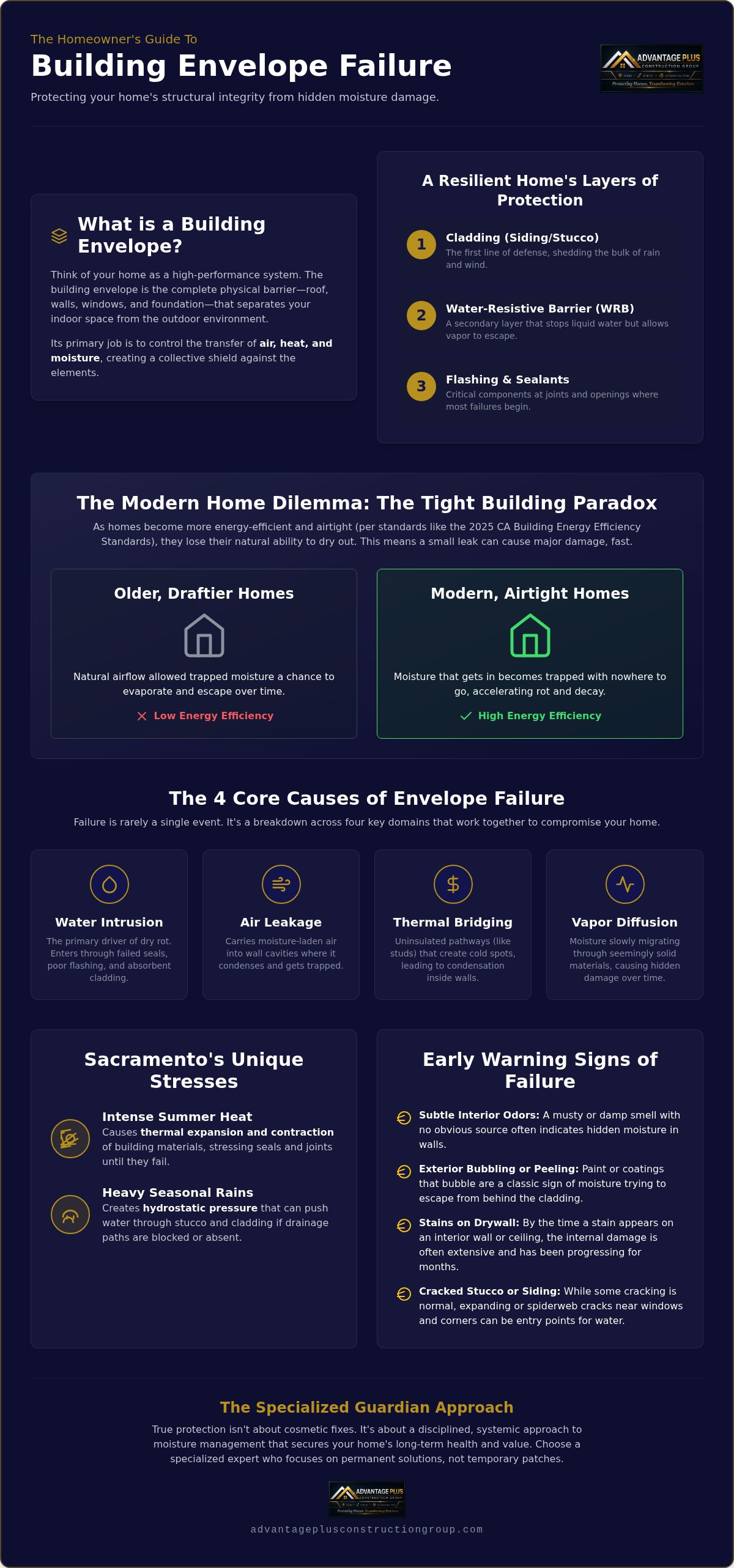
Think of your home as a high-performance vault. The building envelope is the physical separator between your conditioned living space and the unconditioned outdoor environment. It is not merely a single layer of material. It is a sophisticated, integrated system where the roof, walls, windows, and foundation act as a collective shield. To understand the foundational science of this system, one might ask: What is a Building Envelope? Essentially, it is the boundary that manages the transfer of air, heat, and moisture. When this boundary loses its ability to perform these functions, a building envelope failure occurs.
The danger of this failure lies in its stealth. Structural damage rarely announces itself with a dramatic event. Instead, it begins quietly behind your cladding, hidden from view by your fiber cement siding or stucco. What starts as a microscopic breach in a window seal can evolve into a systemic compromise that threatens the very bones of your property. By the time you see a stain on the drywall, the internal rot has often been progressing for months or even years.
The Components of a Healthy Exterior System
A resilient home relies on a disciplined hierarchy of protection. Each layer must be installed with precision to ensure longevity and defense. These components include:
- Cladding: This is your first line of defense. Whether you choose professional stucco systems or durable fiber cement siding, the cladding sheds the bulk of rain and wind.
- Water-Resistive Barrier (WRB): Located directly behind the cladding, this secondary layer allows vapor to escape while preventing liquid water from reaching the wooden studs.
- Flashing and Sealants: These are the critical transition points. Most failures originate at the joints, corners, and openings where different materials meet.
Why Modern Homes are More Vulnerable
There is a unique challenge in contemporary construction often called the "Tight Building Paradox." As energy codes become more stringent, such as the 2025 California Building Energy Efficiency Standards, homes are built to be increasingly airtight. This is excellent for your utility bills, but it leaves very little room for error. In older, draftier homes, moisture could eventually dry out through natural airflow. In a modern, high-efficiency home, trapped moisture has nowhere to go. This leads to a rapid building envelope failure that can cause structural decay much faster than in homes built decades ago. Understanding the difference between cosmetic wear and a functional, systemic failure is the first step toward securing your investment.
The 4 Core Causes of Envelope Failure
A building envelope failure is rarely a single, catastrophic event. It is a slow, methodical breakdown across four key physical domains: water intrusion, air leakage, thermal bridging, and vapor diffusion. While each operates differently, they often work in tandem to compromise your home. Water is the most immediate threat, but uncontrolled air leakage carries moisture into wall cavities where it cannot escape. Thermal bridging creates cold spots that invite condensation, and vapor diffusion allows moisture to migrate through solid materials. When these forces are not managed, the structural integrity of your property is at risk.
Modern homes face a unique challenge known as the "Tight Building Paradox." In our pursuit of extreme energy efficiency, we have created structures that are incredibly airtight. This is excellent for climate control, but it eliminates the home's natural ability to breathe or dry out. If moisture enters a modern wall assembly through a small defect, it remains trapped. This lack of drying potential means that even a minor breach can lead to rapid structural decay. Professionals rely on the Building Envelope Design Guide to navigate these complexities and ensure that efficiency does not come at the cost of durability.
Water: The Silent Destroyer
Water is the primary driver of dry rot. It is patient, and it is relentless. True security does not come from trying to make a house "waterproof," which is largely a myth. Instead, it comes from disciplined moisture management and clear drainage planes. In many stucco systems, hydrostatic pressure can actually push moisture through the material if there is no path for it to escape. When flashing at window headers is missing or incorrectly lapped, it directs runoff behind the cladding rather than shedding it away. Our exterior envelope services focus on creating these essential exit paths for water, ensuring it never stays long enough to do damage.
Poor Detailing and Installation Errors
The most common cause of failure is not a bad product, but a bad transition. Generalist contractors often miss the nuances where different materials meet. Detailing is the precision work performed at joints, edges, and material intersections to ensure a continuous and functional seal. Common errors include missing kick-out flashing at roof-to-wall intersections or improperly lapped water-resistive barriers. These mistakes are usually invisible to the naked eye. They require a specialized eye to detect and a disciplined hand to correct. By prioritizing these transitions, we move from temporary fixes to long-term structural security.
Sacramento Specifics: Why Local Homes Fail
Sacramento's weather is a study in extremes. We experience intense, unrelenting summer heat followed by heavy, concentrated winter rains. This cycle is a primary driver of building envelope failure in our region. The Sacramento sun acts as a catalyst for material fatigue. When materials are subjected to temperatures exceeding 100 degrees for days on end, they undergo significant thermal expansion. Stucco and siding shift, pull, and stretch. When the temperature drops at night, they contract. Over time, this constant movement creates microscopic fissures at the most vulnerable points: the transitions.
These breaches are more than cosmetic flaws. They are open invitations for moisture and local pests. In the Sacramento Valley, dry rot is a constant threat because our winter rains provide the perfect environment for fungi to thrive in trapped wall cavities. A building envelope failure doesn't just let water in; it creates a habitat for invasive issues including:
- Subterranean termites that seek out moist, softened wood.
- Wood-boring beetles that thrive in high-humidity wall cavities.
- Fungal growth that accelerates the decay of structural framing.
Stucco Vulnerabilities in Northern California
Traditional stucco is a beloved aesthetic in our area, but it is highly susceptible to intense UV exposure. The "Sacramento Heat" causes the material to become brittle over time. Hairline cracks often appear first. A specialized guardian understands that these cracks are not just surface-level issues; they are the entry points for structural compromise. Water enters these cracks during our winter storms and becomes trapped behind the finish. For homeowners looking to restore or install these systems correctly, consulting experienced stucco contractors Sacramento CA is essential to ensure proper drainage planes are in place.
Siding Performance in Roseville and Granite Bay
In communities like Roseville and Granite Bay, many older homes still rely on traditional wood siding. Over decades, poor moisture barriers lead to "soft" spots where the wood has begun to lose its structural density. Homeowners in Granite Bay often see these failures manifest as paint bubbling or cedar shingles that feel spongy to the touch. The humidity levels in coastal-influenced valleys like Rocklin and Loomis can further complicate this. Moisture lingers in the air and settles into unsealed joints. This is why fiber cement siding installation Sacramento has become the gold standard for local durability. It offers the permanence, defense, and environmental resistance needed to withstand our unique climate without the warping associated with organic materials.
Detecting the Invisible: Signs of Failure
A building envelope failure is a master of disguise. Because the damage typically occurs within the wall cavity, homeowners often miss the early warning signs until the structural compromise is advanced. Vigilance is your best defense. By learning to recognize the subtle fingerprints of moisture intrusion, you can transition from reactive anxiety to proactive protection. These clues manifest across your home's interior, exterior, and even your monthly utility statements.
- Interior Clues: Look for peeling wallpaper, unexplained musty odors, or mold growth specifically near baseboards and window sills.
- Exterior Clues: Bubbling paint on siding usually indicates moisture is trying to escape from behind the board. Warped siding planks or dark, vertical streaks on stucco are also clear indicators of drainage failure.
- Structural Clues: If windows or doors that previously moved freely are now sticking or no longer align with their frames, it may suggest moisture-induced swelling or shifting in the sub-structure.
- Performance Clues: Unexplained spikes in your heating and cooling costs often point to compromised insulation or air leakage within the envelope system.
The 5-Minute Home Exterior Audit
You don't need specialized tools to perform a preliminary check of your home's defenses. Start by inspecting the "penetrations." These are the points where dryer vents, hose bibs, and light fixtures break the surface of your siding or stucco. If the sealants are cracked or missing, water has a direct path to your framing. Next, look for "efflorescence," which appears as white, powdery salt deposits on stucco. This is a sign that water is moving through the material and bringing minerals to the surface. Finally, inspect the ground-to-wall transition. Ensure there is adequate clearance between the soil and your cladding to prevent moisture wicking into the wall assembly.
When to Call an Exterior Envelope Contractor Sacramento
It's tempting to view a hairline crack or a small patch of bubbling paint as a cosmetic nuisance. However, a specialized guardian understands that these are symptoms of a systemic building envelope failure. Waiting "one more season" to address these signs often triples the eventual repair cost as rot spreads to the structural studs. A professional moisture management assessment provides the technical clarity needed to stop damage in its tracks. If you suspect your home's shield has been breached, it's time to schedule a professional envelope evaluation. Doing it right the first time is the only way to ensure the long-term health and value of your property.
Advantage Plus: The Specialized Guardian Approach
Defending your home requires more than a cosmetic update. While a general contractor might focus on the "skin" of a building, we prioritize the entire integrated system. A building envelope failure is often the result of a singular focus on aesthetics at the expense of structural science. We reject this superficial approach. Our team functions as a specialized guardian for your property, ensuring that every layer of your home's exterior works in perfect harmony. We combine technical expertise with a disciplined commitment to moisture management, protecting your investment from the inside out.
Our process is rooted in specialized project management for every job we undertake. In Sacramento, Roseville, and Granite Bay, we've seen how the lack of professional oversight leads to catastrophic results. We don't believe in shortcuts. Instead, we follow a methodical, unhurried path that builds confidence step-by-step. By focusing on durable fiber cement and professional stucco systems, we provide a level of environmental resistance that generalists simply cannot match. We take the weight of responsibility off your shoulders, allowing you to transition from anxiety about hidden rot to the peace of mind that comes with high-quality protection.
Precision in Every Transition
The integrity of your home's shield is won or lost at the transitions. Our project managers maintain a relentless focus on the critical flashing and barrier steps that most installers overlook. We operate according to the Advantage Plus Triplet: durability, aesthetics, and structural security. These three qualities must exist in balance for a project to be successful. We ensure that every window seal, roof-to-wall intersection, and ground-level transition is executed with surgical precision. This disciplined attention to detail prevents the moisture traps that lead to a building envelope failure, ensuring your home remains a fortress against the elements.
Securing Your Investment
An exterior renovation is one of the most significant investments you'll make in your property. It shouldn't be a temporary fix. By choosing specialized expertise in siding and stucco, you're securing the long-term value and structural health of your home. We're deeply committed to the Sacramento community and believe in doing it right the first time. Our work is designed for permanence, utilizing premium materials like fiber cement to provide a lasting defense against thermal expansion and winter rains. You deserve the satisfaction of ownership that comes from professional standards. If you're ready to move beyond superficial upgrades toward true structural security, contact us today for a comprehensive exterior evaluation. Let's build a legacy of protection for your home.
Securing Your Property for the Long Term
Your home represents a significant financial and emotional investment. Protecting that investment requires moving beyond superficial repairs toward a disciplined, systems-based approach. We've explored how a building envelope failure often stems from poor material transitions and the unique environmental stresses of the Sacramento climate. By recognizing the subtle signs of moisture intrusion early, you prevent minor breaches from becoming systemic structural crises.
True security comes from partnering with specialized Sacramento exterior experts who prioritize moisture management, premium fiber cement, and professional stucco solutions. Our dedicated project management oversight ensures that every flashing detail and barrier layer is executed with precision. We reject shortcuts in favor of craftsmanship that stands the test of time. Don't wait for hidden damage to compromise your home's integrity. Take the weight of responsibility off your shoulders and gain the peace of mind that comes with a high-quality defense.
Secure Your Home with a Professional Envelope Evaluation
Frequently Asked Questions
What is the most common cause of building envelope failure?
Improperly installed flashing and sealants at material transitions are the primary causes of building envelope failure. While many homeowners blame the siding itself, the breach usually occurs where the cladding meets windows, doors, or rooflines. When these joints aren't sealed with surgical precision, moisture enters the wall cavity and becomes trapped. This leads to hidden dry rot and structural decay that remains invisible until the damage is extensive and costly to remediate.
Can a building envelope failure be fixed without replacing all the siding?
Remediation is possible through localized repairs if the failure is caught in its earliest stages. However, if moisture has migrated deep into the wall cavity or compromised the structural studs, a partial fix often masks the underlying problem. A specialized expert evaluates the moisture levels behind the cladding to determine if a targeted repair is viable. Often, replacing the affected section and upgrading the flashing is necessary to ensure the system's long-term integrity.
How do I know if my stucco is failing or just has normal cracks?
Normal hairline cracks are usually less than 1/16 of an inch and don't necessarily indicate a systemic failure. You should be concerned if you see wider gaps, bubbling paint, or white powdery deposits known as efflorescence. These signs suggest that water is moving through the stucco and pulling minerals to the surface. If the cracks are accompanied by interior musty odors or damp baseboards, the envelope system has likely been breached and requires a professional assessment.
Does a building envelope failure affect my home’s resale value?
A building envelope failure can significantly decrease your property's resale value and complicate the closing process. During a home inspection, evidence of moisture intrusion or dry rot often triggers a requirement for extensive repairs before a sale can proceed. Buyers are increasingly wary of structural issues that suggest poor maintenance. Proactively addressing these vulnerabilities with premium materials like fiber cement protects your investment and provides the documented security that modern home buyers demand.
How long does a typical building envelope system last?
A typical building envelope system lasts between 20 and 50 years depending on the materials and the quality of the initial installation. While traditional wood siding may require significant maintenance every five to ten years, premium fiber cement systems are engineered to last 30 years or more. Professional stucco systems can also provide decades of service if the drainage planes are managed correctly. Regular inspections of sealants and flashing points are essential to reaching this life expectancy.
Is building envelope failure covered by homeowners insurance?
Most homeowners insurance policies do not cover building envelope failure because it is categorized as gradual damage or a maintenance issue. Insurance typically applies to sudden and accidental events, such as a pipe bursting or a tree falling. Slow moisture intrusion caused by improper flashing or aging sealants is usually the responsibility of the property owner. This makes regular professional evaluations a critical part of your financial strategy for long-term property protection and risk management.
What is the difference between a siding contractor and an envelope specialist?
A siding contractor typically focuses on the aesthetic "skin" of the home and the speed of installation. In contrast, an envelope specialist acts as a specialized guardian who understands the complex physics of air, heat, and moisture transfer. Specialists prioritize the critical transitions, drainage planes, and water-resistive barriers that exist behind the cladding. This disciplined approach ensures that your exterior doesn't just look beautiful but functions as a permanent, high-performance defensive system for your structure.


