

Your home's most dangerous enemy isn't the intense Sacramento sun; it's the silent, invisible moisture creeping behind your wood planks right now. You've likely spent years worrying about soft spots on the trim or peeling paint that refuses to stay fixed. It's exhausting to invest in your property only to feel like you're losing a slow battle against structural decay. We understand that anxiety. You want a home that stands firm, looks beautiful, and requires zero guesswork. This is why choosing fiber cement siding for dry rot prevention Sacramento is the most disciplined choice for long-term security. You're about to learn how a specialized installation creates a permanent moisture shield to protect your home's structural integrity for decades. We'll examine the technical nuances of the building envelope, the requirements of the 2025 California Wildland-Urban Interface Code, and the precise drainage planes that turn your exterior into a fortress. It's time to transition from temporary fixes to a once-and-for-all solution that preserves your investment and your peace of mind.
Key Takeaways
- Identify the environmental factors in Sacramento that trigger dry rot and why standard wood siding fails to protect your structural investment.
- Discover the inorganic science behind fiber cement that prevents fungi and insects from compromising your home's exterior.
- Learn how specialized fiber cement siding for dry rot prevention Sacramento creates a permanent moisture shield through advanced weather-resistive barriers.
- Master the critical flashing techniques that divert water from windows and doors to maintain a perfectly dry building envelope.
- Understand why professional project oversight is the only way to ensure every technical detail is executed with absolute precision.
The Dry Rot Crisis: Why Sacramento Homes Are at Risk
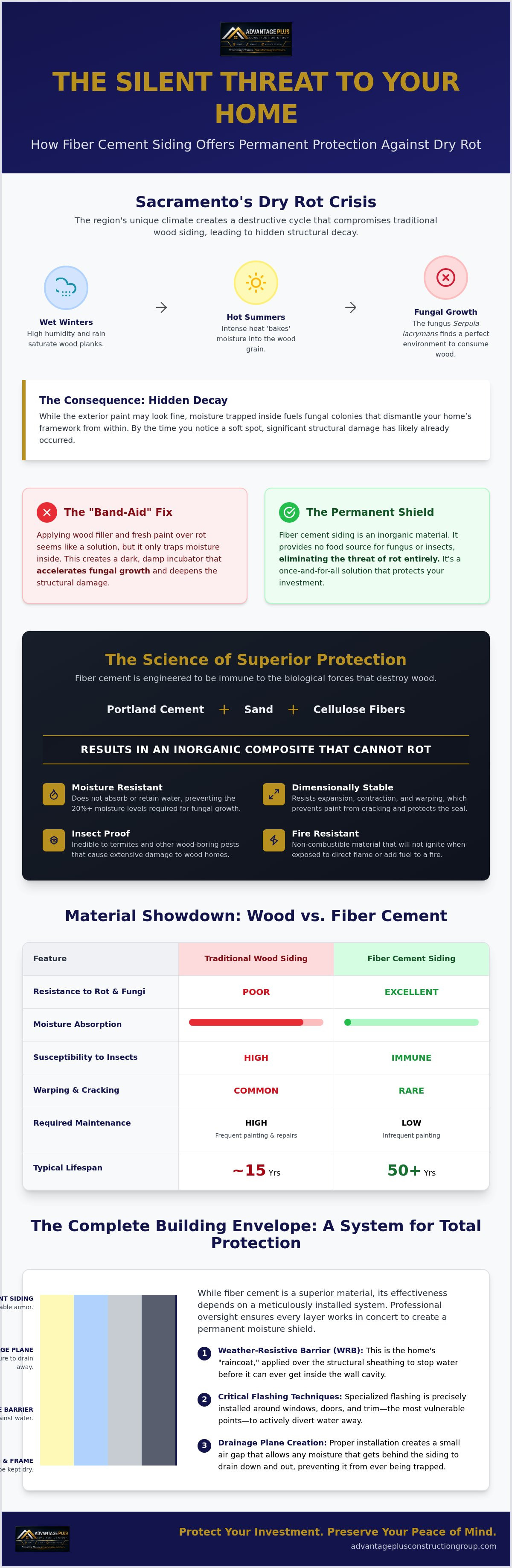
Dry rot is a biological intruder. It doesn't just sit on the surface; it consumes. In the Sacramento region, the wood-destroying fungus known as Serpula lacrymans finds a perfect laboratory within the walls of aging residential structures. This isn't a simple case of weathering. It's a specialized form of decay that transports moisture through its own tubular system, allowing it to rot even seemingly dry wood far from the original water source. For homeowners in Roseville and Granite Bay, this often leads to a harsh reality: traditional wood siding rarely survives past the 15-year mark without significant structural compromise. Investing in fiber cement siding for dry rot prevention Sacramento is not just a cosmetic choice; it's a structural necessity for long-term security.
The danger is rarely visible at first glance. We call it the "Hidden Decay" factor. While the exterior may appear pristine under a fresh coat of latex paint, the moisture trapped within the wood fibers provides the ideal environment for fungal colonies to dismantle your home's framework from the inside out. By the time you notice a soft spot or a crumbling corner, the damage has likely permeated the structural beams. This deferred maintenance doesn't just threaten your safety; it aggressively erodes property values in the competitive Sacramento market. A home with a compromised building envelope is a liability, not an asset.
Sacramento's Unique Moisture-Dry Cycle
Sacramento's climate creates a relentless pressure cooker effect on porous building materials. During our wet winters, standing water and high humidity saturate wood planks and trim. When the intense summer heat arrives, it doesn't just dry the wood; it "bakes" the trapped moisture into the grain. This cycle of expansion and contraction creates micro-fissures in the wood's seal. In localized areas like Fair Oaks and Orangevale, where mature tree canopies keep homes shaded and damp for longer periods, the rate of exterior decay is significantly higher. Unlike traditional timber, Fiber cement siding is engineered to withstand these biological pressures without absorbing the water that fuels fungal growth.
The Limitations of Temporary Repairs
Many homeowners attempt to combat rot with wood filler and a fresh layer of paint. These are "band-aid" solutions that often accelerate the problem. By sealing the surface without addressing the internal moisture, you're effectively trapping the fungus in a dark, damp incubator. Ignoring soft spots in fascia, soffits, or window sills is a gamble with the structural integrity of your property. True protection requires a transition from anxiety-driven repairs to a permanent exterior shield. You need a solution that removes the biological food source for rot entirely, providing the disciplined protection your investment deserves.
Why Fiber Cement is the Ultimate Shield Against Decay
True structural security begins with material science. While wood relies on chemical treatments that eventually leach away, fiber cement is inherently resistant to the biological processes that destroy Sacramento homes. This material is a high-performance composite of Portland cement, sand, and cellulose fibers. By removing the organic "food source" that fungi require to survive, fiber cement siding for dry rot prevention Sacramento provides a defensive perimeter that simply cannot be breached by rot. We view this as the "Specialized Guardian" approach; we choose materials that prioritize your home's long-term health over the temporary convenience of cheaper, more porous alternatives.
Fungi and wood-boring insects are opportunistic. They seek out damp, soft fibers to colonize and consume. The science of wood decay and prevention confirms that once moisture levels in timber exceed 20 percent, the structural integrity of the wood begins to fail. Fiber cement solves this by being almost entirely inorganic. It doesn't absorb water like cedar or pine, and it doesn't provide the nutrients necessary for fungal growth. This creates a permanent moisture shield that remains effective even during the wettest Sacramento winters.
Dimensional stability is another critical factor in preventing decay. When wood siding absorbs moisture, it expands; when the sun hits it, it contracts. This constant movement shears the paint bond, creating microscopic cracks where water can enter. Fiber cement is remarkably stable. It resists the thermal expansion and contraction that plagues other materials, ensuring your paint seal remains intact for years. This stability protects the underlying building envelope from the "hidden decay" that often goes unnoticed until it's too late.
Fiber Cement vs. Wood and Vinyl
The choice between materials often comes down to how they handle Sacramento's environmental stress. Wood siding is beautiful but high-maintenance; it requires frequent staining and sealing to prevent saturation. Vinyl siding is often marketed as low-maintenance, but it lacks the rigidity to act as a true structural shield. Its "weep holes" can actually trap moisture against your home's sheathing if not installed perfectly. Our detailed comparison of Fiber Cement vs Vinyl Siding highlights why a rigid, cementitious barrier is the superior choice for rot prevention.
The James Hardie Standard in Sacramento
We specifically utilize James Hardie products because of their HardieZone technology, which is engineered for the specific climatic demands of Northern California. Beyond its rot resistance, fiber cement is a non-combustible, rot-resistant composite that meets the rigorous requirements of the 2025 California Wildland-Urban Interface (WUI) Code. This provides a dual layer of protection against both moisture and fire, two of the greatest threats to local properties. Consulting with an expert for a professional building envelope assessment is the most reliable way to ensure your home is equipped with this level of defense.
Step-by-Step Fiber_Cement_Plank_Siding_Installation for Rot Prevention
Installation is more than a sequence of tasks. It is a disciplined execution of a moisture-management strategy. For homeowners seeking fiber cement siding for dry rot prevention Sacramento, the process begins long before the first plank is leveled. We treat every project as a forensic recovery, ensuring the underlying structure is sound before we apply the final armor. Our approach is methodical, logical, and uncompromising. We don't just replace siding; we rebuild the building envelope to ensure your home remains a fortress against the elements for decades.
Substrate Inspection and Dry Rot Removal
We never install new siding over "punky" or soft wood. Doing so merely hides the infection and guarantees a future failure. In areas like Rocklin and Loomis, where older homes may have suffered from years of neglected maintenance, we meticulously strip away failing layers to inspect the structural sheathing. If we find rot, we replace it. This ensures a clean slate, providing a stable, dry foundation that allows the new exterior to perform at its maximum potential. It's a matter of professional pride to ensure the bones of your home are as healthy as the new skin we're providing.
Once the substrate is secured, we install a high-grade Weather Resistive Barrier (WRB). This isn't just house wrap; it's a sophisticated membrane designed to allow vapor to escape while blocking liquid water from entering. We overlap all seams and flash every penetration to create a continuous drainage plane. This secondary line of defense is vital. It protects the structural frame from the rare moisture that might migrate past the primary siding layer during extreme weather events.
Precision Cutting and Nailing Techniques
Accuracy is paramount in creating a permanent moisture shield. We use specialized shears rather than traditional saws to ensure crisp, clean edges while significantly reducing dust. This precision allows us to maintain the strict 1/8-inch gap required at trim junctions, which we then seal with high-performance, flexible sealant. We employ "blind nailing" techniques, driving fasteners through the top of the plank where the subsequent course will cover them. This prevents water entry through nail heads, eliminates unsightly rust streaks, and preserves the aesthetic integrity of the finish.
Proper layout involves more than just straight lines. We integrate starter strips and maintain specific air-gap clearances at rooflines and decks to ensure proper drainage. This prevents the capillary action that pulls moisture into the wall cavity. By combining advanced caulking with seamless trim integration, we complete the building envelope. The result is a home that offers the triple benefit of structural performance, environmental resistance, and lasting beauty.
The Building Envelope: Critical Moisture Management Techniques
Siding alone is not enough. To achieve true fiber cement siding for dry rot prevention Sacramento, we must look beyond the planks to the building envelope. This system of layers works in unison to shed water, block air infiltration, and allow moisture vapor to escape. Without a disciplined approach to flashing and drainage, even the highest quality materials will eventually fail. We focus on the technical nuances that generalists often overlook, ensuring every transition point is a barrier rather than an entry point for decay.
Kick-out flashing is perhaps the most critical yet frequently omitted detail in residential construction. This small piece of metal diverts water away from the wall where a roofline terminates against a vertical surface. Without it, water cascades directly into the wall cavity, leading to catastrophic rot at the base of the structure. Similarly, Z-flashing above windows and doors is non-negotiable. It creates a physical path for water to exit the wall system rather than seeping behind the trim. These details are the difference between a temporary upgrade and a permanent moisture shield.
Water Management Behind the Planks
A continuous moisture barrier is the backbone of a resilient exterior. We utilize advanced seam tape and high-performance flashing to ensure the Weather Resistive Barrier (WRB) remains unbroken around every corner and penetration. Relying on "caulk-only" methods is a mistake in Sacramento's extreme weather cycle. Over time, heat and UV exposure cause caulk to shrink and crack, creating invisible pathways for moisture. Our process for Fiber Cement Siding Installation Sacramento prioritizes mechanical flashing over chemical sealants to ensure long-term structural performance.
The Rain Screen principle further enhances this protection. By maintaining a small air gap between the siding and the WRB, we allow the building to "breathe." This gap facilitates drainage and promotes airflow, drying out any incidental moisture before it can fuel fungal growth. It's a sophisticated approach that aligns with the 2025 California Building Standards Code (Title 24), which mandates a continuous drainage plane behind all new siding to create a permanent moisture shield.
Trim and Joint Protection
We recommend using fiber cement trim to create a unified, rot-proof exterior. Unlike wood trim, which often absorbs water at the joints, cementitious trim remains stable and inorganic. When handling butt joints, we use back-flashing rather than just caulk to ensure water cannot penetrate the seam. The building envelope is only as strong as its weakest flashing. To ensure your home is fully protected, you should consult with an exterior envelope specialist who understands these high-stakes details. This level of oversight guarantees your investment is secured against the silent threat of structural decay.
Securing Your Investment: Professional Oversight and Long-Term Care
A premium exterior is more than the sum of its parts. It is the result of disciplined planning, technical mastery, and rigorous oversight. While the material science of fiber cement siding for dry rot prevention Sacramento provides the foundation, the final outcome depends entirely on the precision of the build. We believe that every homeowner deserves the peace of mind that comes from a "once-and-for-all" solution. This is why we prioritize project management as a core component of our service, ensuring that the structural integrity of your property is never left to chance.
Evaluating the return on your investment involves looking at the long-term health of your home. By preventing rot, you are preserving the structural frame, maintaining the appraisal value, and eliminating the cycle of expensive, repetitive repairs. A house equipped with a high-performance building envelope is a premium asset in the Sacramento real estate market. It signals to future buyers that the property has been maintained with a focus on defense, longevity, and craftsmanship. This transition from maintenance anxiety to total security is the most valuable benefit we provide.
Long-term care for your new exterior is remarkably simple. Unlike wood, which requires frequent staining and sanding, fiber cement only needs basic attention to remain in top condition. We recommend an annual rinse with a low-pressure garden hose to remove dust and debris. Periodically inspect the sealant around windows and doors to ensure it remains flexible. Keep your gutters clear to prevent water from overflowing onto the siding. These small, easy steps protect your moisture shield and ensure your home remains a fortress against the Central Valley's environmental pressures.
Why Specialized Project Management Wins
General contractors often fall into the "generalist trap," where they oversee dozens of different trades without mastering the technical nuances of any single one. Our project managers are specialized guardians of the building envelope. They catch the small details that others miss, such as a slightly misaligned starter strip or a gap in the flashing tape. We hold our teams to the rigorous craftsmanship standards expected in Granite Bay and Roseville. Our final inspection isn't just a walkthrough; it's a disciplined verification of every joint, seam, and fastener to ensure your home is perfectly sealed.
Next Steps for Your Sacramento Home
The first step toward securing your home is a professional assessment. We'll help you identify existing vulnerabilities and provide a clear roadmap for a permanent solution. Understanding the fiber cement siding cost Sacramento homeowners can expect is vital for your planning process. Don't let another season of fluctuating humidity compromise your structural beams. We invite you to reach out and schedule your professional envelope consultation today. Let us take the weight of responsibility off your shoulders and provide the lasting protection your investment deserves.
Protecting Your Sacramento Legacy with Precision
Structural integrity is the foundation of your home's value and your family's safety. We have explored how the inorganic science of fiber cement halts fungal growth and why specialized flashing techniques are the only way to create a fail-safe building envelope. Choosing fiber cement siding for dry rot prevention Sacramento is a strategic investment in the long-term defense of your property. It's time to move past the frustration of temporary wood repairs and embrace the certainty of a permanent moisture shield. Precision is everything. Our expert project management ensures every detail meets the highest standards of craftsmanship throughout the greater Sacramento region. We specialize in fiber cement and stucco systems designed to withstand the unique environmental pressures of the Central Valley. You deserve the peace of mind that comes from knowing your home is guarded by seasoned experts who refuse to take shortcuts. Secure your home with a professional building envelope assessment from Advantage Plus Construction Group and take the first step toward a worry-free exterior. Your home is your most significant investment; let us help you protect it for decades to come.
Frequently Asked Questions
Does fiber cement siding actually prevent dry rot from returning?
Fiber cement siding provides a permanent solution because it removes the organic food source that wood-decaying fungi require to survive. Unlike cedar or pine, this high-performance composite material doesn't absorb the moisture that triggers fungal growth. When combined with a professional building envelope, fiber cement creates an impenetrable barrier. It's a disciplined choice for homeowners who want to end the cycle of repetitive repairs and secure their structural integrity for the long term.
How long does a fiber cement plank siding installation take in Sacramento?
A typical installation for a standard Sacramento home generally spans seven to ten working days. This timeline accounts for the meticulous removal of old materials, substrate inspection, and the precision application of the new moisture shield. More complex projects involving multi-story structures or intricate trim details may require additional time. We prioritize technical accuracy over speed, ensuring every flashing detail is executed perfectly to guarantee long-term structural performance and security.
Is fiber cement siding more expensive than repairing wood siding?
The initial investment for a full fiber cement installation is higher than a localized wood repair, but it's significantly more cost-effective over time. Wood repairs are often temporary fixes that fail to address the underlying moisture issues. Fiber cement eliminates the need for frequent painting, sealing, and rot remediation. By choosing this permanent solution, you're protecting your home's appraisal value and avoiding the cumulative costs of recurring structural decay and repetitive maintenance.
Can dry rot spread behind new fiber cement siding if not properly removed?
Dry rot will continue to compromise your home's frame if infected wood isn't completely removed before the new siding is installed. Simply covering up the problem allows the fungus to remain active within the wall cavity. Our specialized process involves a forensic inspection of the sheathing and studs. Using fiber cement siding for dry rot prevention Sacramento only works if we replace any compromised wood first, ensuring the new exterior acts as a healthy shield.
What is a building envelope and why does it matter for my home?
The building envelope is the integrated system of materials, including siding, weather barriers, and flashing, that separates your interior from the external environment. It matters because it's your home's primary defense against moisture, air, and heat transfer. A high-performance envelope ensures that liquid water stays out while allowing moisture vapor to escape. This balance is critical for preventing the "hidden decay" that often destroys Sacramento homes from the inside out.
Does James Hardie siding require special maintenance in the Sacramento climate?
James Hardie products are engineered for Northern California's specific climate and require minimal maintenance compared to traditional wood. We recommend a basic annual rinse with a garden hose to remove dust and environmental debris. It's also wise to inspect the caulking at joints and transitions every few years to ensure the seal remains intact. This simple, unhurried routine preserves the visual appeal and protective qualities of your exterior for decades without intensive labor.
Can I install fiber cement siding over my existing wood siding?
We strongly advise against installing new fiber cement over existing wood planks. Doing so traps moisture between the layers, creates a breeding ground for rot, and prevents a proper inspection of the underlying structure. A "Specialized Guardian" approach requires a full tear-off to ensure the building envelope is correctly integrated with the substrate. This disciplined method is the only way to guarantee the long-term security and structural performance of your home's exterior.
What are the signs that my Sacramento home already has dry rot?
Common indicators include bubbling or peeling paint, crumbly wood textures, and dark discolorations on your siding or trim. You might also notice a persistent musty odor near exterior walls or see fungal growth that resembles mushrooms or white webbing. If your wood feels soft or "spongy" when pressed with a screwdriver, the structural integrity is already compromised. Identifying these signs early is vital for preventing expensive damage to your home's internal framework.


