
Did you know that approximately 43% of structures in Sacramento now face a significant wildfire risk? As the 2026 California Wildland-Urban Interface codes take full effect, the debate between fiber cement vs vinyl siding Sacramento becomes a matter of survival and structural integrity. You've likely worried about your siding warping under the relentless Central Valley sun or felt the sting of rising insurance premiums in high-risk zones. It's a common concern for homeowners who want to protect their greatest investment from heat, embers, and the threat of dry rot.
This guide settles the material conflict by focusing on long-term defense and financial wisdom. You'll learn which material stands up to 269 days of intense UV exposure, complies with the latest ember-resistant regulations, and offers the highest return on investment. We'll break down the technical performance of these systems, examine how they impact your energy bills, and show you how to achieve a premium look that stays protected for over 30 years. From fire-resistance ratings to thermal efficiency, here is everything you need to choose a siding that offers true peace of mind.
Key Takeaways
- Analyze how Sacramento's intense heat and UV exposure affect different materials to avoid premature warping and fading.
- Evaluate fiber cement vs vinyl siding Sacramento through the lens of the 2026 WUI codes to ensure your home meets new wildfire safety standards.
- Identify the long-term ROI of non-combustible siding and how it secures your property investment for decades.
- Learn why a complete exterior envelope system, including a proper water resistive barrier, is vital for preventing dry rot.
- Compare maintenance requirements to see which material offers the best balance of aesthetic appeal and structural defense.
Why Your Siding Choice Matters in the Sacramento Climate
Sacramento is a punishing environment for building materials. The Sacramento Valley climate presents a unique set of challenges that test the limits of your home's exterior. We experience 100-degree summer spikes followed by months of saturated, driving rain. This constant cycle of expansion and contraction puts immense stress on any cladding system. Choosing between fiber cement vs vinyl siding Sacramento isn't just a matter of curb appeal; it's a critical decision regarding the structural defense of your property. Your home deserves a shield that remains stable when the heat rises and stays bone-dry when the atmospheric rivers arrive.
Understanding the materials is the first step toward security. Siding (construction) systems generally fall into two categories for local homeowners: synthetic and composite. Vinyl is a plastic-based product valued for its low upfront cost. Fiber cement is a high-performance composite of wood fiber, sand, and cement. In neighborhoods like Roseville and Citrus Heights, "standard" siding often fails because it's treated as a decorative skin rather than a functional component of the exterior envelope. A failure here doesn't just look bad. It compromises your indoor comfort and threatens the very bones of your home.
The Central Valley Heat Factor
The sun is a silent predator in our region. With an average of 269 sunny days per year, intense UV exposure is a constant reality. This radiation breaks down the chemical bonds in standard vinyl, causing it to become brittle and lose its original color. Thermal expansion is the physical growth and movement of siding panels as they absorb solar heat, often leading to visible buckling or unsightly gaps. When materials aren't engineered for these 40-degree daily temperature swings, they lose their ability to protect. High-quality protection requires a material that remains dimensionally stable even under the direct glare of a July afternoon.
Moisture and the Sacramento Winter
While our summers are dry, the rainy season is the true test of your home's moisture barrier. Driving rain can find the smallest imperfection in a siding joint. If water gets trapped behind the panels, it creates a breeding ground for localized dry rot and attracts termites to the damp wood. This is why we emphasize the exterior envelope contractor Sacramento philosophy. We don't just hang boards; we manage the entire system. From the Water Resistive Barrier (WRB) to the precision of the flashing, every layer must work in harmony to keep the home core protected. A specialized guardian understands that the siding is only as strong as the system supporting it. Proper installation ensures that moisture is channeled away from your structure, preserving your investment for the next 30 years.
Fiber Cement Siding: The Defensive Shield for California Homes
Fiber cement represents the gold standard in structural defense. It isn't a mere cosmetic upgrade. It's a heavy-duty composite engineered from Portland cement, fine sand, and cellulose fibers. This specific combination creates a "permanent" board that possesses the density of masonry with the workable versatility of wood. Unlike synthetic alternatives, this material doesn't warp under the Central Valley sun or soften during a heatwave. It remains dimensionally stable, providing a rigid barrier that protects your home's skeletal structure from the elements. This durability makes it a cornerstone of the fiber cement vs vinyl siding Sacramento debate for homeowners who prioritize longevity over temporary fixes.
The protective nature of fiber cement extends to biological threats as well. Termites, carpenter ants, and woodpeckers are persistent issues in older Sacramento neighborhoods and wooded foothills. These pests find no sustenance or shelter in a cement-based product. By removing the food source, you eliminate the risk of structural damage that often goes unnoticed until it becomes a costly repair. You get the authentic texture of cedar or smooth modern planks without the inherent vulnerabilities of natural wood. It's a disciplined choice for those who value craftsmanship and structural health.
Fire Safety and WUI Compliance
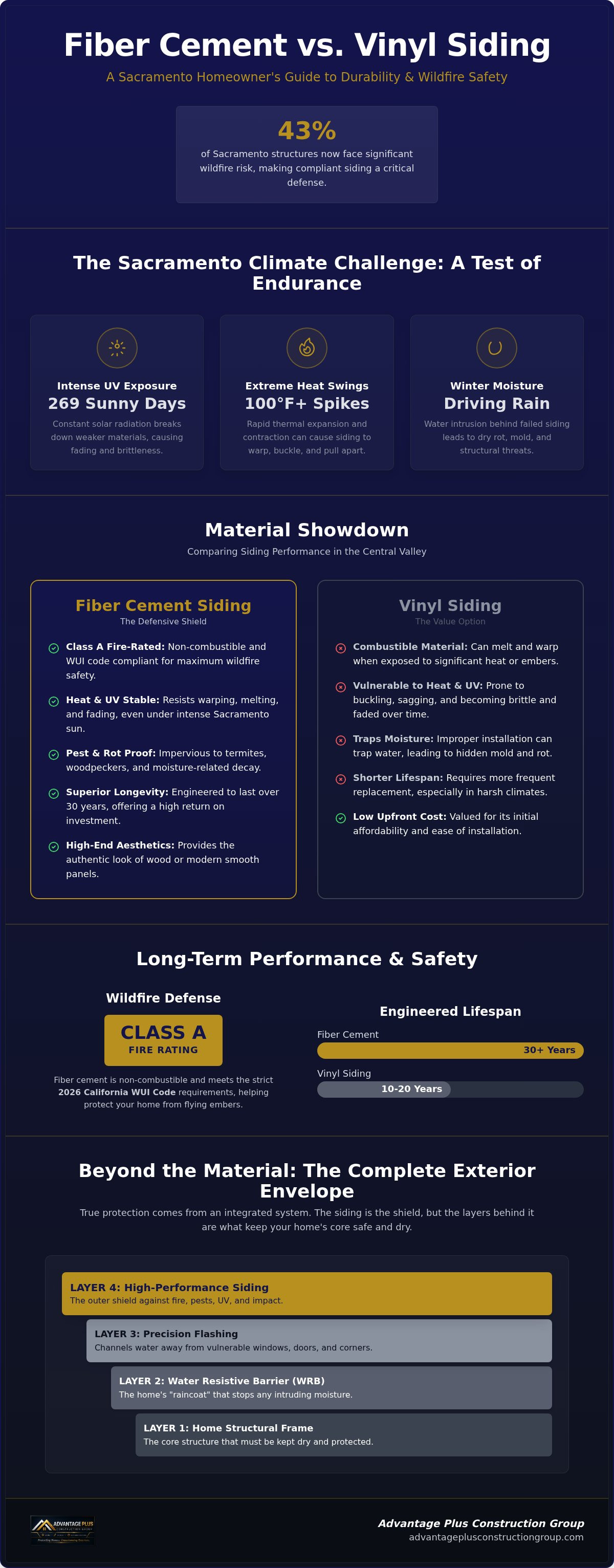
In regions like Granite Bay and Rocklin, fire safety isn't optional. As of January 1, 2026, the California Wildland-Urban Interface (WUI) Code, Title 24, Part 7, is in full effect. This regulation mandates the use of ignition-resistant materials in high-risk zones. Fiber cement carries a Class A fire rating, meaning it's non-combustible and won't fuel a fire. This performance is a primary reason why 43% of Sacramento structures at significant wildfire risk are transitioning to this material. As your Specialized Guardian, we view this as a vital layer of security. It doesn't just protect your equity; it provides essential time for your family in an emergency. Many insurers now recognize this structural resilience, which can lead to more favorable coverage terms in WUI zones.
Long-Term Durability and ROI
Investing in your home's exterior should yield measurable returns. A professional fiber cement siding installation Sacramento delivers an estimated ROI of 70% to 80%. While the upfront cost is higher than vinyl, the lifespan of 30 to 50 years ensures you won't be repeating the process in a decade. You avoid the cycle of frequent replacements. Maintenance is straightforward. A simple 15-year repaint cycle keeps the aesthetic fresh, whereas vinyl often requires a full replacement once it fades or cracks. If you're ready to transition from property anxiety to long-term peace of mind, exploring a specialized exterior envelope strategy is the first step toward a more secure home.
Evaluating Vinyl Siding: Value, Versatility, and Local Vulnerabilities
Vinyl siding remains a frequent choice for homeowners prioritizing immediate budget relief and rapid project completion. Its lightweight nature allows for a streamlined installation process, often making it the go-to for quick aesthetic refreshes. From traditional lap styles to modern board and batten designs, the material offers a variety of visual profiles that mimic more expensive cladding. However, the term "maintenance-free" is frequently a misnomer in our specific region. While you won't need to paint vinyl, you cannot easily repair it once environmental stressors take their toll. In the context of fiber cement vs vinyl siding Sacramento, the choice of vinyl often represents a compromise between short-term savings and long-term structural defense.
PVC, the primary component of vinyl, faces significant degradation when exposed to the high-register UV radiation common in the Central Valley. Over time, the chemical stabilizers in the plastic break down. This leads to a loss of flexibility and a noticeable shift in color, particularly on south and west-facing walls. Unlike fiber cement, which stands firm against the elements, vinyl is a reactive material that struggles to maintain its integrity under the weight of our local climate. It's a choice that requires a clear understanding of its physical limitations before committing to a full exterior overhaul.
The Vulnerability of Plastic
Sacramento summers regularly push temperatures into the triple digits. For a plastic-based product, this heat is more than an inconvenience; it's a structural threat. A specific, often overlooked risk is the "melting" phenomenon caused by concentrated reflective heat from modern, energy-efficient windows on neighboring homes. These windows can act as magnifying glasses, focusing solar energy onto vinyl surfaces and causing the panels to warp, buckle, or liquefy. This thermal sensitivity, combined with 269 sunny days per year, creates a high-stakes environment where plastic siding often reaches its breaking point far sooner than expected.
Cost vs. Security
Understanding the cost of siding installation Sacramento requires looking beyond the initial invoice. While vinyl might save money on day one, the "temporary fix" mentality often invites higher long-term expenses through frequent repairs and premature replacement. We view the exterior envelope as a defensive system. A lower price tag shouldn't come at the expense of your home's security or your peace of mind. Choosing a permanent solution over a superficial upgrade ensures that your investment remains protected, your energy bills stay managed, and your property value continues to grow without the looming threat of material failure.
Performance Showdown: Fire Safety, Heat, and Maintenance
A true performance evaluation requires looking at how these materials handle the physical stresses of the Sacramento Valley. Impact resistance is often the first point of failure during our occasional spring storms. While high-quality vinyl can flex, it often becomes brittle over time and cracks when struck by hail or wind-blown debris. In contrast, the dense composition of fiber cement offers superior impact resistance, standing firm against physical damage that would leave other homes needing immediate repairs. This structural resilience is a central pillar in the fiber cement vs vinyl siding Sacramento comparison for homeowners who demand a defensive shield that doesn't falter under pressure.
Energy efficiency is another critical metric for Central Valley residents. Modern siding options often include insulated backings to improve the "R-value," or thermal resistance, of your walls. While insulated vinyl can reduce heat transfer, fiber cement’s natural thermal mass provides a more consistent barrier against the radiating heat of a 105-degree afternoon. By slowing the transfer of heat into your home's framing, you reduce the load on your HVAC system and lower your monthly energy bills. The "Guardian" verdict is clear: for those seeking the highest level of peace of mind, the material that neither melts nor fuels a fire is the only logical choice.
The Maintenance Reality Check
Maintenance requirements are often misunderstood as "zero vs. high." Vinyl requires regular power washing to prevent mold and grime buildup, yet it offers no path for repair once a panel is damaged. Fiber cement requires a disciplined inspection of its caulking every few years and a fresh coat of paint roughly every 15 years. While vinyl appears cheaper initially, the 10-year maintenance and repair cost of fiber cement is often lower because you are preserving a permanent structure rather than managing a degrading plastic skin. Look for these early warning signs to maintain your home's integrity:
- Vinyl: Chalking of the surface, panels that feel brittle to the touch, or "oil canning" where the boards look wavy.
- Fiber Cement: Separating caulk at the joints, faded paint, or minor chips from heavy mechanical impact.
Choosing for Your Specific Neighborhood
Your specific location within the region should dictate your material selection. In Granite Bay, where wildfire risk is a primary concern, non-combustible siding is a necessity for WUI compliance and long-term security. Conversely, in established suburbs like Citrus Heights, the focus often shifts toward matching residential exterior renovation Sacramento CA trends, such as earthy sage greens and dramatic charcoal accents. Local HOAs also play a significant role, as many now mandate fiber cement for its premium appearance and fire-resistant properties. If you are ready to secure your home with a specialized exterior system, you should consult with a specialized envelope expert to ensure your choice aligns with both local regulations and long-term protection goals.
Beyond the Material: Why the Exterior Envelope System Wins
While the surface debate of fiber cement vs vinyl siding Sacramento often dominates the conversation, the true integrity of your home rests in the layers you cannot see. Siding is a defensive shield, but it's only as effective as the system supporting it. If the underlying substrate is neglected, even the highest-grade boards will eventually fail to protect your home from structural decay. We view the exterior of your property as a unified envelope, a precision-engineered barrier designed to manage heat, moisture, and air pressure simultaneously. It's the difference between a temporary cosmetic fix and a permanent structural solution.
The critical component in this system is the Water Resistive Barrier (WRB). In the Sacramento Valley, our winters bring concentrated, driving rain that can penetrate even the tightest siding joints. A specialized WRB acts as a secondary skin, allowing water vapor to escape from the inside while blocking liquid water from reaching your wooden framing. When combined with expert flashing and high-performance sealants, this system creates a rot-free environment. Our "Specialized Guardian" approach prioritizes these hidden details, ensuring that every transition and penetration is hermetically sealed against the elements. This level of discipline is why siding installation project management is vital; it provides the oversight necessary to guarantee that the moisture barrier is flawless before the first plank is ever installed.
The Anatomy of a Protected Wall
A truly secure home is built in stages, each reinforcing the last. The process begins with inspecting the structural sheathing for existing damage. We then apply a high-performance moisture barrier, followed by precision-cut flashing around windows, doors, and roofline transitions. Only after these defensive layers are verified do we install the final siding material. General contractors often overlook these intersections, leading to trapped moisture and localized dry rot. The Advantage Plus commitment to structural integrity means we never take shortcuts with the envelope. We build for permanence, not just for the visual appeal of the final day. Our focus on craftsmanship ensures that your home remains a dry, secure sanctuary regardless of the season.
Next Steps for Your Sacramento Home
The transition from anxiety about property maintenance to the peace of mind of a secure home begins with an expert assessment. A professional exterior evaluation identifies hidden vulnerabilities before they become catastrophic failures. During a specialized consultation, we analyze your home's unique exposure to sun and rain, providing a roadmap for long-term protection. If you're ready to invest in a premium exterior that stays protected for over 30 years, you deserve to work with the best siding contractors Sacramento CA. Secure your home's future by prioritizing craftsmanship and structural health today. Your property is your greatest investment; treat it with the professional care it requires.
Securing Your Home’s Future in the Central Valley
Choosing the right cladding is a decision that impacts your property's safety and value for decades. While the fiber cement vs vinyl siding Sacramento debate often starts with upfront costs, it truly ends with structural performance. Fiber cement remains the superior choice for those facing the 2026 WUI fire codes and intense Central Valley UV exposure. However, even the best materials fail without professional project oversight and a focus on the entire exterior envelope. Protecting your home requires a disciplined approach to moisture barriers and precision flashing that generalists often overlook.
As local Roseville and Granite Bay experts, we specialize in transitions from maintenance anxiety to long-term security. We don't just install boards; we manage the complex science of your home's exterior envelope to prevent dry rot and ensure energy efficiency. It's time to stop worrying about warping or fire risks and start investing in craftsmanship that lasts. You deserve a partner who prioritizes your home’s structural health above all else. Request Your Specialized Exterior Evaluation today and take the first step toward a premium, protected exterior. Your home is ready for its next thirty years of safety.
Frequently Asked Questions
Is fiber cement siding more expensive than vinyl in Sacramento?
Fiber cement involves a higher initial investment, often costing 50% to 80% more upfront than standard vinyl products. This price difference reflects the material's density and the specialized labor required for a secure, long-term installation. While vinyl is a budget-friendly short-term choice, fiber cement is a permanent structural upgrade. Homeowners should view this through the lens of longevity; the higher entry cost eliminates the need for frequent replacements common with plastic cladding.
Does fiber cement siding help with home insurance in California fire zones?
Yes, choosing non-combustible materials like fiber cement is a strategic move for insurance stability. As of January 2026, the California WUI code mandates ignition-resistant cladding in high-risk zones. Many insurers prioritize homes that meet these rigorous safety standards, as they are significantly less likely to fuel a wildfire. This structural resilience offers peace of mind and potentially more favorable coverage terms in regions like Granite Bay and the surrounding foothills.
How long does vinyl siding last in the Sacramento heat?
In the intense Sacramento heat, standard vinyl siding typically begins to show signs of failure within 10 to 15 years. The 269 sunny days our region averages annually cause plastic to become brittle and lose its original color. Unlike fiber cement, which remains stable, vinyl is prone to warping and buckling when temperatures spike. Frequent UV exposure significantly shortens its functional life compared to more durable, heat-resistant composite alternatives.
Can I install fiber cement siding over my existing wood siding?
We strongly advise against installing new cladding over old wood siding. A proper exterior envelope requires a clean, stable substrate to ensure long-term structural health. By stripping the old material, we can inspect your sheathing for hidden dry rot or pest damage that would otherwise remain trapped. This disciplined approach ensures your new system is anchored to a sound structure, preventing future failures and protecting your property's value for decades.
What is the best siding for preventing dry rot in Roseville?
Fiber cement is the gold standard for preventing dry rot in Roseville, provided it's part of a professionally managed exterior envelope. Because the material doesn't absorb moisture or support fungal growth, it eliminates the primary food source for rot. When paired with a high-performance Water Resistive Barrier, it creates a breathable but watertight shield. This system ensures that moisture never reaches your home's framing, preserving your structural integrity through wet winters.
Does fiber cement siding increase my home value more than vinyl?
Fiber cement consistently delivers a higher return on investment than vinyl, with estimated ROI reaching 70% to 80% in the current market. Appraisers and buyers recognize the premium quality and fire-resistant nature of composite boards. When comparing fiber cement vs vinyl siding Sacramento, the increased resale value often offsets the initial price gap. It is a permanent upgrade that signals to future owners that the home has been professionally protected.
What maintenance does James Hardie siding require in the Central Valley?
Maintenance for premium fiber cement in the Central Valley is straightforward but essential for long-term defense. You should perform a basic cleaning once a year to remove dust and environmental debris. Every few years, inspect the caulking at the joints to ensure the moisture seal remains intact. A fresh coat of paint is typically required every 15 years, which is a far simpler task than the full replacement often needed for degraded vinyl.
Which siding is better for energy efficiency in hot climates?
Fiber cement is generally superior for energy efficiency in hot climates because of its natural thermal mass. It absorbs and releases heat more slowly than thin plastic, helping maintain a stable indoor temperature during triple-digit heatwaves. While insulated vinyl options exist, the dimensional stability of fiber cement prevents the gaps and air leakage that compromise thermal performance. This material choice reduces the load on your HVAC system, lowering your monthly energy bills.


