

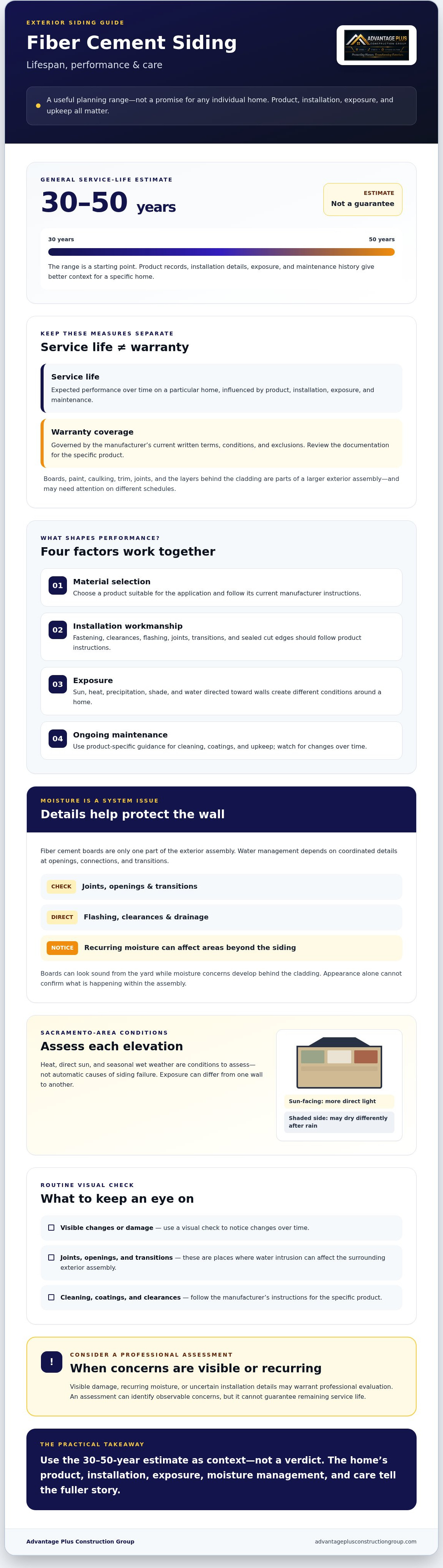
Fiber cement siding can last 30 to 50 years, but that range isn’t a promise for every home. If you’re asking how long does fiber cement siding last, the answer depends on more than the material. Installation quality, moisture management, exposure, and ongoing care all affect its service life. Treat 30 to 50 years as a general estimate, not a guarantee.
It’s reasonable to wonder whether water, missed maintenance, or an installation flaw could shorten that timeline. Details such as fastening, clearances, and sealed cut edges help protect siding from premature damage.
This guide explains what affects fiber cement siding’s lifespan, how exposure around a Sacramento-area home can influence performance, and what routine care may help preserve its condition. You’ll also learn which warning signs deserve attention and when a professional evaluation may help clarify the condition of your exterior. A careful inspection can offer more useful information than a lifespan estimate alone.
Key Takeaways
- When considering how long does fiber cement siding last, treat lifespan figures as estimates, not promises about an individual home.
- Compare expected service life, warranty coverage, and maintenance requirements as separate measures of long-term performance.
- Pay attention to joints, openings, and transitions, where water intrusion can affect the surrounding exterior assembly.
- Use a visual check to spot changes, and follow the manufacturer’s instructions for cleaning, coatings, and clearances.
- Visible damage, recurring moisture, or uncertain installation details may warrant a professional assessment. An assessment can identify observable concerns, but it can’t guarantee remaining service life.
How Long Does Fiber Cement Siding Last? A Realistic Lifespan Answer
A practical planning estimate for fiber cement siding is 30 to 50 years. That range isn’t a forecast for every home or a guarantee of performance. The product, installation quality, exposure, and upkeep all influence how long the siding remains serviceable. Check the manufacturer’s current documentation for product-specific guidance, including lifespan information and warranty terms.
Fiber cement siding service life is the period it can be expected to perform on a particular home, subject to product, installation, exposure, and maintenance conditions. It describes expected performance, not a promise that every installation will last equally long. For a foundational overview of the material, see Fiber cement siding.
What does a fiber cement siding lifespan estimate actually mean?
Service life and warranty coverage are different measures. A lifespan estimate concerns expected performance over time. A warranty is governed by the manufacturer’s current written terms, conditions, and exclusions. Review the terms for the specific product rather than assuming its warranty matches the estimated lifespan.
The siding boards are only one part of the exterior assembly. Joints, openings, transitions, trim, coatings, and the layers behind the cladding all contribute to how the wall manages water. Paint and caulking may need attention on a different schedule from the boards, so don’t treat the siding’s expected life as the lifespan of every exterior component.
Why can two fiber cement installations age differently?
Exposure, workmanship, drainage, and maintenance all shape performance. Fastening, clearances, and cut-edge treatment should follow the product’s instructions. Poorly coordinated joints or transitions can allow moisture to reach areas the siding is meant to protect, making installation quality and the broader exterior envelope central to long-term performance.
Consider two homes with similar siding. One has carefully executed details that direct water away from openings. The other has a vulnerable transition near a window. The boards on both may look sound from the yard, yet moisture concerns can develop behind the cladding before they’re obvious on the surface. Appearance alone can’t confirm what’s happening within the assembly.
So, how long does fiber cement siding last on your home? The 30-to-50-year range is a starting point, not a site-specific assessment. Product records, installation details, exposure, and maintenance history provide better context for understanding an existing exterior.
What Determines How Long Fiber Cement Siding Lasts?
Fiber cement siding service life is primarily influenced by the product selected, installation workmanship, exposure to sun and moisture, and ongoing maintenance. These factors interact. A durable board still depends on well-coordinated details and a wall assembly that manages water appropriately. For a balanced overview of material benefits and trade-offs, see Angi’s pros and cons of fiber cement siding.
- Material selection: Confirm that the product is suitable for the application, then follow its current manufacturer instructions.
- Installation: Correct fastening, clearances, flashing, joints, and transitions help the siding and surrounding wall work together.
- Exposure: Sun, heat, precipitation, shade, and water directed toward the walls create different conditions around a home.
- Maintenance: Follow product-specific guidance for cleaning, coatings, and upkeep, and watch for visible changes over time.
How do installation and moisture management affect lifespan?
Moisture management starts with the details. Flashing around openings, clearances from adjacent surfaces, and properly designed joints and transitions should follow the manufacturer’s instructions. If water gets past an exterior detail, it may affect parts of the wall assembly beyond the siding. That’s why boards, connections, and the layers behind the cladding need to be considered together.
A recurring damp area near a window or transition deserves attention, even if the surrounding boards appear intact. Learn more about the role of a moisture barrier in siding installation and how moisture control relates to protecting an exterior assembly.
How can Sacramento-area exposure influence aging?
For a Sacramento-area home, heat, direct sun, and seasonal wet weather are conditions to assess, not automatic causes of siding failure. Exposure can differ from one wall to another. A sun-facing elevation may receive more direct light, while a shaded side may dry differently after rain. Roof runoff and nearby landscaping can also affect how much water reaches a section of siding.
Look at the whole home. Note where surfaces receive sustained sun, where water collects or splashes, and whether plants or other features keep areas shaded or obstruct inspection. These observations can help explain why two walls on the same house, or two similar homes, show different signs of aging. They don’t establish a fixed lifespan penalty for local weather.
If the siding’s condition or installation details are unclear, a professional review can help clarify what’s observable across the exterior. Sacramento-area homeowners can learn about fiber cement siding and exterior envelope services from Advantage Plus Construction Group.
Does Fiber Cement Siding Really Last for Decades? Claims and Caveats
Fiber cement’s reputation for durability can make a long service life sound certain. It isn’t. An industry estimate describes expected performance under assumed conditions, not a prediction for every home. The answer to “how long does fiber cement siding last” depends on the specific product, how it was installed, its exposure, and how the home is maintained.
Keep three measures separate: expected service life, warranty coverage, and maintenance needs. A warranty doesn’t establish how long siding will perform, and a long-lasting board doesn’t mean coatings, caulking, trim, or other exterior components need no attention. For a comparison of material characteristics, see this fiber cement versus vinyl durability guide.
| Claim | What it means | What homeowners should verify |
|---|---|---|
| “Designed to last for decades” | A general statement about expected durability, not a home-specific forecast. | Which product the claim covers and what installation and upkeep it assumes. |
| “Covered by a long warranty” | Coverage is limited to the terms and conditions in the written warranty. | Current coverage, exclusions, transfer rules, and installation requirements. |
| “Low maintenance” | Maintenance needs may differ by product, finish, and exposure. | Manufacturer instructions for cleaning, coatings, and other care. |
Does a long warranty mean the siding will last that long?
No. Warranty duration and service life measure different things. A warranty sets out what the manufacturer covers and under which conditions. It doesn’t promise that the material will perform for that entire period in every environment. Before relying on a warranty, read the current document for the exact product, including exclusions, transfer rules, and required installation practices. Don’t infer coverage from a headline or verbal summary.
What should homeowners verify before trusting a lifespan claim?
Start with the exact product and its current installation instructions. Check what the claim assumes about installation, exposure, maintenance, and finish care, then compare those assumptions with the home’s actual conditions. If the siding is already installed, look for product records and available project documentation. Uncertainty about installation or the exterior assembly can make a general lifespan estimate less useful.
These distinctions help set realistic expectations: a material claim is not a warranty, and neither replaces product-specific care instructions. Review the documentation before drawing conclusions about the siding on your home.
How to Maintain and Inspect Fiber Cement Siding Over Time
A consistent visual check can help you notice changes before they’re easy to overlook. There’s no universal inspection schedule for every product or home, so follow the manufacturer’s guidance and check the exterior when conditions or visible changes call for a closer look. Keep a record of observations to distinguish a new issue from an existing mark.
What should homeowners look for during a visual check?
Walk around the home and inspect the siding from a safe vantage point. Pay particular attention to joints, penetrations, and places where different exterior materials meet. Look for changes such as:
- Boards: Cracks, looseness, breaks, or other visible damage.
- Connections: Changes around joints, windows, doors, and other penetrations.
- Surface and sealants: Peeling or worn paint, and caulking that appears separated or deteriorated.
- Water exposure: Areas below roof runoff, near landscaping, or where surfaces stay damp.
Photograph any changes and note where they occur. A visible defect doesn’t reveal the full condition of the wall behind it, so don’t diagnose concealed moisture from appearance alone. If a concern recurs, spreads, or is difficult to interpret, seek a professional assessment. For a separate overview of possible replacement indicators, see this signs you need new siding checklist.
Which maintenance practices help protect siding performance?
Use product-specific guidance rather than a generic cleaning or repainting schedule. The manufacturer’s instructions should guide cleaning methods, coatings, clearances, and care for the installed product. Avoid unapproved pressure-washing or abrasive techniques, which may damage a surface or finish. If product records aren’t available, identify the siding before choosing a cleaning method or coating.
Keep drainage paths clear, and manage plants or other landscaping so they don’t trap moisture against the exterior or prevent you from seeing the siding. Check the manufacturer’s documentation before deciding whether paint or caulking needs attention. Timing and suitable materials can vary by product and installation.
Careful observation won’t determine exactly how long does fiber cement siding last, but it can help you spot changes and respond thoughtfully. If you’re uncertain about visible siding concerns or the surrounding exterior assembly, learn about siding and exterior envelope services from Advantage Plus Construction Group.
When to Have Fiber Cement Siding Professionally Assessed
A professional review can be useful when you notice cracked or loose boards, changes around joints or openings, or moisture that keeps returning in the same area. It may also help if you don’t know how the siding was installed or which product is on your home. These signs don’t prove the siding has failed, but they can point to questions worth investigating.
What can an exterior siding assessment clarify?
A review can document visible siding conditions and examine how joints, transitions, drainage paths, and nearby exterior details come together. That broader view matters because a concern may involve more than the face of a siding board. Advantage Plus Construction Group specializes in fiber cement siding and exterior envelope services, with project managers overseeing site preparation and installation on its projects.
Bring any installation records, product information, warranty documents, and notes about past repairs or recurring dampness. This history can provide context for visible conditions. A visual assessment can identify observable concerns, but it can’t confirm every concealed condition or guarantee how many years of service remain. Further evaluation may be needed if an issue appears to extend beyond what can be seen.
What are practical next steps for Sacramento-area homeowners?
Before contacting a contractor, take clear photos of the areas that concern you and note when or where you’ve observed changes. Gather available product and warranty records, along with any prior repair history. These details can make the conversation more focused and help clarify what’s known, what remains uncertain, and what may warrant closer review.
For background on project planning and installation considerations, see this fiber cement siding installation guide. If you’re still wondering how long does fiber cement siding last on your home, a site-specific review can help explain its observable condition without promising a remaining service life.
Homeowners in the Sacramento region, including Roseville, Granite Bay, New Castle, Rocklin, Penryn, Loomis, Citrus Heights, Orangevale, Fair Oaks, Carmichael, and Antelope, can discuss a fiber cement siding or stucco project with Advantage Plus Construction Group.
Protect Your Siding’s Long-Term Performance
The best answer to how long does fiber cement siding last is specific to the home. A lifespan estimate offers a useful starting point, but product requirements, installation details, moisture management, and ongoing care shape real-world performance. Warranty coverage and maintenance needs are separate considerations, not guarantees of how long every installation will serve.
Watch for visible changes, follow the manufacturer’s care instructions, and take recurring moisture or uncertain installation details seriously. A professional review can clarify observable concerns and help you understand what may need attention, without promising a precise remaining service life.
Advantage Plus Construction Group specializes in premium fiber cement siding and professional stucco installations for Sacramento-area homeowners. Project managers oversee material procurement, site preparation, and installation. Contact Advantage Plus Construction Group to discuss your exterior project.
Frequently Asked Questions
How long does fiber cement siding typically last?
Fiber cement siding is commonly estimated to last 30 to 50 years, but that range isn’t a guarantee for an individual home. If you’re asking how long does fiber cement siding last on your house, the answer depends on the specific product, installation quality, exposure, and maintenance. Check the manufacturer’s current documents for product-specific guidance, and treat a general service-life estimate separately from warranty coverage.
Can fiber cement siding last longer with proper installation and maintenance?
Proper installation and product-specific care can support lasting performance, though they can’t guarantee a particular service life. Follow the manufacturer’s instructions for fastening, clearances, joints, and cut edges, and use its guidance for cleaning and coatings. Keep drainage paths clear and watch for changes around openings or transitions. These steps help protect the siding and surrounding exterior assembly, but they don’t eliminate every risk from exposure or concealed moisture.
Does fiber cement siding rot or suffer moisture damage?
Fiber cement siding doesn’t rot in the same way wood can, but that doesn’t make the entire wall immune to moisture concerns. Water entering around joints, openings, or transitions may affect other parts of the exterior assembly. Look for recurring damp areas, damaged caulking, or changes near penetrations, but don’t assume a visual check can reveal concealed conditions. If moisture keeps returning, consider having the area professionally assessed.
How often should fiber cement siding be inspected or repainted?
There isn’t one inspection or repainting interval that applies to every fiber cement product and home. Follow the installed product’s manufacturer instructions for inspection, cleaning, finish care, and repainting. During a visual check, look for cracked or loose boards, changes in paint, separated caulking, and areas exposed to runoff. Record changes over time. If you can’t identify the product or its care requirements, consult its documentation or seek professional guidance.
What are the signs that fiber cement siding needs repair or replacement?
Cracked, loose, or visibly damaged boards warrant closer attention, as do changes around joints, openings, or places where materials meet. Peeling paint, separated caulking, or recurring dampness may also signal that the area needs review. These signs don’t automatically mean the whole siding system needs replacement. Document what you see and where it appears; a professional assessment can help clarify observable concerns and possible next steps.
Does Sacramento weather affect how long fiber cement siding lasts?
Sacramento-area sun, heat, and seasonal wet weather are exposure factors to consider, not automatic causes of early siding failure. Conditions vary across a home: a sunny wall, a shaded elevation, or an area beneath roof runoff may experience different exposure. Homeowners in Roseville, Granite Bay, New Castle, Rocklin, Penryn, Loomis, Citrus Heights, Orangevale, Fair Oaks, Carmichael, and Antelope can assess these local conditions without assuming a fixed lifespan penalty.
Is fiber cement siding lifespan the same as its warranty period?
No. Expected service life is an estimate of how long siding may perform under particular conditions; a warranty describes coverage under specific written terms. Neither establishes that every installation will have the same outcome. Review the current warranty for the exact product, including exclusions, transfer rules, and installation requirements. Also check maintenance instructions, since required care may affect coverage. Don’t treat a warranty’s duration as a guaranteed lifespan for your home.


