

The most sophisticated siding in the world is essentially useless if the layer beneath it fails. Your home’s true defense isn't the fiber cement or stucco you see from the street; it's the invisible shield that manages water, air, and pressure. Many homeowners live with a quiet anxiety that hidden dry rot is eating away at their property's core while they sleep. You deserve the peace of mind that comes from a project done right the first time. We understand that the distinction between a house wrap and a vapor barrier can feel confusing, especially when you're worried about contractors taking shortcuts on your most valuable investment.
This guide empowers you to master the technical essentials of moisture barrier siding installation to shield your home from structural compromise. By the end of this article, you'll understand the "why" behind every layer of your home's exterior envelope. We'll examine the 2024 International Residential Code requirements, clarify the specific roles of various breathable membranes, and outline the professional standards required for a dry, permanent, and premium result. It's time to transition from maintenance anxiety to the confidence of high-quality protection. Let's explore the craftsmanship, defense, and longevity your home requires.
Key Takeaways
- Learn why the weather-resistive barrier acts as your home's secondary skin. Siding alone cannot create a waterproof seal, making the internal shield your primary defense against dry rot.
- Understand the performance gap between woven and non-woven wraps. Selecting a material with the proper perm rating allows your structure to breathe while maintaining a permanent defense against the elements.
- Identify the specific barrier requirements for your siding type. Fiber cement and stucco systems each demand unique shielding strategies to ensure effective moisture management and structural longevity.
- Discover the technical precision required for a successful moisture barrier siding installation. Following the "shingle fashion" rule ensures that gravity-driven drainage keeps your home’s core dry and secure.
- Gain confidence in professional standards through specialized oversight. Expert project management identifies and corrects hidden shortcuts, protecting your property's integrity for the long term.
The Foundation of Home Protection: What is a Moisture Barrier?
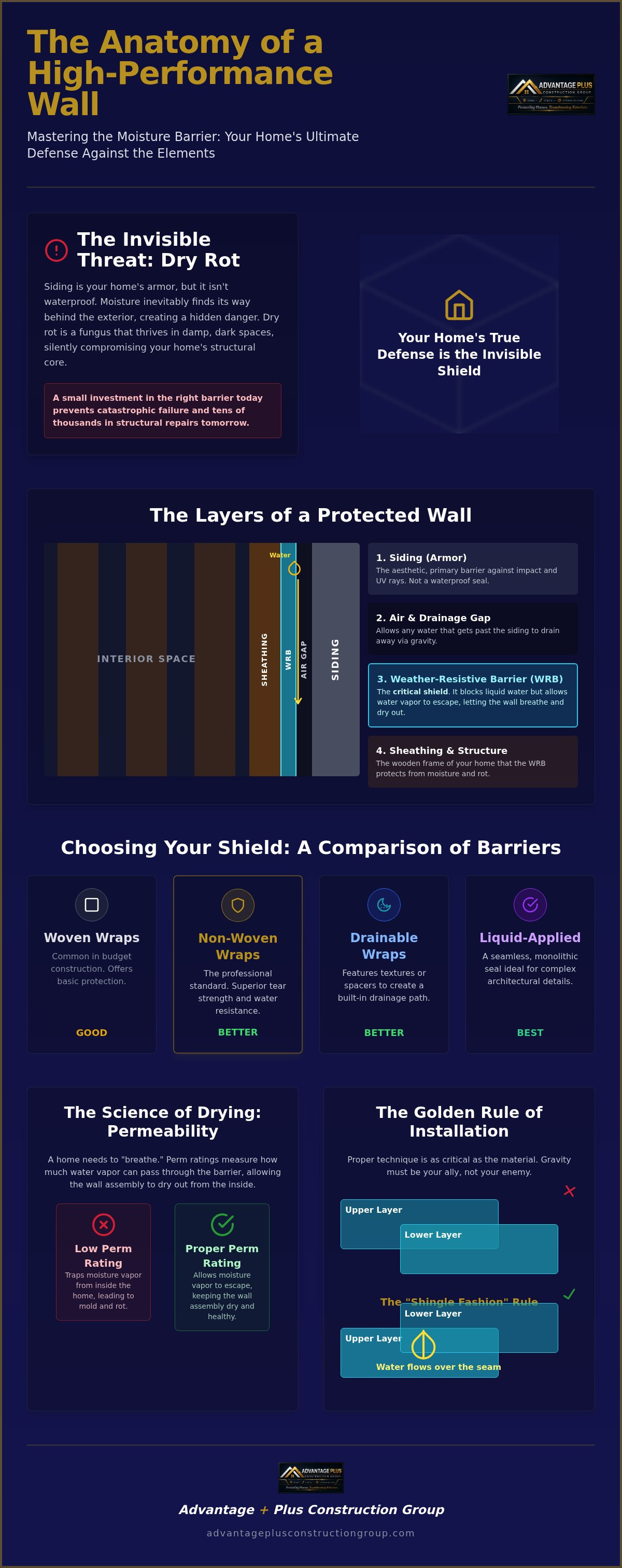
The siding on your home is a beautiful suit of armor, but it isn't a submarine. Even the most meticulously installed fiber cement or stucco systems allow some degree of moisture to penetrate the exterior. This is where the weather-resistive barrier (WRB) proves its worth. Think of it as a secondary skin. It's the silent guardian protecting the structural studs and sheathing from the inevitable intrusion of water. In the professional world of moisture barrier siding installation, we view this layer as the most critical component of the entire project. The cladding is for aesthetics and impact; the barrier is for survival.
Many homeowners use the terms house wrap, moisture barrier, and vapor barrier interchangeably. They shouldn't. A high-quality house wrap is a specific type of moisture barrier designed to block liquid water while allowing water vapor to escape. A vapor barrier, conversely, is often used on the interior to prevent moisture from moving through the wall from the inside out. Confusing these materials leads to trapped moisture and structural decay. Our approach prioritizes defense, longevity, and craftsmanship by choosing the exact membrane your specific structure requires.
The Role of the Building Envelope
An effective building envelope must manage three distinct forces: air, water, and thermal transfer. The relationship between your siding, the moisture barrier, and the plywood sheathing is a delicate balance of defense and breathability. In the Sacramento region, our homes face unique environmental stressors. We deal with intense summer heat followed by heavy winter rains and persistent tule fog. This cycle of expansion, contraction, and saturation makes a high-performance envelope non-negotiable. Without a specialized guardian layer, the "Premium Shield" of your siding is incomplete.
Preventing the Silent Threat: Dry Rot
Dry rot is the ultimate predator of Northern California homes. It is a fungal infection that thrives in the dark, damp spaces between your siding and your studs. Once moisture is trapped behind a compromised shield, the wood begins to lose its structural integrity. The financial stakes are high. Investing in a premium moisture barrier siding installation is a disciplined choice that prevents catastrophic failure. A small investment in the right materials today saves the tens of thousands of dollars required to remediate structural rot tomorrow. Look for early warning signs like soft spots near window trim, peeling paint, or a persistent musty odor near exterior walls.
Technical Anatomy: Choosing the Right Shielding System
Selecting the right material is a technical decision that dictates the lifespan of your property. Standard woven wraps are common in budget construction, but they often lack the durability required for long-term security. Professional standards favor non-woven breathable membranes. These materials offer superior tear strength and water resistance. For homes with complex architectural details or numerous window penetrations, liquid-applied barriers provide a seamless, monolithic seal that traditional wraps cannot match. This level of precision is essential for a truly protective moisture barrier siding installation.
Modern innovation has introduced drainable house wraps. These systems feature integrated spacers or textures that create a built-in drainage path. This ensures that any water finding its way behind the cladding can quickly exit via gravity. If you are planning a specialized exterior envelope service, understanding these material differences is the first step toward a dry, structurally sound home. It's about moving beyond temporary fixes to embrace a system built for permanence.
Permeability and the Science of Drying
Permeability is measured by "Perm ratings," which quantify how much water vapor can pass through a material in a specific timeframe. Your home needs to breathe. Moisture from daily activities like cooking and showering naturally migrates toward the exterior walls. If your barrier has a low perm rating, this vapor becomes trapped against the wood sheathing, leading to hidden mold growth. In the Sacramento climate, where humidity shifts seasonally, matching the perm rating to local conditions is vital. A barrier that is too tight causes condensation; a barrier that is too loose fails to block wind-driven rain.
The Rainscreen Advantage
A rainscreen is a design philosophy that creates a dedicated air gap, or drainage plane, between the siding and the moisture barrier. This gap serves two critical purposes. First, it allows liquid water to drain freely. Second, it facilitates air circulation that dries out the back of the siding. For premium fiber cement projects, rainscreens are the gold standard. They prevent "solar vapor drive," a phenomenon where sun-warmed siding pushes moisture into the wall assembly. This added ventilation significantly extends the life of your paint and prevents the warping of siding materials. Proper moisture barrier siding installation incorporates these advanced drainage principles to ensure the high stakes of structural integrity are met with disciplined, professional solutions.
Material Matching: Siding Types and Barrier Requirements
A "one size fits all" approach to home protection is a dangerous shortcut. Different siding materials interact with moisture in vastly different ways. Some act as a loose-fitting rainscreen, while others function like a porous sponge. A disciplined moisture barrier siding installation must account for these physical properties to ensure a permanent, premium result. Our role as specialized guardians is to match the technical specifications of the barrier to the specific demands of the cladding. This precision is what separates a standard renovation from a professional structural defense.
Wood and engineered wood siding are particularly vulnerable to "backside absorption." When moisture becomes trapped behind these organic materials, it leads to warping, fungal growth, and premature paint failure. Vinyl siding, while made of inorganic plastic, is designed with weep holes and loose laps that naturally allow water to pass through. In these cases, the barrier isn't just a backup; it is the primary drainage plane. Without a high-performance shield, the water that slips behind the vinyl panels would sit directly against your home's plywood sheathing.
Best Practices for Fiber Cement Siding
Fiber cement is a dense, high-performance material, but its weight can compress standard, low-quality house wraps. A successful fiber cement siding installation Sacramento project requires a non-compressive, high-perm barrier that maintains its drainage gap even under the pressure of heavy panels. We pay close attention to preventing the "wicking" effect at the base of the wall. This occurs when the bottom edge of the siding draws ground moisture upward into the material. Using a specialized shield in synergy with James Hardie products creates a robust defense that thrives in the Sacramento climate.
The Stucco Challenge
Stucco presents a unique technical hurdle because it is applied wet and tends to bond to the layers beneath it. If stucco bonds directly to the house wrap, it can tear the barrier as the house naturally shifts or the material cures. This is why experienced stucco contractors Sacramento CA must implement a dual-layer system. The first layer acts as the primary water-resistive barrier, while the second serves as a "bond-break." This allows the stucco to move independently of the home's structure. It prevents cracks and ensures that the drainage plane remains functional behind the masonry. Proper moisture barrier siding installation for stucco is a disciplined process that rejects shortcuts in favor of long-term structural integrity.
The Specialized Installation Process: A Step-by-Step Guide
Execution is the final test of craftsmanship. A superior moisture barrier siding installation begins long before the first roll of house wrap is unfurled. It starts with a disciplined inspection of the home’s sheathing. We identify existing soft spots, moisture stains, or structural compromises that must be addressed before the new shield is applied. To ignore these signs is to build on a failing foundation, a shortcut that our specialized team refuses to take. This preparation ensures that the core of your home is sound, dry, and ready for long-term protection.
The primary law of water management is gravity. We apply every layer in "shingle fashion," ensuring each upper sheet overlaps the one below it. This creates a continuous, downward path for water to exit the system safely. Our fastening protocols are equally rigorous. We prioritize plastic cap nails over standard staples. Staples can tear the membrane or create small, unsealed punctures that compromise the shield's integrity. Cap nails provide a secure, gasket-like seal that maintains the barrier’s performance under environmental stress. It is a methodical, unhurried process that prioritizes the health of the structure over speed.
Precision Overlapping and Seaming
Standard industry practices often allow for minimal overlaps, but professional reliability demands more. We adhere to a 6-inch horizontal and 12-inch vertical overlap standard to ensure maximum defense. Every seam is then treated with specialized high-adhesion flashing tape. This step is critical at corner transitions, where the risk of corner-rot is highest. By sealing these junctions with precision, we create a monolithic defense that protects your home’s core from wind-driven rain and air infiltration. This attention to detail creates the peace of mind that comes with high-quality protection.
Flashing Integration: The Guardian’s Secret
The most vulnerable points of any structure are the penetrations. As a leading exterior envelope contractor Sacramento, we focus on the seamless integration of Z-flashing and window fins. Z-flashing directs water away from horizontal ledges, while properly integrated window fins ensure that water flowing down the WRB cannot slip behind the window frame. We also pay close attention to kick-out flashing at roof-to-wall intersections. This often-overlooked detail prevents water from pouring directly into the wall cavity during heavy Sacramento rains. If you are ready to secure your home with a disciplined, professional approach, contact our exterior envelope specialists to discuss your moisture barrier siding installation today.
Beyond the Barrier: Ensuring Long-Term Exterior Integrity
The most advanced materials and technical protocols are only as effective as the human oversight governing their application. Professional project management serves as the final, critical layer of your home's defense. While the physical products provide the barrier, the discipline of rigorous supervision ensures that no shortcuts are taken during the moisture barrier siding installation. Hidden errors, such as a single unsealed penetration or a reversed lap, can lead to the very structural compromise you are trying to avoid. Investing in permanence today is a protective measure against the catastrophic costs of remediation in the future.
Long-term integrity requires a commitment to annual maintenance. Even a perfect installation needs periodic observation. We recommend a yearly inspection of your home's exterior envelope, focusing on the sealants around windows and the condition of the kick-out flashing. Catching minor wear early preserves the "Specialized Guardian" shield we build around your property. This proactive approach ensures that environmental resistance remains at its peak, protecting both the physical durability and the visual appeal of your investment.
The Value of Specialist Oversight
At Advantage Plus Construction Group, our project managers do more than just track schedules and budgets. They provide specialized oversight rooted in a deep understanding of exterior envelope science. A generalist contractor might view a house wrap as a simple checklist item; we view it as a high-stakes engineering requirement. We ensure every step meets and exceeds the 2024 International Residential Code standards. This transition from anxiety to peace of mind is the emotional reward of knowing your installation was handled by experts who prioritize your investment and property health.
Your Next Steps for a Protected Home
Evaluating your home for signs of envelope failure is the first step toward long-term security. Look for localized paint peeling, staining near the foundation, or gaps in the caulking around doors. These are often the first outward symptoms of an internal moisture problem. When preparing for a consultation, gather any original construction documents or previous repair records to help our specialists understand your home’s history. This preparation allows for a more accurate and efficient diagnostic process.
Securing your home's future starts with a professional exterior envelope assessment. Our team will perform a thorough evaluation of your current system, identifying vulnerabilities before they become structural crises. Don't leave your property's core to chance. Choose a partner dedicated to the craftsmanship and defense your home deserves. We take the weight of responsibility off your shoulders, ensuring your home remains a dry, structurally sound sanctuary for decades to come.
Securing Your Home's Permanent Defense
Your home's structural integrity depends on the invisible layers that manage moisture, air, and pressure. By mastering the technical nuances of permeability and demanding the discipline of a shingle-fashion overlap, you've taken the first step toward long-term security. A successful moisture barrier siding installation isn't just about the materials; it's about the specialized oversight that prevents hidden shortcuts and ensures every junction is sealed for permanence. This methodical approach transforms your exterior from a simple facade into a robust, multi-layered shield.
At Advantage Plus Construction Group, we act as the specialized guardian for your property. Our expert project managers oversee every detail to ensure your project stays on budget and on time, whether you are in Roseville, Granite Bay, or the greater Sacramento region. We protect what matters most by prioritizing the health of your building envelope over superficial upgrades. Don't leave your home's core vulnerable to the silent threat of dry rot. We invite you to protect your home with a specialized exterior envelope consultation today. It's time to trade property anxiety for the peace of mind that comes with professional reliability and elite craftsmanship. Your home deserves a shield that lasts.
Frequently Asked Questions
Does every house need a moisture barrier behind the siding?
Yes, the 2024 International Residential Code (IRC) mandates at least one layer of a water-resistive barrier behind all exterior veneers. This layer serves as your home's secondary skin, protecting the structural sheathing from water that inevitably passes through the cladding. Without it, your home's core is vulnerable to structural decay and mold. It's a critical component of a professional moisture barrier siding installation that ensures the longevity of your property's exterior envelope.
What is the difference between house wrap and a moisture barrier?
House wrap is a specific category of weather-resistive barrier designed to block liquid water while remaining vapor-permeable. The term moisture barrier is a broader classification that includes house wraps, liquid-applied membranes, and asphalt-saturated felt. A high-quality house wrap allows your home to "breathe" by letting internal vapor escape, whereas a non-breathable moisture barrier can trap condensation inside your walls and cause hidden dry rot.
Can I install a moisture barrier over old siding?
You should never install a moisture barrier over old siding. A proper installation requires stripping the exterior down to the original sheathing to inspect for existing damage or rot. Covering old siding traps moisture between the layers, creating a breeding ground for fungus and structural compromise. Our specialized process involves a thorough inspection of the building envelope before the new shield is applied to ensure a permanent, premium result.
How long can a moisture barrier be exposed to the sun before siding is installed?
Most high-performance moisture barriers can remain exposed to UV rays for 30 to 120 days, though this varies by manufacturer. Prolonged exposure beyond the recommended limit degrades the material's chemical integrity and reduces its water-shedding capabilities. We prioritize unhurried but efficient project management to ensure your siding is installed well within these safety margins. This protects the durability of the shield and maintains the satisfaction of home ownership.
Why is my contractor using cap nails instead of regular staples?
Cap nails are the professional standard because they provide a secure, gasket-like seal around the penetration point. Standard staples are a common contractor shortcut that can easily tear the barrier during high winds or temperature shifts. These tears allow water to seep behind the membrane, leading to the structural compromise you are trying to avoid. Using plastic cap nails reflects a commitment to craftsmanship and doing things right the first time.
Is a vapor barrier the same thing as a weather-resistive barrier?
No, they serve different functions. A weather-resistive barrier (WRB) is designed to keep liquid water out while letting vapor pass through from the inside. A vapor barrier is usually installed on the "warm" side of the wall to stop water vapor from entering the wall cavity in the first place. Confusing the two can be disastrous for your home’s health. A true moisture barrier siding installation uses a breathable WRB to prevent moisture from being trapped against your studs.
How do I know if my current moisture barrier has failed?
You can identify a failed barrier by looking for localized paint peeling, musty odors near exterior walls, or dark staining on your siding. These symptoms often indicate that water has penetrated the secondary skin and is saturating the wood beneath. In the Sacramento region, these issues are frequently linked to poor flashing at windows or reversed overlaps. If you notice soft spots near your home's foundation, it's time for a professional exterior envelope assessment.
What is a rainscreen and do I need one in Sacramento?
A rainscreen is a specialized drainage plane that creates a dedicated air gap between your siding and the moisture barrier. In the Sacramento climate, where heavy winter rains are common, a rainscreen is highly recommended for fiber cement and stucco systems. This gap allows liquid water to drain freely and facilitates air circulation to dry out the back of your siding. It's a premium defense strategy that significantly extends the life of your home's exterior.


