

A low siding estimate can become an unwelcome surprise when the scope, cleanup, or concealed wall damage is left unclear. The most useful questions to ask a siding contractor in Carmichael cover credentials, material suitability, itemized estimates, payment terms, possible extra work, cleanup, contract details, and post-installation service. In Carmichael, hot summers, wildfire seasons, and occasional heavy rain make protection and installation details as important as appearance.
It’s reasonable to want a clear scope and an exterior that protects your home over time. Advantage Plus Construction Group specializes in exterior work across Sacramento County, Placer County, El Dorado County, and surrounding Northern California communities, including Carmichael, Fair Oaks, Roseville, Rocklin, Folsom, and Orangevale. Its focus on siding, moisture management, and fire-conscious exterior solutions helps homeowners assess more than the bottom line.
This guide explains what to ask, what to look for in the answers, and how to clarify estimates and contract terms before work begins, from the initial inspection through the final walkthrough.
Key Takeaways
- Request an in-person assessment and an itemized estimate so the scope, payment schedule, cleanup, and possible extra work are easier to understand.
- Discuss the contractor’s licensing, insurance, relevant siding experience, and responsibility for permits before work begins.
- Ask how the selected material will be installed, including how the crew will address wall conditions and vulnerable areas.
- Make sure the written contract identifies the work, products, schedule, and process for documenting changes.
- Plan for a final walkthrough to review completed work, cleanup, and any remaining concerns before closing out the project.
Questions about estimates, debris removal, and incidental costs
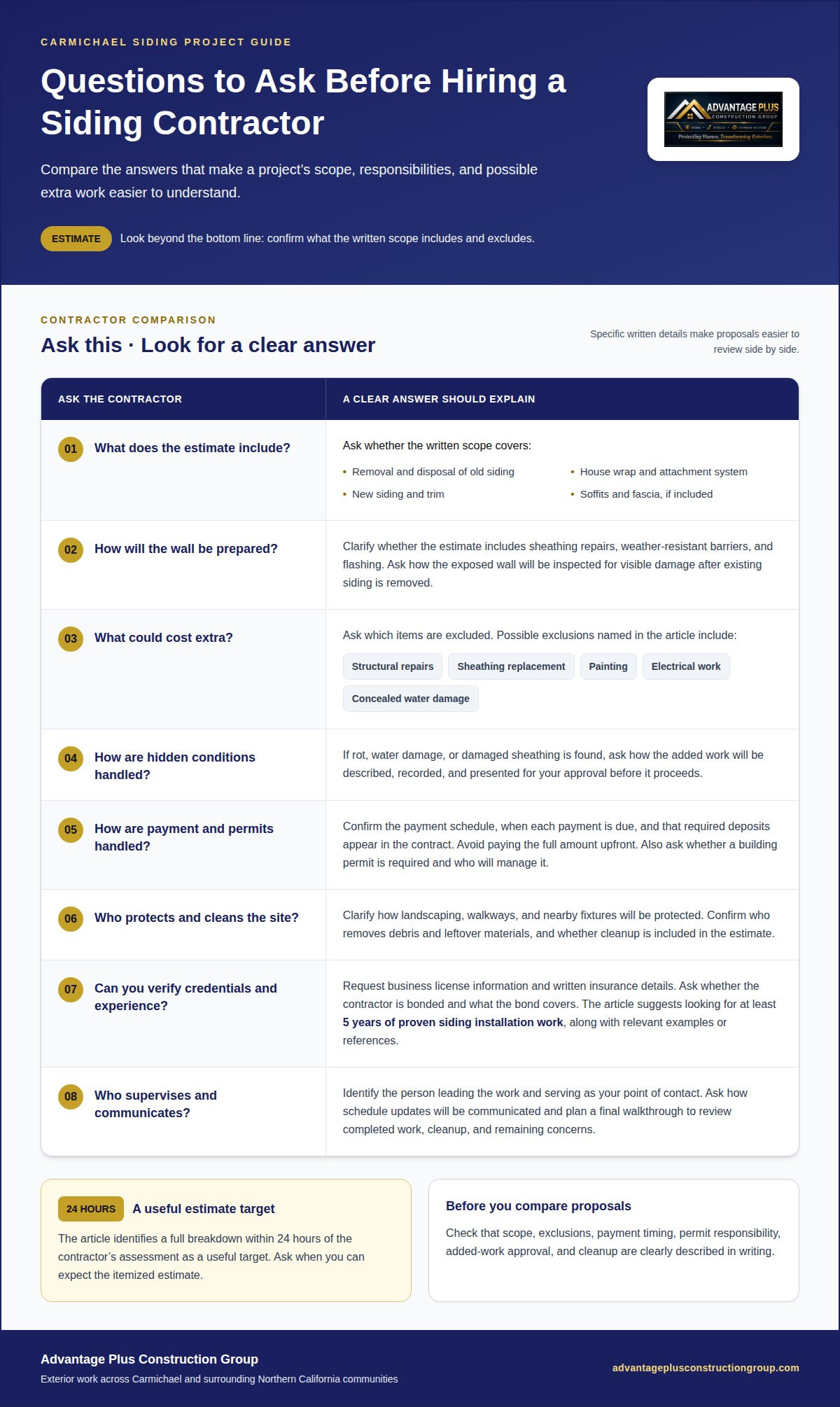
A dependable estimate starts with an on-site visit, measurements, and a written description of the siding project. Ask whether the estimate includes removal of existing siding, house wrap, the attachment system, new siding, trim, and disposal. Soffits and fascia may be separate items, so their inclusion should be clear before you compare proposals. A detailed scope helps you understand what the investment covers, not just the bottom line.
Ask for an itemized breakdown and when you can expect it. A useful target is a full breakdown within 24 hours of the contractor’s assessment. An in-person inspection matters because measurements, wall conditions, windows, and exterior fixtures affect the work. References can help you understand how a contractor communicates, but the written scope is what clarifies the specific tasks and exclusions for your home.
- Removal: Does the estimate cover taking off old siding and hauling away debris?
- Wall preparation: Are sheathing repairs, weather-resistant barriers, and flashing included?
- Finish work: Are trim, painting, soffits, or fascia part of the scope or separate items?
- Site protection: How will the crew protect landscaping, walkways, and nearby fixtures?
- Leftover materials: Will usable materials remain with you, or will the crew remove them?
These details can reveal potential additional work. An estimate may exclude structural repairs, sheathing replacement, painting, electrical work, or concealed water damage. Ask how discoveries will be documented and how added work will be presented for approval before proceeding. For example, if damaged sheathing appears after the old siding is removed, clarify whether work pauses for your approval and how the change will be recorded.
How does a siding contractor address rot, water damage, and old siding removal? The existing material is removed so the exposed wall can be inspected for visible damage before it is covered again. Ask how repairs will be scoped and approved if rot or water damage appears, since concealed conditions can change the work required.
Clarify the payment schedule before signing. Ask when the deposit or first payment is due, whether each required deposit appears in the contract, and whether you’ll receive a receipt. Avoid paying the full amount upfront. The contract should connect payments to a clear project scope, rather than leaving timing open to interpretation.
Finally, ask what final cleanup includes, including debris removal and protection for Carmichael landscaping. A clear estimate should explain who removes leftover materials and how incidental work is approved. For details on the siding work available in Carmichael, review siding services as you prepare questions for your estimate.
Are You Licensed, Bonded, and Insured?
Ask about the contractor’s business identity and insurance coverage before agreeing to work. These questions help clarify who is responsible if an incident affects your home, a worker, or nearby property. Request written insurance information and make sure the contract names the same business. Consistent records make it easier to identify the party responsible for the project.
Ask directly whether the contractor is bonded and what the bond covers for your project. Bonding and insurance are different forms of protection, so a simple “yes” does not explain the terms. Request relevant documentation and details about the issuing organization. Clear, specific answers give you a stronger basis for comparing contractors than a broad claim of being reputable.
Licensing is one part of the assessment; relevant siding experience is another. Ask how long the contractor has performed siding installations and request examples or references from similar exterior projects. Look for at least 5 years of proven siding installation work. Ask who will supervise the crew and serve as your point of contact, especially if the project includes several work stages or requires schedule coordination.
- Business credentials: What business license information can you provide?
- Insurance: What insurance policy covers the work, and how can I review its details?
- Bonding: Are you bonded, and what does the bond apply to?
- Experience: How long have you completed siding projects, and can you provide relevant references?
- Project oversight: Who will lead the work and communicate schedule updates?
Permits deserve a separate conversation. Ask whether your siding project requires a building permit and who will handle it with the local planning department. The written agreement should identify permit responsibilities, so you know who manages each step. This clarity also helps you understand how permit tasks fit into the project plan and who will communicate if an approval affects scheduling.
Before choosing a contractor, consider the answers together. A clear explanation of licensing, insurance, bonding, experience, and permit responsibilities helps you assess the contractor’s approach, not just the estimate. Keep the contractor’s written information with your project records. It gives you a useful reference if questions arise during the work or while reviewing the completed exterior.
For an exterior project that needs coordinated planning, a contractor’s exterior project approach can help clarify how installation and oversight fit together.
Experience with specific siding materials
Ask which siding materials the contractor installs regularly, then request examples of completed projects using your preferred material. Common options include vinyl, fiber cement, wood, engineered wood, and metal. Each has different appearance, maintenance needs, and installation details. A contractor experienced with one material may not have the same familiarity with another. Ask how the chosen material suits your home’s exposure, exterior condition, and maintenance priorities.
Material advice should explain trade-offs, not simply promote one option. Ask how fiber cement compares with wood or engineered wood for durability and upkeep. Carmichael’s hot summers and occasional heavy rain make installation details and moisture management relevant to the decision. Ask how the material works as part of the complete exterior assembly, including wall preparation and details around windows and other openings. Advantage Plus Construction Group specializes in exterior systems, with a focus on moisture management as part of siding recommendations and installation standards.
Product details matter. Before signing, ask for the manufacturer, product line, profile, color, and finish in writing. This helps prevent substitutions or misunderstandings between the estimate and delivered materials. If you’re considering James Hardie fiber cement, ask about the contractor’s experience installing it and how the crew follows manufacturer specifications. The principal of Advantage Plus Construction Group spent five years as a James Hardie Technical Representative. That experience informs the company’s siding recommendations and attention to manufacturer installation requirements. The answer should explain the installation approach clearly, rather than relying on a brand name alone.
- Material experience: Which projects demonstrate your work with this siding type?
- Product identification: Which manufacturer, line, profile, color, and finish are specified?
- Installation method: How will the crew prepare the wall and address vulnerable areas?
- Warranty coverage: What does the manufacturer’s warranty cover, and what workmanship coverage applies?
- Schedule: How could material selection or availability affect the start and completion dates?
Distinguish material warranties from workmanship coverage. Ask which manufacturer material warranty applies to the selected product and what workmanship warranty the contractor provides. Request the relevant documents and clarify their terms, exclusions, and claim process. Keep the written information with your contract so you have a clear record if a product concern or installation issue arises later.
Insulation deserves a focused question, too. Some siding products have form-fitted insulation, which can improve energy efficiency more than siding that only blocks drafts and air leaks. Ask what the proposed assembly includes and how it changes the overall scope. The right comparison considers the wall system, not just the visible finish.
Ask how the contractor will communicate changes related to product selection or delivery. Find out who will notify you, how schedule updates will be shared, and whether an alternative material would require your written approval. Clear answers help you weigh appearance, performance, and project timing before installation begins.
Post-installation service and complaint handling
Agree on how to report a concern after installation. Ask who receives service requests, which contact method creates a written record, and what information helps the team assess an issue. For example, note the affected wall, when you first noticed the concern, and whether it changes after rain. Clear details help direct follow-up to the right part of the project.
Ask what happens after you submit a concern. A useful process identifies who reviews the report, whether a site visit may be needed, and how the next step will be communicated. If the issue remains unresolved after an initial review, ask how to escalate it. These questions establish a path for communication without assuming every concern has the same cause or remedy.
Keep a project record after closeout. Save the signed agreement, approved changes, product information, final correspondence, and photos of areas discussed during the walkthrough. If a concern appears later, these records can help show what work was completed and where the issue occurred. Keep messages together rather than relying on memory or scattered conversations.
- Describe the concern: Note its location, appearance, and when you first observed it.
- Document it: Take clear photos and keep related communications in one place.
- Use the agreed contact: Send the report through the channel identified for service requests.
- Confirm next steps: Record who will follow up and what review or visit is planned.
- Keep the outcome: Save the resolution details with the project records.
Clarify what information the installation team will leave with you. Ask for the final product identification and any care or maintenance instructions that apply to the installed materials. If you later notice a finish concern, knowing the material and affected area can make your report more precise. Keep those records accessible alongside the agreement.
Household coordination matters during the work. Identify a preferred contact for questions, note access restrictions, and agree how the crew will communicate unexpected changes to the day’s plan. This avoids relying on informal messages passed between household members. If you’re away during installation, clarify how updates and decisions will reach you.
After installation, report concerns promptly through the agreed process and keep the exchange factual. A location, date, and clear description give the project team a useful starting point. Documented follow-up helps everyone understand the concern and track the steps taken to address it.
Comparing contractors and reviewing contracts
Compare written proposals by scope, materials, project oversight, and schedule, not just the bottom line. If you compare proposals, make sure each covers the same replacement work, then note where the scopes differ. One may include removal and trim, while another describes only the new siding. A fair comparison starts with matching details.
Ask each contractor for references or testimonials from past customers. Look for examples involving similar homes, materials, or exterior conditions. Then ask who will oversee the installation team and serve as your main project contact. Knowing who handles questions, schedule updates, and decisions can make communication more direct once work begins. These standards of clear oversight and verified project experience apply across the construction industry, whether vetting local trades or working with established building firms such as Pronamic Construction.
Review the contract before signing. It should identify the work scope, price, payment schedule, and estimated start and completion dates. The product description should name the manufacturer, product line, profile, color, and finish. For a fiber cement project, those details clarify which cement-based siding is included and reduce ambiguity about substitutions.
Use this contract checklist:
- Scope: Does the agreement explain removal, preparation, installation, and cleanup?
- Materials: Are the manufacturer and selected product details recorded clearly?
- Schedule: Are the expected start and completion dates stated, with possible conflicts discussed?
- Responsibility: Is the project contact identified, along with who oversees the crew?
- Changes: Does the agreement explain how scope changes receive written approval?
A change order documents adjustments to the agreed work. Ask how the contractor will describe a change, communicate its effect on the schedule or payment, and obtain your approval before proceeding. If the scope changes after a site condition is uncovered, a written record helps both parties track the revised work.
Ask how the crew will protect your home during installation. The contract or work plan should address exposed areas, nearby property, and household access. Carmichael homeowners may also want to discuss events, driveway access, or other scheduling conflicts before work begins. Ask how delays will be communicated and who will provide updates.
Choose the proposal that makes the project easiest to understand and manage. A clear scope, named materials, responsible contact, and written change process support an informed decision about your home’s exterior. Use these contract checkpoints to request a siding project estimate and clarify the work planned for your home.
Advantage Plus Construction Group
Advantage Plus Construction Group helps Carmichael homeowners turn contractor questions into a clear plan for exterior work. If you’re weighing estimates, siding materials, project scope, or how installation details protect against moisture, a focused assessment can help clarify the decisions ahead. The team provides exterior project management and detailed estimates, helping you understand the proposed work before moving forward. Its work includes fiber cement siding, stucco systems, exterior envelope services, and siding and stucco repairs. For a home with aging siding or concerns about the wall beneath it, discuss the visible condition, desired finish, and project priorities during an on-site estimate. Contact Advantage Plus Construction Group to discuss your Carmichael home’s siding project.
Move Forward With a Clear Exterior Plan
The questions to ask a siding contractor in Carmichael are a starting point for a more confident project decision. Connect the details of your home with the exterior result you want, from durable protection to a finish that complements its architecture. A clear conversation can help shape a plan around your priorities, whether the work involves fiber cement siding, stucco systems, or broader exterior envelope services.
Advantage Plus Construction Group helps homeowners assess exterior projects and understand the work proposed for their homes. Request a free, no-obligation on-site estimate to discuss your goals and receive a written project quote. Bring your priorities and any relevant project documents so the conversation can focus on what matters most to your property.
Contact Advantage Plus Construction Group to take the next step toward an exterior plan built around your home. A clear starting point can make it easier to protect your investment and feel confident about the work ahead.
Frequently Asked Questions
Can I Get an Estimate?
Advantage Plus Construction Group provides a free, no-obligation on-site estimate. To make the visit more productive, gather any available home plans, exterior inspection notes, and inspiration images before the estimator arrives. These can help clarify dimensions, existing features, and the look you want. If you have an HOA, keep its exterior design requirements handy so they can inform the project discussion.
Do You Have Any References From Satisfied Customers?
Ask for references connected to the type of exterior work you’re considering, then focus your conversation on the customer’s experience. You might ask how the crew handled communication, protected the property, and responded when plans needed adjustment. Those details can reveal how the project was managed day to day. Consider which aspects matter most for your household before evaluating someone else’s experience.
Do Your Siding Products Come With a Warranty?
Advantage Plus Construction Group provides manufacturer material warranties and a workmanship warranty. Before installation, clarify which documents apply to the selected product and where they’ll be provided after the project. Keep the paperwork with your home records, along with product identification and installation documentation. These records offer a practical reference for understanding applicable terms or locating the right information later.
Does Your Siding Add Insulation to My Home?
Some siding products include form-fitted insulation, while others don’t. Ask whether the proposed selection has insulation built into the product or whether the estimate describes siding alone. You can also ask how the selected assembly relates to existing windows and exterior trim. Those specifics help you understand what the proposed installation changes, rather than assuming every siding option affects insulation in the same way.
When Will You Begin My Project?
After approval, projects can often begin in as little as 2 weeks. Use the planning conversation to clarify what “begin” means for your household, such as the first day of on-site work or an earlier delivery or preparation step. Also discuss access needs, pets, driveway use, and any days when the home won’t be available. Clear coordination helps the start feel orderly.
What Licenses and Insurance Should a Siding Contractor in California Have?
Ask the contractor to explain the business identity and insurance coverage that apply to the work. If subcontractors or separate crews will participate, clarify who coordinates their work and how responsibilities are managed. This helps distinguish the company responsible for overseeing the project from the people performing specific tasks. Keep the answers with your project paperwork so you can refer to them during planning.
Does Siding Replacement in Carmichael Require a Building Permit?
Permit needs depend on the scope of work, so ask how the local planning department’s process applies to your project. Also distinguish a building permit from any separate HOA design approval. A community may review exterior color or appearance, while permit questions concern the proposed construction work. Discuss both early if your home is subject to association rules.
What Questions Should I Ask About a Siding Contractor’s Experience and References?
Ask the contractor to describe a past project with conditions similar to your home, then listen for how the team handled unexpected challenges and coordinated the work. Ask what the homeowner found helpful and what they would clarify before starting. These details offer context beyond a general endorsement and help you decide whether the contractor’s working approach fits your priorities.


